
 Algeria
 Egypt
 Libya
 Morocco
 Sudan
 Tunisia
 Benin
 Burkina Faso
 Cabo Verde
 Côte d'Ivoire
 Ghana
 Guinea
 Guinea-Bissau
 Liberia
 Mali
 Mauritania
 Niger
 Nigeria
 Senegal
 Sierra Leone
 The Gambia
 Togo
 Cameroon
 Central African Republic
 Chad
 DR Congo
 Equatorial Guinea
 Gabon
 Republic of the Congo
 São Tomé and Príncipe
 Burundi
 Comoros
 Djibouti
 Eritrea
 Ethiopia
 Kenya
 Madagascar
 Malawi
 Mauritius
 Mozambique
 Rwanda
 Seychelles
 Somalia
 South Sudan
 Tanzania
 Uganda
 Angola
 Botswana
 Eswatini
 Lesotho
 Namibia
 Zambia
 Zimbabwe
Ballots have been counted, but local governance remains up for negotiation. After the municipal election on 4 November 2026, many South African councils have no clear majority. Agreements reached in the coming days will have a direct bearing on budgets, infrastructure maintenance and day-to-day services.
A more fragmented political landscape
The African National Congress (ANC)’s decline does not mean it is leaving centre stage. The party still came first nationally, but will now have to persuade other elected representatives to govern many municipalities. This change extends a realignment already visible in the 2024 national elections, when the ANC lost its absolute majority in Parliament.
Final results announced on Sunday 8 November gave the ANC 30.76% of the vote. The Democratic Alliance (DA) secured 24.64%, while the uMkhonto weSizwe (MK) party, associated with former president Jacob Zuma, won nearly 9.8%. These figures, reported by the Independent Electoral Commission and South African media outlet Mail & Guardian, confirm that voters are split among a larger number of parties. The official declaration of the municipal results records 127 councils without a majority among the country’s 213 municipalities.
Estimates changed as the count progressed. Preliminary data indicated a different number of councils without a majority. The final figure reported by the Electoral Commission is therefore the one to use. Nor should negotiations under way in about 120 councils, mentioned in some early reports, be confused with the final count of councils without a majority.
Building alliances, council by council
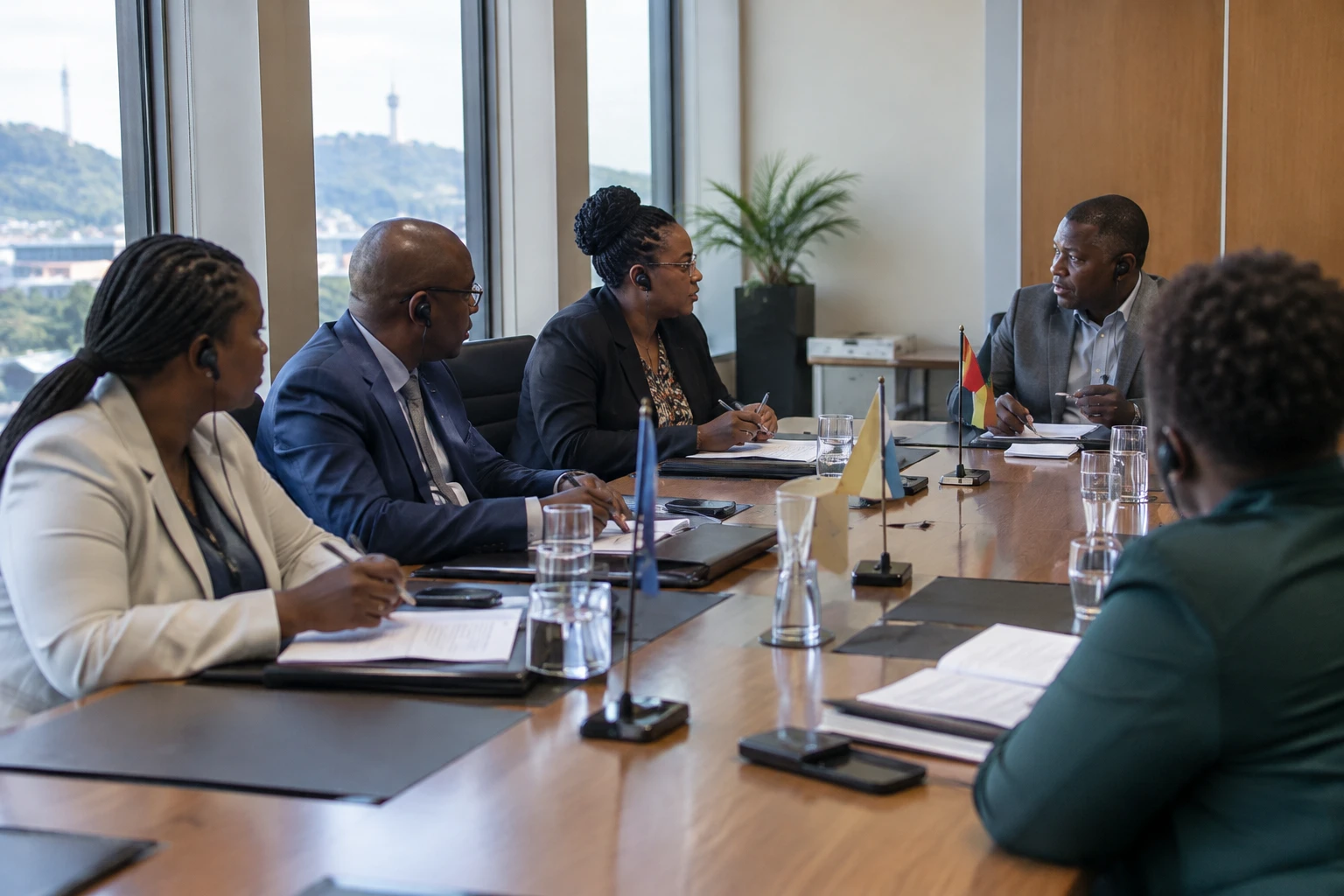
A council without a majority — often called a “hung council” in South African debate — arises when no party holds more than half the seats on its own. Parties must then secure the support of other elected representatives to appoint council leaders and pass decisions. A coalition may bring together long-term partners or rest on ad hoc agreements.
The balance of power varies from city to city. The DA leads in several major metropolitan areas, but does not have enough seats to govern alone everywhere. In Cape Town, by contrast, it retains a majority. In eThekwini, which includes Durban, the MK came first without securing control of the council on its own. The ANC, DA, MK, Economic Freedom Fighters (EFF) and ActionSA could therefore become decisive partners, depending on local arrangements. The report on the final results likewise notes that several major cities have no majority.
The timetable needs clarification. Parties are not legally required to conclude all their coalition agreements within 14 days. That deadline applies to the first meeting of the new council, where elected representatives must, among other things, choose municipal office-holders. In practice, negotiations are urgent, but they are not the same as this legal deadline, as this explanation of the framework for forming coalitions points out.
Local government at the heart of the negotiations
South African municipalities organise essential services: water distribution, sanitation, waste collection and the maintenance of some infrastructure. A deal between parties does not, by itself, guarantee a stable administration. If partners fall out over the budget or withdraw their support for the mayor, projects may slow down and difficult decisions become harder to make.
These effects will not be the same everywhere. In major metropolitan areas, decisions affect extensive networks and large budgets, as well as very large populations. In rural municipalities, access to services and administrative capacity are also at stake, but resources and priorities differ. For residents, the political outcome will be measured less by the number of posts handed out than by continuity of services and delivery of announced projects.
Municipal coalitions are not new in South Africa. They became more common after the 2016 and 2021 local elections. Disagreements between partners have sometimes led to changes of mayor and deadlock. The South African government itself presents councils without a majority as an established feature of local political life, not an exceptional situation. The official explanations of coalitions note that several parties must then join forces to govern.
A test for parties and the SADC
The municipal election follows the formation in 2024 of a national unity government bringing together the ANC, DA and other parties. But agreements reached at national level do not automatically dictate those made by municipalities: each council has its own balance of power and concerns. The ANC must preserve its ability to negotiate despite its decline. The DA and other parties, in turn, must show they can turn their gains into functioning administrations.
This election primarily concerns South African politics. Its regional significance, however, extends to the Southern African Development Community (SADC), of which South Africa is a central member. The evolution of its coalition practices will be watched in a region where political balances and local institutional capacities vary widely from country to country. It is not a uniform model, but a practical example of electoral competition followed by public negotiations.
The next stage will play out in the councils themselves: inaugural meetings, the selection of mayors and agreements to keep administrations running. The election results have reshuffled the cards. The parties’ ability to maintain majorities and meet local needs will determine whether this fragmentation leads to workable governance or further deadlock.



