Egypt
 Libya
 Morocco
 Sudan
 Tunisia
 Benin
 Burkina Faso
 Cabo Verde
 Côte d'Ivoire
 Ghana
 Guinea
 Guinea-Bissau
 Liberia
 Mali
 Mauritania
 Niger
 Nigeria
 Senegal
 Sierra Leone
 The Gambia
 Togo
 Cameroon
 Central African Republic
 Chad
 DR Congo
 Equatorial Guinea
 Gabon
 Republic of the Congo
 São Tomé and Príncipe
 Burundi
 Comoros
 Djibouti
 Eritrea
 Ethiopia
 Kenya
 Madagascar
 Malawi
 Mauritius
 Mozambique
 Rwanda
 Seychelles
 Somalia
 South Sudan
 Tanzania
 Uganda
 Angola
 Botswana
 Eswatini
 Lesotho
 Namibia
 South Africa
 Zambia
 Zimbabwe
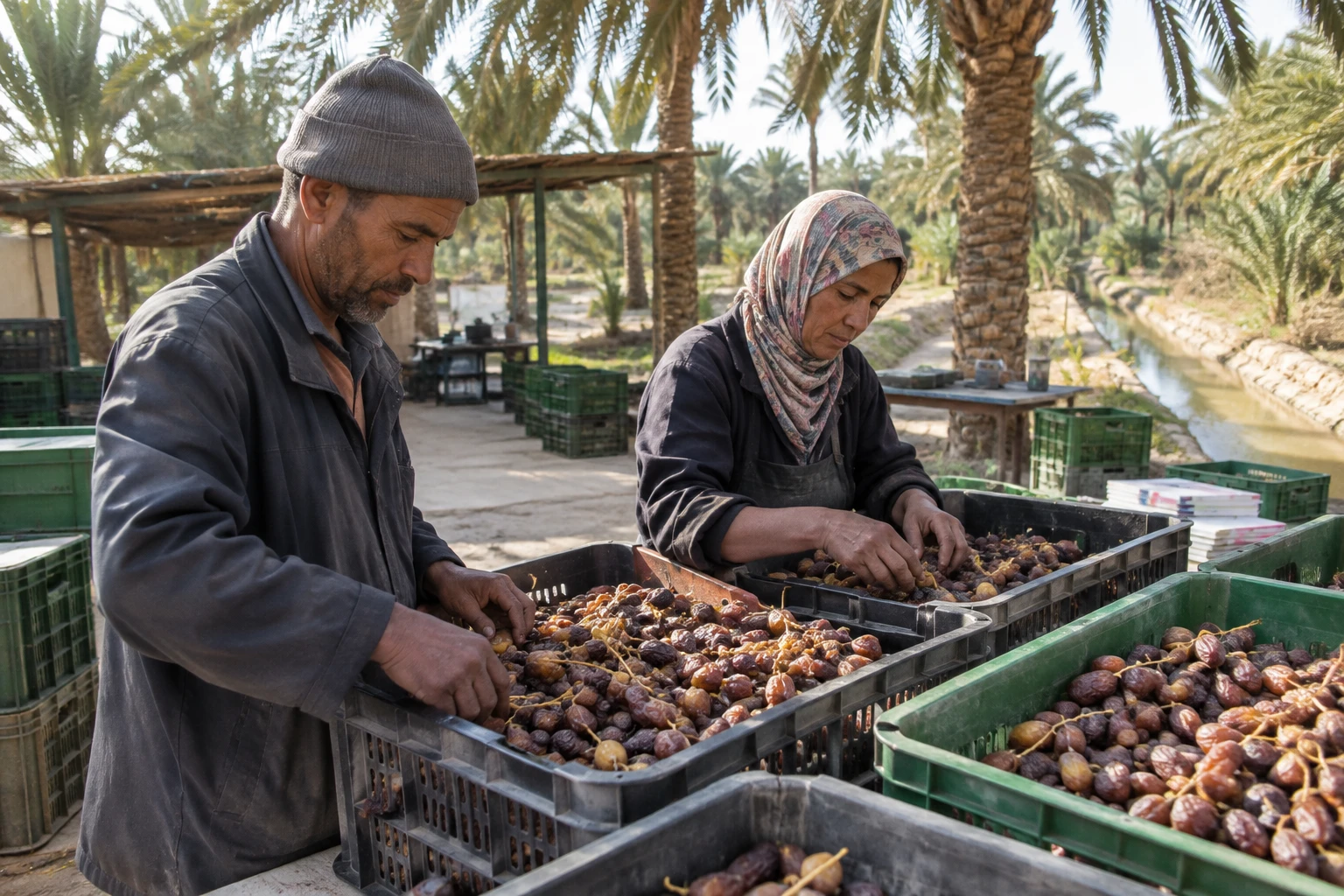
In North Africa’s oases, a good harvest alone does not guarantee higher incomes. Producers must also be able to irrigate their palm trees, preserve the fruit and sell it at the right time. For the 2026–2027 season, forecasts point to different trajectories: an announced increase in Morocco and several Algerian growing areas, an expected decline in Tunisia, while Egypt is investing in processing and storage.
Harvests set to rise, but no consolidated national total for Algeria
In Algeria, available estimates cover wilayas rather than a consolidated national total. In Biskra, the country’s largest date-growing area, agricultural services forecast more than 410,000 tonnes, around 10,000 tonnes more than in the previous season. Deglet Nour is expected to account for nearly 60% of the volume. Local officials attribute the increase to new plantations coming into production and the adoption of water-saving irrigation techniques. Several Algerian media outlets reported these figures, citing information from the APS news agency.
Further to the north-east, agricultural services in Ouled Djellal are forecasting 1.18 million quintals, or around 118,000 tonnes. They point in particular to the contribution of new palm trees that have reached maturity. In Touggourt, in the Oued Righ region, the forecast stands at nearly 147,500 tonnes. Local services there have also reported a preventive campaign against boufaroua, a mite that attacks the fruit, and other pests. These announcements remain estimates ahead of the end of the harvest.
The increase in volumes also raises a commercial question. Dates need to be sorted, packaged and stored before they are sold. In Biskra, local media have highlighted that outlets and storage capacity will affect the value of the harvest. A plentiful crop is an opportunity for producers, but it does not automatically translate into better prices.
In Morocco, the challenge of growth in the oases
In Morocco, the agriculture ministry presented a forecast of 177,000 tonnes for 2026–2027 in Erfoud on 28 October, an increase of 11% year on year. The figure was reported by SNRT News, Morocco’s public audiovisual broadcaster. Another press article puts the figure at around 180,000 tonnes: the discrepancy is a reminder that these are still estimates, not a final tally.
Production is concentrated in particular in the Drâa-Tafilalet region, where palm groves underpin the economic activity of oasis communities. A Moroccan programme to intensify and rehabilitate traditional oases, with 792 million dirhams allocated for 2021–2030, includes plans to distribute 2.6 million selected vitroplants. These laboratory-produced plants are intended to help renew the palm groves. The ministry says more than 917,000 had been distributed by the end of October.
Local production does not, however, meet all Moroccan demand, estimated at between 220,000 and 250,000 tonnes a year. The country therefore remains dependent on imports. For producers, the challenge is not limited to increasing volumes: it also concerns storage, processing and the place of locally grown dates in the domestic market. The programme’s results will also depend on water availability and its management in areas where agricultural activities share a limited resource.
In Tunisia, water and incomes at the heart of the season
Tunisia is forecasting a harvest of 354,000 tonnes, compared with 404,000 tonnes in the previous season, an announced decline of 12.4%. Representatives of the agriculture ministry presented the figures to a parliamentary committee in October. Tunisia’s public radio station RTCI and several national media outlets also reported the estimate. It is attributed to the ministry and is not yet a final tally.
In the southern oases, elected officials have reported irrigation difficulties, ageing pipelines and dried-up wells. The expected decline makes these constraints more acute for growers, particularly when access to water determines fruit quality and harvest timing. The authorities have announced 3.4 million nets to protect bunches from rain and pests. Pollination operations are reported to have covered around 53.5 million bunches.
To facilitate sales, the ministry plans to set up direct-sale outlets from November 2026 and has announced a reference price of 5.2 Tunisian dinars per kilogram. This benchmark is intended to support producers and make the supply more accessible. Its impact will depend, however, on prices actually charged, production costs and the capacity of sales channels to absorb the harvest.
Egypt focuses on preservation and processing
Egypt, the largest producer by volume among the countries discussed here, estimates its 2026 harvest at 2.1 million tonnes, across all varieties. Khaled El-Haggan, a producer-exporter and head of a dates committee within the Egyptian Export Council for Agricultural Crops, gave the estimate to FreshPlaza. He links the sector’s growth to orchards planted in recent years reaching maturity. This projection is based on a statement from an industry participant; the data consulted do not provide a second independent national estimate.
The season has also been marked by delays linked to irregular weather conditions. According to El-Haggan, some areas harvested earlier than usual, while others fell behind. Fruit size and quality are reported to have been affected in some areas. For producers, these variations can weigh on sorting, prices and access to markets, even when overall volume remains high.
In October, the Siwa International Dates Festival showcased processing and preservation equipment supported by Egyptian-Emirati co-operation. Egypt’s public media outlet Ahram Online and the Emirati news agency WAM report the rehabilitation of a public factory in Siwa and the New Valley dates complex, as well as cold-storage facilities in Bahariya with capacity for 4,000 tonnes. This equipment can help reduce losses and spread sales over time. It cannot, however, replace strong producer networks or stable commercial outlets.
Storage and access to water: two indicators to watch
These forecasts are not directly comparable: they cover different areas and periods, and in Algeria only regional estimates are available here. They nevertheless point to shared priorities. Morocco is seeking to strengthen its oases and meet demand that exceeds production. Algeria needs to turn its regional volumes into sales that fetch better prices. In Tunisia, irrigation and the sale of a smaller harvest will be decisive. Egypt, meanwhile, is developing preservation and processing capacity.
Across North Africa, the sector links oasis agriculture, rural jobs, domestic trade and exports. The next figures to watch are final harvest totals, the prices actually received by producers and the use made of announced storage capacity. Rising volumes alone will not show whether the value created goes to growers, packaging plants or distribution channels.