Algeria
 Egypt
 Libya
 Morocco
 Sudan
 Tunisia
 Benin
 Burkina Faso
 Cabo Verde
 Côte d'Ivoire
 Ghana
 Guinea
 Guinea-Bissau
 Liberia
 Mali
 Mauritania
 Niger
 Nigeria
 Senegal
 Sierra Leone
 The Gambia
 Togo
 Cameroon
 Central African Republic
 Chad
 DR Congo
 Equatorial Guinea
 Gabon
 Republic of the Congo
 São Tomé and Príncipe
 Burundi
 Comoros
 Djibouti
 Eritrea
 Ethiopia
 Kenya
 Madagascar
 Malawi
 Mauritius
 Rwanda
 Seychelles
 Somalia
 South Sudan
 Tanzania
 Uganda
 Angola
 Botswana
 Eswatini
 Lesotho
 Namibia
 South Africa
 Zambia
 Zimbabwe

A gas project can promise significant revenues without yet producing a single cubic metre. In Mozambique, Rovuma LNG is moving towards an investment decision, but its timeline still depends on permits, financing and agreement with the country’s communities and institutions.
Rovuma Basin project still in preparation
Mozambique has for several years been banking on the vast gas reserves discovered offshore from Cabo Delgado, in the north of the country. But turning these resources into public revenue and jobs depends on complex projects exposed to delays and security risks. The province has been affected by an armed insurgency since 2017, which has led, among other things, to the suspension of gas works and the declaration of force majeure on some projects.
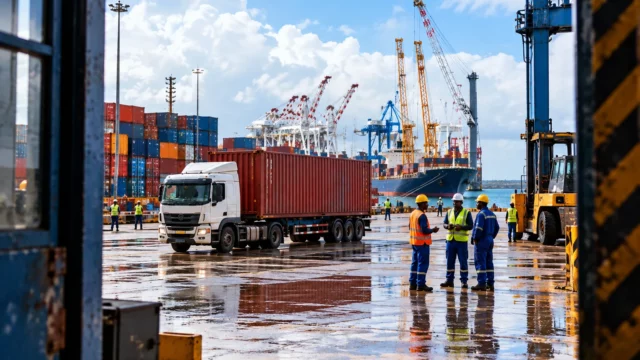
Rovuma LNG is separate from Mozambique LNG, the project led by TotalEnergies in the Area 1 concession. It is intended to develop the fields in the Mamba complex, in the offshore Area 4 concession. The gas would be transported to an onshore liquefaction facility, then sold as liquefied natural gas (LNG), cooled for transport by ship.
The project also concerns Mozambique’s place in the Southern African Development Community (SADC), a regional organisation that includes countries across southern Africa. Energy security, infrastructure and gas trade extend beyond Mozambique’s borders. However, regional benefits will first depend on decisions taken in Maputo and the returns actually secured within the country.
ExxonMobil strengthens commitment, but work has yet to start
On 30 October 2026, ExxonMobil announced that it had reached an agreement with Eni to raise its stake in Rovuma LNG to 50%. The US group will remain operator, meaning it will be responsible for running the project. The announcement appears in the company’s quarterly results. ExxonMobil has not detailed which Mozambican exploration assets it plans to exit as part of this reorganisation.
The change concerns ExxonMobil’s stake in the project. It does not mean that the structure of the Area 4 concession has been completely reshaped. The Mozambique Rovuma Venture (MRV), a joint venture bringing together ExxonMobil, Eni and China National Petroleum Corporation (CNPC), holds 70% of the concession. The remaining 30% is held in equal shares by Mozambique’s state-owned ENH, South Korea’s KOGAS and XRG, a subsidiary of Emirati company ADNOC. The exact stakes after the agreement should be read in light of the final transaction documentation.
ExxonMobil’s proposed design provides for capacity of 18.6 million tonnes of LNG a year. That is more than the 15.2 million tonnes envisaged in the initial plan. But announced capacity is neither guaranteed production nor a commissioning date. The project has yet to reach a final investment decision (FID), the stage at which partners formally commit to financing construction.
Preparatory work is nevertheless under way. In August, the partners announced about $1.1 billion in contracts and preliminary commitments, notably for equipment and site-preparation activities. Letters of intent have also been signed for onshore and offshore work. These steps advance engineering and procurement, but remain conditional on the FID and the required permits.
Promised benefits, conditions to be checked
In May 2026, the National Petroleum Institute (INP), the sector’s regulator, said that the amendment to the development plan was undergoing technical assessment. The review covers financing, economic viability, local content and obligations to supply the Mozambican market. In other words, the project still has to demonstrate that it can be financed and specify what it will bring to the country beyond exports.
ExxonMobil is targeting a final investment decision before the end of 2026. This remains a corporate objective, not a decision that has been secured. It depends, among other things, on the authorities’ approval of the amended plan and the partners’ ability to finalise their commitments. The lifting of force majeure announced by ExxonMobil in November 2025 enabled preparatory work to resume, but does not amount to project approval or a guarantee against further delays.
Economic projections should also be presented with caution. A study commissioned by Standard Bank and published in June 2026 estimates that Rovuma LNG could add about $11 billion a year to Mozambique’s gross domestic product. It also projects annual tax revenues of close to $4 billion and around 151,000 direct, indirect or induced jobs. These are scenario estimates, not results already achieved. Their realisation will depend on the duration of construction, gas prices, taxation, local procurement and the share of jobs actually accessible to Mozambicans.
The effects will not be distributed evenly. Public procurement and tax revenues concern the state and formal businesses; jobs, training and local contracts will have a greater bearing on what workers and small businesses can gain. In Cabo Delgado, where the project is located, security, population displacement and access to livelihoods remain tangible concerns. Investment announcements are therefore not enough to assess local acceptance or the quality of the benefits.
A test of resource governance
ExxonMobil’s increased stake to 50% strengthens its commercial exposure to Rovuma LNG and clarifies its role as operator. It does not, however, settle the questions of final financing, permits or the sharing of benefits. For the Mozambican government, the challenge will be to turn an export project into manageable revenues, skills and local opportunities, while protecting public finances from overly optimistic forecasts.
At regional level, the project will be watched as an indicator of African states’ ability to negotiate with major energy groups and regulate large infrastructure projects. The next milestone to watch is the final investment decision announced for the end of 2026. Until it is taken and public approvals are complete, Rovuma LNG remains an industrial promise in preparation, not yet a new source of revenue for Mozambique.
Details of the agreement and timeline appear in ExxonMobil’s third-quarter 2026 results. The Mozambican regulator has published the status of the technical review of the amended plan on the National Petroleum Institute website. The economic estimates are detailed by Standard Bank Mozambique.