Algeria
 Egypt
 Libya
 Morocco
 Sudan
 Tunisia
 Benin
 Burkina Faso
 Cabo Verde
 Ghana
 Guinea
 Guinea-Bissau
 Liberia
 Mali
 Mauritania
 Niger
 Nigeria
 Senegal
 Sierra Leone
 The Gambia
 Togo
 Cameroon
 Central African Republic
 Chad
 DR Congo
 Equatorial Guinea
 Gabon
 Republic of the Congo
 São Tomé and Príncipe
 Burundi
 Comoros
 Djibouti
 Eritrea
 Ethiopia
 Kenya
 Madagascar
 Malawi
 Mauritius
 Mozambique
 Rwanda
 Seychelles
 Somalia
 South Sudan
 Tanzania
 Uganda
 Angola
 Botswana
 Eswatini
 Lesotho
 Namibia
 South Africa
 Zambia
 Zimbabwe
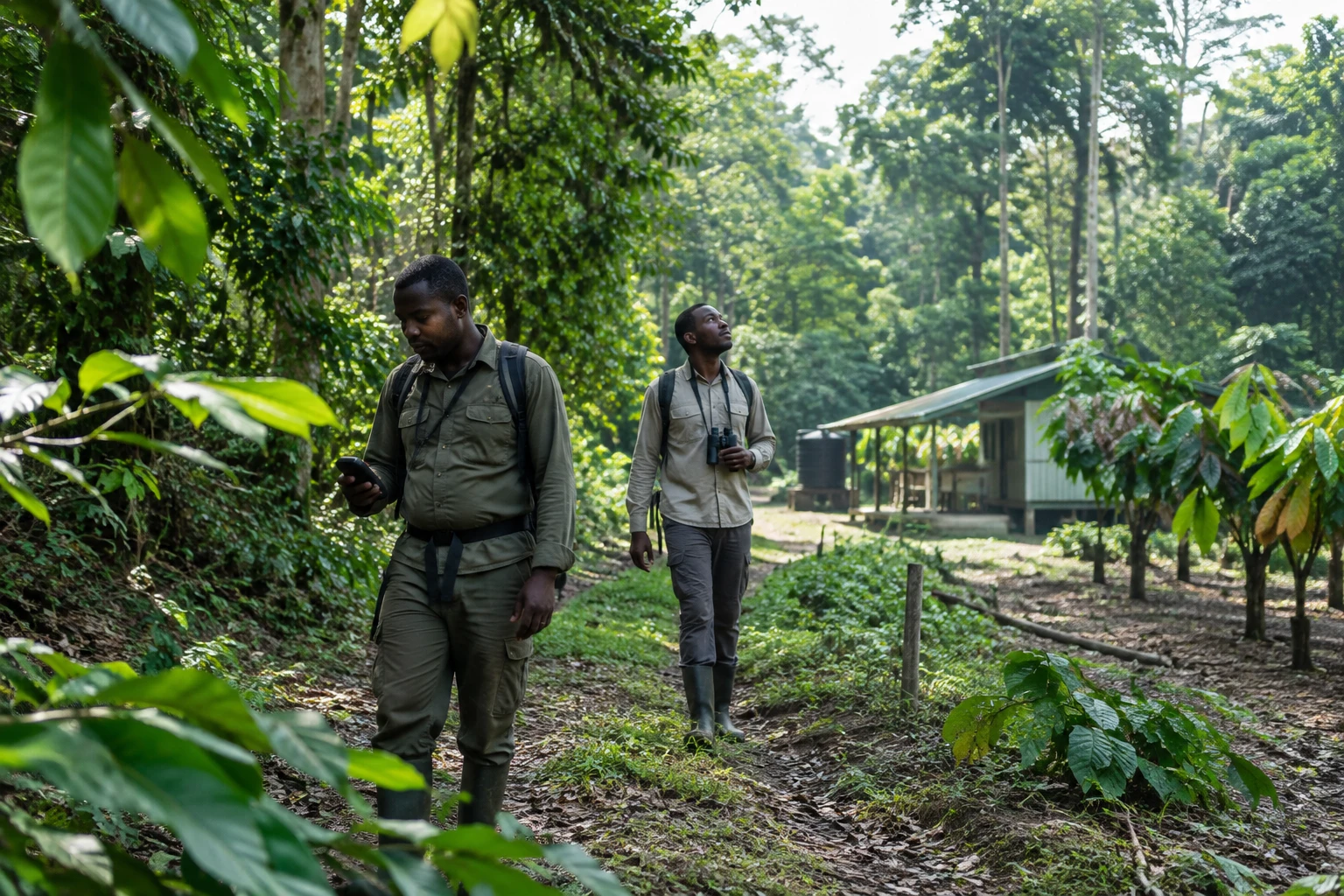
At Taï, protecting the forest is not only about what happens beneath the trees. It also concerns neighbouring villages, farmland and ecological links that extend beyond the Liberian border. In south-west Côte d’Ivoire, the park is a reminder that a protected area is both a refuge for wildlife and a territory where conservation must accommodate real human activities.
A forest massif at the heart of West Africa
Taï National Park lies between the Cavally and Sassandra rivers, in the Ivorian regions of Cavally, Nawa and San Pedro. It covers 508,186 hectares. Together with the N’Zo Partial Fauna Reserve to the north, the protected complex spans 536,016 hectares. It is managed by the Ivorian Office of Parks and Reserves (OIPR), the national body responsible for managing parks and reserves.
This forest is part of the vast Upper Guinea forest region, which stretches across several West African countries. The Cavally forms a natural border between Côte d’Ivoire and Liberia, making the preservation of habitats on both sides a cross-border ecological issue, not just a national one.
UNESCO added the park to its World Heritage List in 1982. The designation recognises, in particular, the value of its forest ecosystems and biodiversity. Taï is one of the region’s major remaining tracts of tropical rainforest, but its international status does not replace the daily work of monitoring and management on the ground.
Remarkable species, a living heritage
The park is home to endangered species, including the pygmy hippopotamus, as well as a wide variety of primates. UNESCO records eleven species of monkey in this protected area. Forest elephants, leopards and several species of duiker — small forest antelopes — are also among the animals found there.
Taï’s chimpanzees are particularly well known to researchers for their tool-use behaviours. The OIPR says they handle more than twenty-six tools, including to crack nuts. These observations add to knowledge about primate behaviour, while also underscoring that research depends on the lasting protection of their habitat.
People also live around Taï’s boundaries. Local communities depend on agriculture and other activities linked to the area’s resources. Involving them in management, taking their needs into account and limiting conflicts over land use are therefore practical conditions for conservation, just as much as monitoring forest cover.
Protection is also measured by pressures around the park
The park is protected, but the surrounding landscapes have been transformed by agricultural expansion. Scientific studies of the region describe, in particular, the effects of cocoa farming, logging and artisanal gold mining on neighbouring environments. These findings do not mean that all farming around the park exerts the same pressure; rather, they show why conservation must distinguish between the practices and areas involved.
The forest provides important ecosystem services. It is a habitat for many species and contributes to the water cycle, carbon storage and regulation of the local climate. But these benefits do not automatically translate into income for residents. Protection policies must therefore bring together monitoring, sustainable farming and development opportunities for neighbouring communities.
Ivorian authorities have announced monitoring measures to address damage to the protected area. In June 2024, the OIPR drew up a three-year plan covering 2024-2026. It provides, in particular, for the use of drones and GPS communications equipment to support field teams. This is an announced plan: its effectiveness depends on implementation, available resources and coordination with local stakeholders.
A shared concern with Liberia
The continuity of forest between south-west Côte d’Ivoire and Liberia gives Taï regional significance. Management confined to administrative borders risks leaving breaks in habitats and the corridors used by wildlife. Cooperation and cross-border ecological monitoring initiatives can help improve coordination on protection, while respecting each state’s responsibilities.
For Côte d’Ivoire, the challenge is to reconcile the conservation of a World Heritage Site, the livelihoods of neighbouring populations and the region’s economic activities. For West African partners, Taï is a reminder that forests and species do not stop at national borders. Monitoring the measures announced, the condition of habitats around the park and the place given to local communities will be essential indicators of what comes next.
Ivorian data on Taï National Park and its area, the park’s listing at the UNESCO World Heritage Centre, the OIPR’s presentation of the site and the Ivorian Press Agency’s report on the 2024-2026 monitoring plan shed light on the challenges of management and conservation.