Algeria
 Egypt
 Libya
 Morocco
 Sudan
 Tunisia
 Benin
 Burkina Faso
 Cabo Verde
 Côte d'Ivoire
 Ghana
 Guinea
 Guinea-Bissau
 Liberia
 Mali
 Mauritania
 Niger
 Nigeria
 Senegal
 Sierra Leone
 The Gambia
 Togo
 Cameroon
 Central African Republic
 Chad
 Equatorial Guinea
 Gabon
 Republic of the Congo
 São Tomé and Príncipe
 Burundi
 Comoros
 Djibouti
 Eritrea
 Ethiopia
 Kenya
 Madagascar
 Malawi
 Mauritius
 Mozambique
 Rwanda
 Seychelles
 Somalia
 South Sudan
 Tanzania
 Uganda
 Angola
 Botswana
 Eswatini
 Lesotho
 Namibia
 South Africa
 Zambia
 Zimbabwe
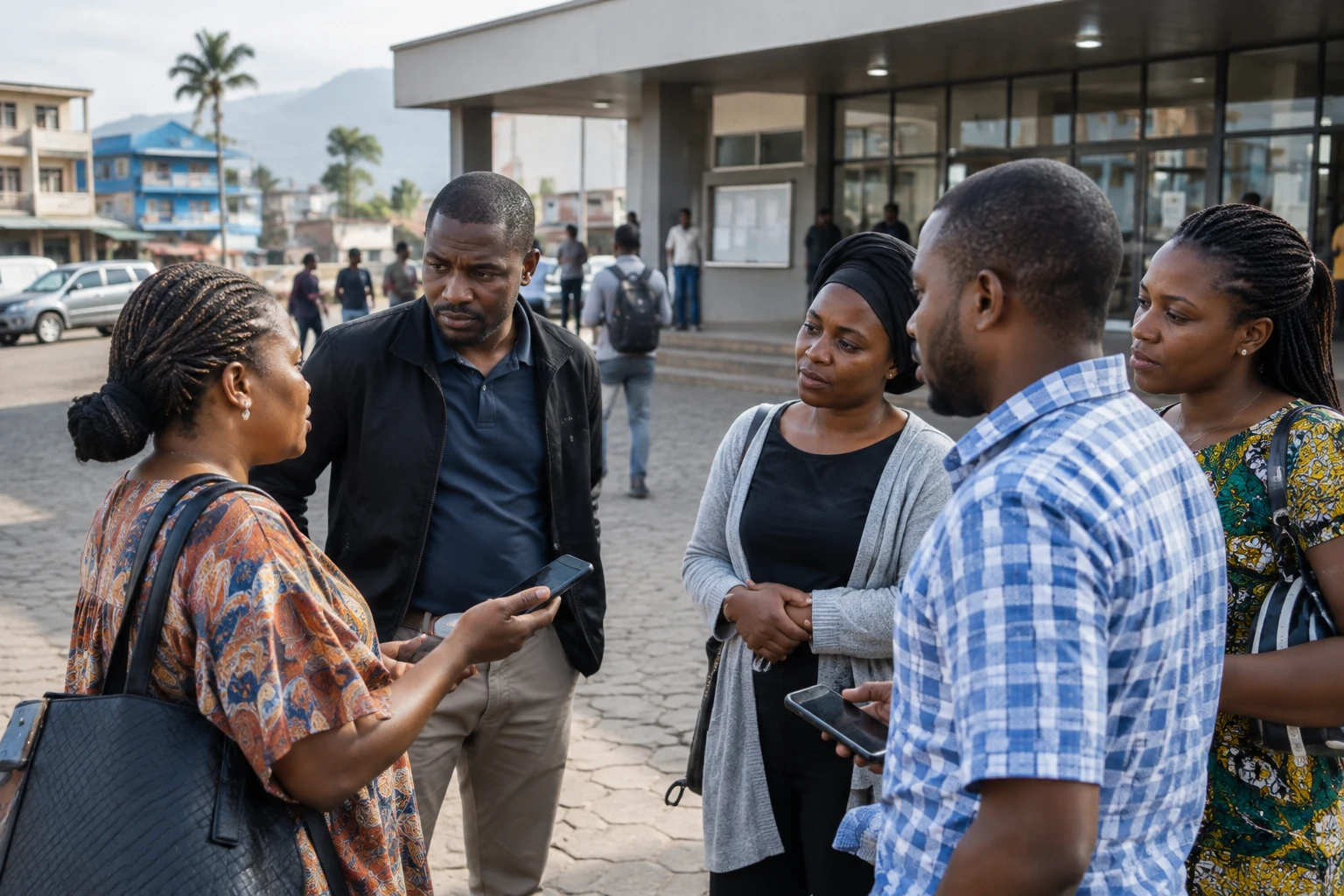
In Goma, a meeting between the United Nations and a movement bringing together political figures and armed group leaders raises an immediate question: how can a channel for dialogue be maintained without giving the impression of recognising a rival authority to Kinshasa? The meeting comes as the war in the east of the Democratic Republic of the Congo (DR Congo) continues to shift military and diplomatic ground.
A UN mission at the heart of a Congolese power struggle
MONUSCO is the United Nations mission tasked, among other things, with helping to protect civilians and supporting peace efforts in DR Congo. Its mandate, renewed by the Security Council until 20 December 2026, also provides for a role in supporting peace processes and monitoring the ceasefire. Its work is nevertheless taking place in a context where Congolese authorities, armed groups and regional actors dispute the terms of a way out of the crisis.
In the east, the M23’s seizure of Goma and other urban centres has profoundly altered the political landscape. The city, the provincial capital of North Kivu, is now at the centre of a conflict affecting residents of urban areas as well as communities in surrounding territories. For displaced families, traders and local services, the stakes are measured first and foremost in access to security, healthcare, markets and transport routes.
The conflict extends beyond the borders of DR Congo. DR Congo and the United States accuse Rwanda of supporting the M23; Kigali rejects the accusations. Tensions also involve Uganda and Burundi, neighbours directly linked to security issues in the Great Lakes region. In this context, African Union efforts and regional and international diplomatic initiatives are seeking to secure a lasting ceasefire and revive talks.
James Swan meets FRN officials
On 3 November in Goma, MONUSCO chief James Swan met former Congolese president Joseph Kabila and officials from the Front for the Refoundation of the Nation (FRN). The movement was created in October and brings together groups previously associated with the Congo River Alliance (AFC), including the M23. Radio Okapi and Actualite.cd also reported the meeting and identified Corneille Nangaa and Bertrand Bisimwa among the participants, describing them as FRN vice-presidents.
According to Radio Okapi, the discussions formed part of the UN mission’s exchanges with actors in the conflict in the east, including on civilian protection, humanitarian access and ceasefire monitoring. Such contact does not, by itself, mean that the UN recognises the FRN as a government or as representing all Congolese people. It allows the mission to speak with actors who have a direct influence on the situation in the areas where it operates.
After the meeting, Bertrand Bisimwa criticised MONUSCO’s record. He said the mission had failed and that a new mandate would not change the situation. He also said he preferred the mission’s withdrawal to continue. These remarks express the FRN’s position; they are not an independent assessment of the UN mandate.
The criticism comes after the Security Council renewed MONUSCO’s mandate until 20 December 2026. The resolution provides for a maximum of 11,500 military personnel and asks the mission to support peace processes and monitoring mechanisms. The disagreement is therefore less about an imminent withdrawal decision than about the UN’s role in a process whose actors and terms remain contested.
A meeting, but no peace deal
Joseph Kabila’s presence gives the meeting a particular political dimension. The former president led DR Congo from 2001 to 2019. On 30 September 2025, the High Military Court sentenced him to death in absentia, including for treason and participation in an insurgent movement. This was a ruling by a Congolese court, not an international conviction. His role in the FRN now explicitly links a figure from the former ruling class with a coalition that includes armed groups.
For Kinshasa, this development makes it harder to distinguish political opposition from armed rebellion. For the FRN, the meeting with James Swan provides diplomatic access and an opportunity to set out its positions. For MONUSCO, contact may help convey messages or support verification mechanisms, without resolving the dispute over the movement’s political legitimacy or responsibility for the fighting.
This distinction matters to residents. A meeting between leaders guarantees neither an end to the fighting nor the return of public services to the areas concerned. The effectiveness of dialogue will instead be judged by concrete signs: fewer ceasefire violations, more regular humanitarian access, protection of civilians and the possibility for displaced people to return safely. Needs and consequences vary from one area to another, and not all communities have access to the same services or routes out.
The regional process remains the decisive test
The Goma meeting adds to diplomatic efforts around peace processes and the ceasefire. The Security Council resolution tasks MONUSCO with supporting these efforts and provides for continued work with the relevant monitoring frameworks. But a peacekeeping mission cannot, on its own, compel the parties to honour an agreement: this depends on commitments from Congolese actors and states in the region.
Across the Great Lakes region, the central question is therefore whether channels for discussion will produce verifiable commitments, and not just meetings. The next steps to watch are implementation of the ceasefire, the functioning of verification mechanisms and developments in MONUSCO’s mandate as its deadline approaches. For people in eastern DR Congo as well as in Kinshasa, the impact on security and daily life will determine the measure of this diplomacy.