Algeria
 Libya
 Morocco
 Sudan
 Tunisia
 Benin
 Burkina Faso
 Cabo Verde
 Côte d'Ivoire
 Ghana
 Guinea
 Guinea-Bissau
 Liberia
 Mali
 Mauritania
 Niger
 Nigeria
 Senegal
 Sierra Leone
 The Gambia
 Togo
 Cameroon
 Central African Republic
 Chad
 DR Congo
 Equatorial Guinea
 Gabon
 Republic of the Congo
 São Tomé and Príncipe
 Burundi
 Comoros
 Djibouti
 Eritrea
 Ethiopia
 Kenya
 Madagascar
 Malawi
 Mauritius
 Mozambique
 Rwanda
 Seychelles
 Somalia
 South Sudan
 Tanzania
 Uganda
 Angola
 Botswana
 Eswatini
 Lesotho
 Namibia
 South Africa
 Zambia
 Zimbabwe
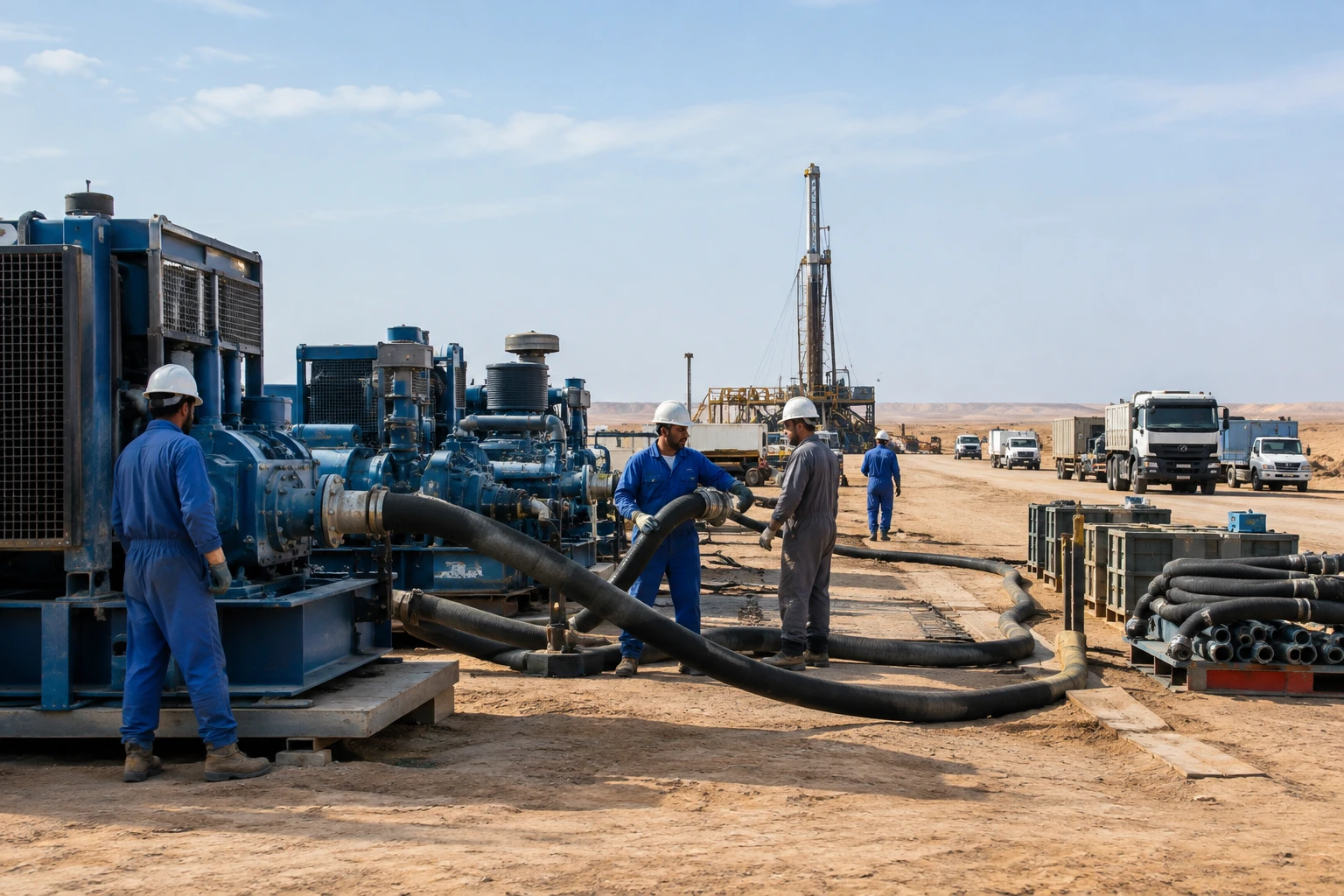
In Egypt’s Western Desert, a horizontal well is soon to undergo a major technical operation. The stakes go beyond this project: Egypt is seeking to extract more gas from its existing facilities, as domestic production has fallen in recent years and imports are weighing on supply.
A new phase for a well already drilled
The Obaiyed H18 well, drilled in 2019 in the Western Desert, reaches a depth of about 5,630 metres. Its horizontal section extends for more than 1,600 metres. Badr El Din Petroleum Company (Bapetco) plans to carry out multi-stage hydraulic fracturing there, with support from Halliburton. Egypt’s Petroleum Ministry announced on 29 October 2026 that preparations for the project were under way and that operations were expected to begin in the following days.
Bapetco is a joint venture between EGPC, Egypt’s state-owned oil company, and the Cheiron and Capricorn Energy groups. According to the ministry, the operation is intended to stimulate gas flow through the formations crossed by the well. It comprises six fracturing stages, followed by preparation of the well and its final completion.
Fracturing involves injecting fluid under pressure to open or widen cracks in the rock and make it easier for gas to flow into the well. The use of this technique does not, by itself, mean that the site is a shale gas field. Available information on Obaiyed H18 describes it as a horizontal gas well, without classifying it as a shale well.
Halliburton is to deploy 18 high-pressure pumps, with a combined hydraulic power of more than 40,000 horsepower, according to Egypt’s ministry. The company and Bapetco have spent several months preparing the technical operation. No specific target for additional production from Obaiyed H18 has been made public. The result will therefore have to be measured after the well is brought into operation, rather than assumed in advance.
Pressure on domestic supply
The operation comes amid declining gas production. Egypt’s Planning Ministry said domestic gas production fell to about 33.4 million tonnes in the 2024-2025 financial year, from 41.3 million tonnes the previous year. Meanwhile, the International Energy Agency estimated that Egyptian production fell sharply in 2025, as the country increased its imports of liquefied natural gas.
Gas remains essential for electricity, industry and household use. When local supply cannot keep pace with demand, the authorities must balance domestic supply, purchases from abroad and export activities. Households and businesses may be affected by energy shortages, while imports leave public finances more exposed to international prices and transport costs.
The government says it stabilised production at the end of 2025 and wants to revive the sector. This official assessment must be considered alongside production and import data, which show that the challenge remains real. In February 2026, the ministry announced a programme to drill 101 exploration wells during the year. The task is therefore twofold: to discover new resources and make better use of fields already in production.
Bapetco targets growth, but returns are not guaranteed
Bapetco’s targets give a sense of the effort under way. In the first half of the 2025-2026 financial year, the company drilled 15 wells using nine rigs. Its reported average production was 49,000 barrels of oil equivalent per day, including 171 million cubic feet of gas and 18,500 barrels of condensates. These figures, reported by Egypt’s State Information Service, describe the company’s level of activity, not the expected output from fracturing Obaiyed H18.
For the 2026-2027 financial year, Bapetco is targeting 60,000 barrels of oil equivalent per day, including 195 million cubic feet of gas and 25,000 barrels of condensates. The company plans 37 exploration and development wells, with estimated investment of $315 million. It also intends to combine eight Western Desert concessions under an integrated contract to coordinate exploration and production.
These targets remain forecasts. They will depend on drilling results, well performance and the investments actually made. Fracturing can improve the connection between a well and the producing formations, but its economic value will depend on the volume of gas recovered, the costs and how long the production gain lasts. For now, there is no data to conclude that this method will be enough to reverse the national trend.
An experiment to watch beyond the Western Desert
The ministry describes Obaiyed H18 as a pioneering large-scale operation for Egypt’s sector. If the results are considered successful, the technique could be extended to other horizontal wells. The benchmarks will be tangible: production achieved, consistency of flow and the cost of the intervention, none of which is yet known.
For Egypt, the Arab world’s most populous country, the energy question also has a regional dimension. The Arab Maghreb Union brings together North African states, but energy cooperation and gas markets extend beyond this institutional framework. Cairo’s choices affect Mediterranean balances, not least because the country has liquefaction infrastructure and is seeking to secure its supplies.
Across the continent, Egypt’s experience highlights the diversity of African gas trajectories: some producers are seeking to increase supply, while others must first meet local consumption. The next decisive indicator will be the production actually achieved at Obaiyed H18, followed by any decision to apply the process to other wells. Until then, the operation is a technical test, not yet a proven answer to declining domestic production.