Algeria
 Egypt
 Libya
 Morocco
 Sudan
 Tunisia
 Benin
 Burkina Faso
 Cabo Verde
 Ghana
 Guinea
 Guinea-Bissau
 Liberia
 Mali
 Mauritania
 Niger
 Nigeria
 Senegal
 Sierra Leone
 The Gambia
 Togo
 Cameroon
 Central African Republic
 Chad
 DR Congo
 Equatorial Guinea
 Gabon
 Republic of the Congo
 São Tomé and Príncipe
 Burundi
 Comoros
 Djibouti
 Eritrea
 Ethiopia
 Kenya
 Madagascar
 Malawi
 Mauritius
 Mozambique
 Rwanda
 Seychelles
 Somalia
 South Sudan
 Tanzania
 Uganda
 Angola
 Botswana
 Eswatini
 Lesotho
 Namibia
 South Africa
 Zambia
 Zimbabwe
Images of Côte d’Ivoire tell stories of ordinary gestures as well as major transformations. In the streets, homes and evenings of Abidjan, Paul Kodjo built a visual account of a society representing itself. The preservation of his negatives now raises a practical question: how can this memory be made accessible to Ivorians, beyond exhibitions held abroad?
A visual memory born in the Ivorian press
From 1971, readers of the weekly Ivoire Dimanche discovered Kodjo’s photo-novels. This format tells a story through still images accompanied by text and dialogue. The episodes feature romantic plots, with twists and characters played by models chosen by the photographer.
After returning to Abidjan in 1970, Kodjo founded MAMEDIS, an agency combining photography, cinema and publishing. Photo-novels quickly became an important part of his work. They adapted a genre already popular in Europe, particularly in Italy, to Ivorian settings and characters. But they were more than entertainment: the settings, clothes and relationships between characters also bear witness to an era.
The photographer captured a Côte d’Ivoire undergoing rapid transformation after independence. The images show urban spaces, domestic interiors and leisure activities that developed during the years of economic growth often described as the “Ivorian miracle”. This period of prosperity, mainly associated with the 1960s and 1970s, fostered the growth of urban cultural life, without reducing the country’s entire experience to that of Abidjan.
Kodjo’s perspective blends staging with observation. His compositions borrow from cinema, while his documentary photographs focus on dance evenings, clothing styles and social life in the economic capital. His scenes thus portray Ivorian modernity through its own faces, places and codes.
Negatives saved, a heritage still to be passed on
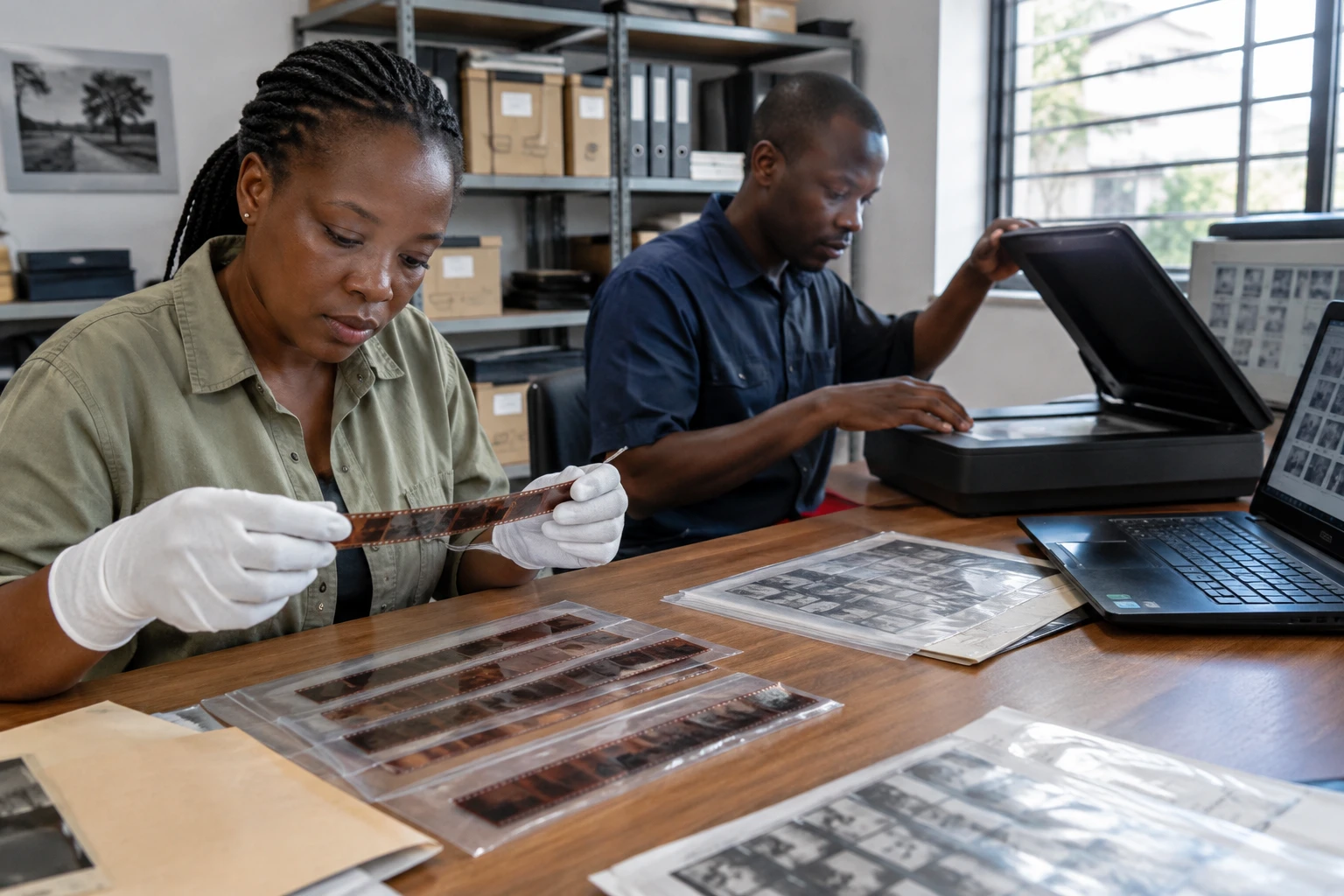
The current circulation of these images depends on painstaking preservation work. Ivorian photographer Ananias Léki Dago and the Les Rencontres du Sud association have been preserving Kodjo’s archive for more than 15 years. A new phase of negative preservation began in 2025, with support from the University of California, Los Angeles’s Modern Endangered Archives programme, which is dedicated to preserving endangered archives.
This work involves more than physical restoration. Digitisation makes fragile images available for consultation and sharing; describing and contextualising them helps explain what they show, but also what they cannot tell on their own. The photographs of Abidjan do not constitute a comprehensive archive of Côte d’Ivoire. They offer a particular point of view: that of a creator attentive to the city, its social scenes and its imaginings.
For the photographers involved in preserving the archive, it is also a space for passing on technical knowledge. Kodjo’s work offers a way to study how he used light, framed his shots and chose characters in their surroundings. His attention to the relationship between bodies and the built environment informs contemporary practice without reducing his legacy to imitation.
Access remains a central issue. A body of work that is preserved but little seen in its country of origin reaches only some of its potential audiences. An exhibition in Côte d’Ivoire would allow generations who lived through the period to reconnect with familiar reference points, while enabling younger people to discover a visual history that is rarely accessible. No date for a local exhibition has yet been announced.
An exhibition in Paris, with wider implications
The exhibition Photoromance, co-produced with Les Rencontres d’Arles, opens on 21 October 2026 at the Palais de Tokyo in Paris and is due to run until 14 February 2027. It brings together images from the photo-novels and a broader selection, some of which has never been exhibited before. The exhibition also revisits Kodjo’s work after his return to Abidjan.
The exhibition gives international visibility to a major photographer in the history of Ivorian imagery. It may also draw attention to the practical conditions for preserving archives in Africa: funding, suitable equipment, conservation expertise and lasting access to collections. External support is contributing to one stage of the work, while knowledge of the archive and its roots lie with Ivorian actors.
The regional significance also lies in the role of the press and photography in shaping popular cultures in West Africa. Kodjo’s career is a reminder that visual forms travel between continents and are then transformed through contact with local audiences. His photo-novel is not a simple import: it stages Ivorian experiences and contributes to the emergence of distinctive narrative codes whose influence has continued in domestic audiovisual production.
For Côte d’Ivoire, the challenge is therefore to bring international recognition into dialogue with local transmission. The Paris event marks a stage, not the culmination of this story. What happens next will depend in particular on continued digitisation, documentation of the archive and the possibility of presenting these works in Abidjan or elsewhere in the country. Preserving Kodjo’s images also means enabling Ivorians to read their social history through a perspective shaped on the ground.
Further information on the work and exhibition: presentation of the Paul Kodjo exhibition at the Palais de Tokyo, Les Rencontres d’Arles entry on Paul Kodjo and biographical information and photographic archives of Paul Kodjo.