Algeria
 Egypt
 Libya
 Morocco
 Sudan
 Tunisia
 Benin
 Burkina Faso
 Cabo Verde
 Côte d'Ivoire
 Guinea
 Guinea-Bissau
 Liberia
 Mali
 Mauritania
 Niger
 Nigeria
 Senegal
 Sierra Leone
 The Gambia
 Togo
 Cameroon
 Central African Republic
 Chad
 DR Congo
 Equatorial Guinea
 Gabon
 Republic of the Congo
 São Tomé and Príncipe
 Burundi
 Comoros
 Djibouti
 Eritrea
 Ethiopia
 Kenya
 Madagascar
 Malawi
 Mauritius
 Mozambique
 Rwanda
 Seychelles
 Somalia
 South Sudan
 Tanzania
 Uganda
 Angola
 Botswana
 Eswatini
 Lesotho
 Namibia
 South Africa
 Zambia
 Zimbabwe
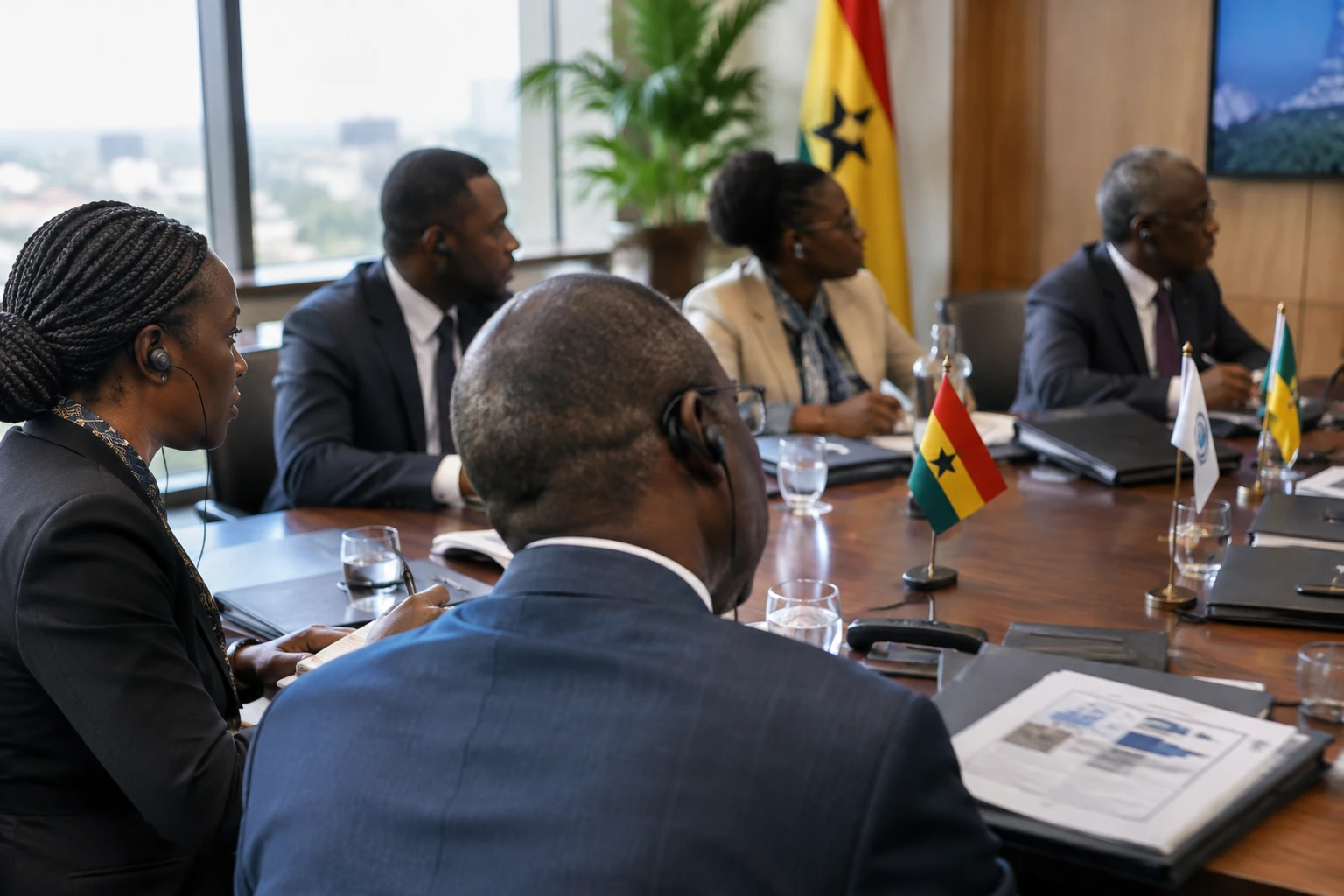
For Ghana, the nuclear question is about more than choosing a supplier. It is about whether the country can finance, regulate and connect a power plant to its grid, while ensuring reliable electricity for households and industry.
A new option among several partners
President John Dramani Mahama announced on 29 October 2026 in Moscow that Ghana had begun talks with Rosatom, the Russian state-owned nuclear group. He was attending the third Russia-Africa forum. The announcement concerns preliminary discussions, not an awarded construction contract.
This option adds to existing partnerships. In April 2024, Nuclear Power Ghana, the body responsible for the programme, signed a framework agreement with China National Nuclear Corporation to study a Hualong One reactor of about 1,200 megawatts. In August of the same year, the body concluded a two-year agreement with US company Regnum Technology Group on NuScale small modular reactors.
In March 2025, the authorities said they had selected the Chinese and US options to pursue the programme’s development. These choices and the talks with Rosatom do not mean that the suppliers have already secured a definitive contract. The country remains in a preparatory phase, in which studies, financing and regulatory decisions still need to move forward.
Nuclear power is part of a broader ambition: meeting the needs of a country seeking to develop local processing of its resources and strengthen its industry. Mahama has presented access to stable, affordable energy as a condition for this strategy. But a power plant alone would resolve neither grid difficulties nor questions of access and cost for users.
The decisive work comes before construction
Ghana is targeting about 1,000 megawatts of operational nuclear capacity by 2034. Nsuban, in the Western Region, has been identified as the preferred site; Obotan, in the Central Region, is a fallback option. This timetable, however, depends on technical and financial steps that remain decisive.
The programme is in the second of three phases defined by the International Atomic Energy Agency. This stage includes site studies, preparation of institutions and regulations, and negotiations with suppliers. The third phase covers preparation for, and construction of, the facility.
Funding for this work remains a sticking point. In March 2026, Nuclear Power Ghana reported that detailed site studies and environmental impact assessments were unfunded. These analyses are essential to verify the project’s feasibility and its effects on residents, land and local resources.
Preparations are nevertheless progressing in some areas. In September 2026, the Ghana News Agency reported that the authorities were continuing site characterisation, regulatory strengthening and training. The government also said that meteorological monitoring systems and geographical checks were under way. These advances do not replace comprehensive studies or a final investment decision.
A nuclear power plant requires capital over several decades. Agreements between states or companies can pave the way for co-operation, but they do not automatically settle the allocation of costs, financial guarantees, waste management, safety or liability in the event of an incident. Ghana will also need to specify how the electricity generated would be integrated into the grid and at what price it would be sold.
The benefits will not be the same for everyone
For businesses that consume large amounts of electricity, stable generation could help secure supply. For households, the impact will depend instead on the final cost, grid quality and how investment costs are passed on through tariffs. People living near the sites will need to be involved in land and environmental studies and in any decisions about possible relocation.
Developing local skills also matters. Ghana already has experience in nuclear research and trains specialists in several fields. Training, safety institutions and the ability to oversee a foreign supplier will matter over the long term as much as the choice of technology.
Competition among partners gives Accra several co-operation options, but also makes it more important to compare offers transparently. Financing terms, skills transfer, participation by Ghanaian companies and national control of operations will need to be assessed before any long-term commitment.
A Ghanaian issue that crosses borders
The issue also matters to West Africa. Ghana is a member of ECOWAS, the Economic Community of West African States, and participates in the West African Power Pool, which aims to link national grids. Planning for a large power plant must therefore take account of transmission capacity and regional trade, not just generation on Ghanaian territory.
Across the continent, the project illustrates the diversity of African energy strategies: some countries are studying nuclear power, while others are focusing mainly on renewables, hydropower, gas or interconnectors. For Ghana, the next concrete milestone is not yet the start of construction, but completing the studies, securing funding for them and clarifying commitments with suppliers. These are the steps that will show whether the ambition amounts to more than diplomatic announcements.
Sources consulted: Ghana News Agency announcement on talks with Rosatom, Anadolu’s corroboration of the announcement, World Nuclear Association overview of Ghana’s nuclear programme, Ghana News Agency report on the selection of the Chinese and US options, information on the study-funding shortfall, status of preparations in September 2026 and mandate of the West African Power Pool.