Algeria
 Egypt
 Libya
 Morocco
 Sudan
 Tunisia
 Benin
 Burkina Faso
 Cabo Verde
 Côte d'Ivoire
 Ghana
 Guinea
 Guinea-Bissau
 Liberia
 Mali
 Mauritania
 Niger
 Nigeria
 Senegal
 Sierra Leone
 The Gambia
 Togo
 Cameroon
 Central African Republic
 Chad
 DR Congo
 Equatorial Guinea
 Gabon
 Republic of the Congo
 São Tomé and Príncipe
 Burundi
 Comoros
 Djibouti
 Eritrea
 Ethiopia
 Kenya
 Madagascar
 Malawi
 Mauritius
 Rwanda
 Seychelles
 Somalia
 South Sudan
 Tanzania
 Uganda
 Angola
 Botswana
 Eswatini
 Lesotho
 Namibia
 South Africa
 Zambia
 Zimbabwe
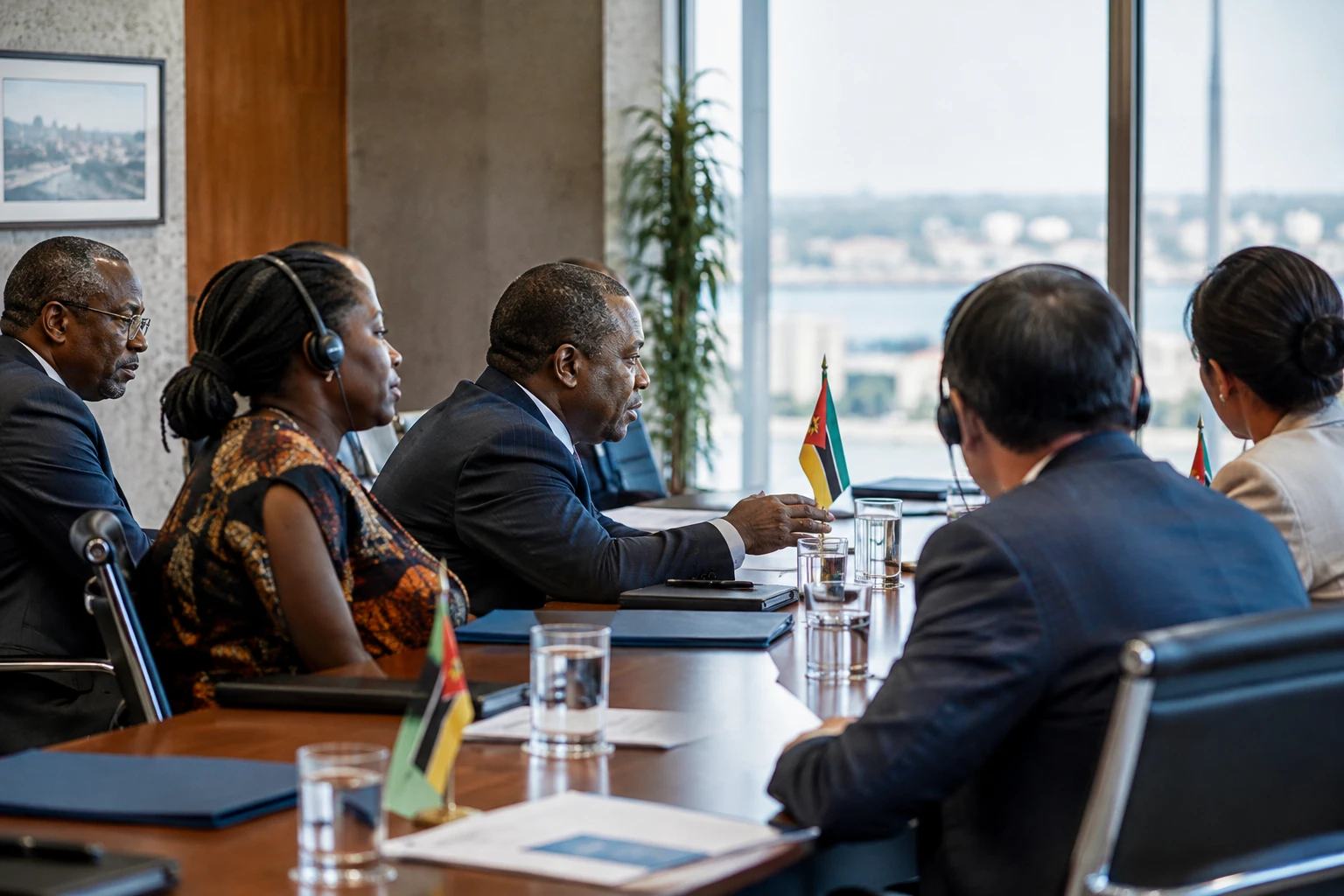
In northern Mozambique, the restart of a vast gas project is once again drawing billions of dollars. But the investment announced by India does not, by itself, guarantee that the expected benefits will be widely shared by Mozambicans.
The Mozambique LNG project is located in the Rovuma Basin, in Cabo Delgado province. It brings together two issues that extend beyond the country’s borders: Mozambique’s place in global gas markets and India’s energy security. It also puts a national question back in the spotlight: how can exported resources be turned into jobs, public revenue and locally accessible energy?
Work resumes, but production is still a long way off
On 26 October 2026, Bharat Petroleum Corporation Limited (BPCL), an Indian state-owned company, said it planned to invest an additional $1.8bn in Mozambique LNG. During its quarterly results conference, its chief financial officer, Vetsa Rama Krishna Gupta, put the sums already committed at about $2.8bn. With future spending and exploration included, BPCL’s total investment could reach $4.5bn to $4.6bn, according to comments reported at the conference.
BPCL owns 10 per cent of the project. The operator, TotalEnergies, holds 26.5 per cent. The consortium also includes Mozambique’s state-owned ENH, Japan’s Mitsui and several Asian partners, including other Indian and Thai companies. The first phase envisages two liquefaction units, with a combined capacity of about 13m tonnes of liquefied natural gas (LNG) a year. LNG is gas cooled for transport by ship.
The schedule has, however, been delayed by several years. In 2021, the consortium suspended work and declared force majeure, a contractual clause that can justify a project’s suspension in exceptional circumstances, after security deteriorated in Cabo Delgado. Force majeure was lifted in November 2025. TotalEnergies and the Mozambican authorities announced the full resumption of onshore and offshore activities on 29 January 2026.
Progress figures vary according to the date and source. BPCL cited 47 per cent completion in September 2026. When the restart was announced, TotalEnergies estimated that the project was 40 per cent complete and targeted first LNG production in 2029. BPCL, for its part, cited gas arriving around the middle of 2028. These dates do not necessarily refer to the same milestone: the Indian company is talking about its supply forecasts, while the operator puts the project’s first production in 2029. They therefore warrant close attention.
India seeks to secure long-term volumes
BPCL’s stake is part of an Indian strategy to diversify supplies. The group said it had signed a purchase contract for 1m tonnes of LNG a year for delivery to India. It is currently offering these volumes to potential customers and hopes to conclude commercial agreements in the coming quarters. The investment allows BPCL to bet both on a share of the project and on future access to an energy resource.
The relationship goes beyond the company. For India, buying Mozambican gas would add another source to a diversified import portfolio. For Mozambique, Indian financing confirms the interest of Asian partners in the Rovuma reserves. But the benefits are not automatically shared among the parties: investors seek returns and reliable deliveries, while the state must negotiate revenues, local jobs and benefits for the regions concerned.
In Maputo, the authorities must also contend with the cost of restarting the project and the consortium’s commitments. In Cabo Delgado, residents and local businesses are directly affected by security, access to land, recruitment and opportunities for subcontracting. The announced resumption brings activity to the site, but is not enough to measure the quality of jobs or the share going to Mozambican suppliers. These factors will determine the project’s economic impact beyond exports.
Expected benefits constrained by security
The return of work teams does not eliminate the risks in the north of the country. Attacks and population displacement in the province have shaped the project’s trajectory. Security co-operation with Rwanda has also accompanied the restart. For the consortium, the continuity of work therefore depends on lasting security conditions. For local communities, the challenge is also to be able to live and work in affected areas, without the protection of facilities becoming the sole measure of stability.
Gas alone will not meet the country’s energy needs either. Production destined mainly for export does not mean that Mozambican households or businesses will automatically have access to more electricity or affordable gas. The question of local content — the share of jobs, purchases and skills entrusted to domestic players — therefore remains central to assessing the investment’s tangible effects.
At regional level, the project forms part of the energy ambitions of the Southern African Development Community (SADC), which brings together Mozambique and its neighbours in southern Africa. LNG exports could strengthen the country’s position in international trade, while making stability in the north an issue for regional partners. They also raise questions about the balance between exports, domestic needs and long-term development goals.
The next steps will be decisive: the project’s progress, whether production deadlines are met and whether BPCL’s announced commercial agreements materialise. It will also be important to see how Maputo manages costs, commitments to local businesses and access to benefits in Cabo Delgado. Mozambique’s gas bet is financed once again; its success will be measured as much by the cargoes exported as by the lasting benefits secured at home.