Algeria
 Egypt
 Libya
 Morocco
 Sudan
 Tunisia
 Benin
 Burkina Faso
 Cabo Verde
 Côte d'Ivoire
 Guinea
 Guinea-Bissau
 Liberia
 Mali
 Mauritania
 Niger
 Nigeria
 Senegal
 Sierra Leone
 The Gambia
 Togo
 Cameroon
 Central African Republic
 Chad
 DR Congo
 Equatorial Guinea
 Gabon
 Republic of the Congo
 São Tomé and Príncipe
 Burundi
 Comoros
 Djibouti
 Eritrea
 Ethiopia
 Kenya
 Madagascar
 Malawi
 Mauritius
 Mozambique
 Rwanda
 Seychelles
 Somalia
 South Sudan
 Tanzania
 Uganda
 Angola
 Botswana
 Eswatini
 Lesotho
 Namibia
 South Africa
 Zambia
 Zimbabwe
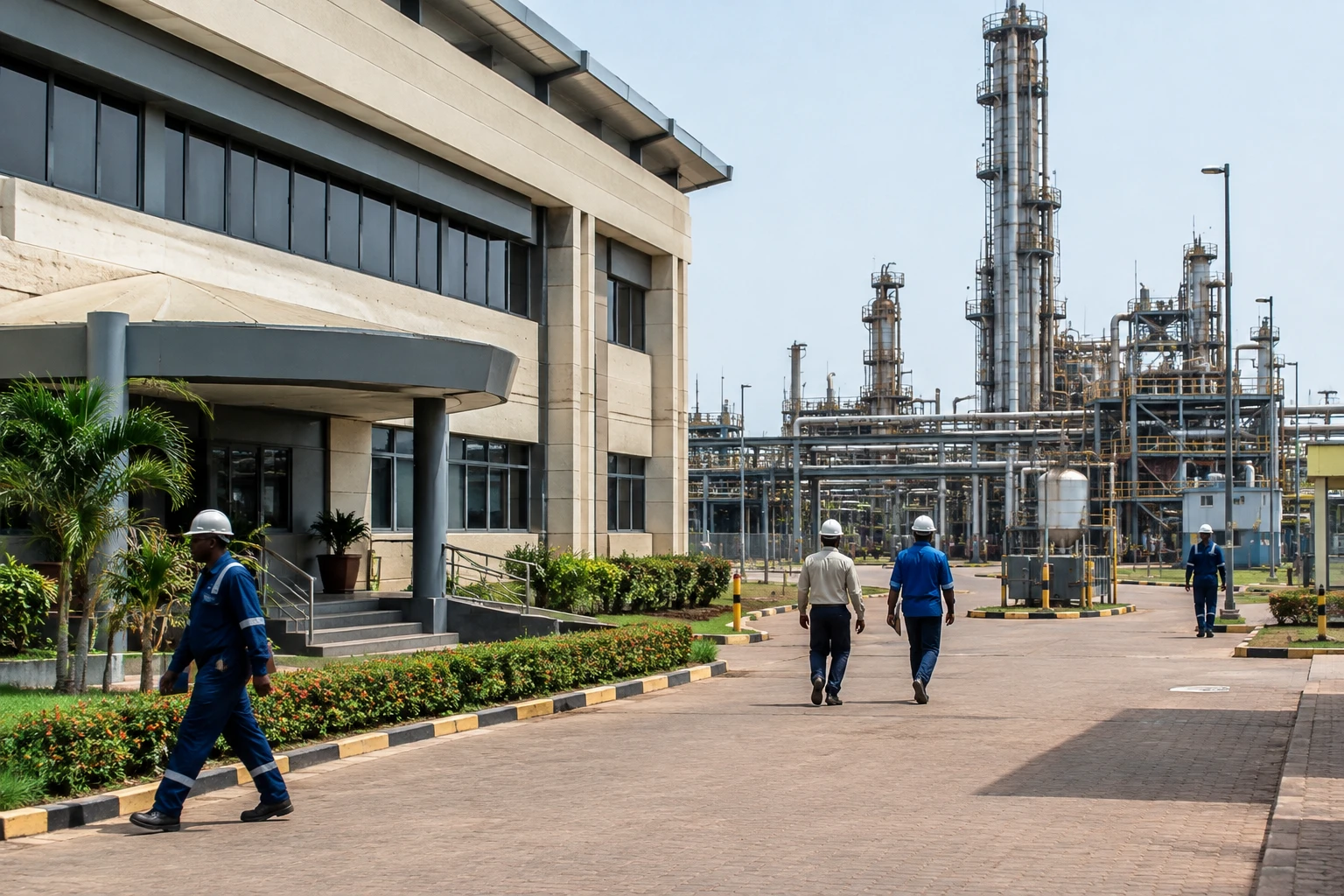
A refinery restarting operations does not yet guarantee a regular supply. Ghana’s challenge is now to turn the Tema Oil Refinery’s (TOR) recovery into sustainable activity without shifting the costs of another bailout onto the state.
From restart to consolidation
Located in Tema, near Accra, TOR is a state-owned refinery central to Ghana’s energy strategy. It resumed crude processing in June 2026, after years of disruption and maintenance work on its main unit. Its nameplate capacity is 45,000 barrels a day, but returning to that level depends in particular on the reliability of its equipment, the capital available and access to crude.
The challenge extends beyond the company. Ghana produces crude oil offshore, but still imports a large share of the fuels consumed in the country. Processing more crude locally could retain a greater share of value in the national economy and reduce exposure to purchases of refined products from abroad. However, a refinery restarted only intermittently is not enough: it must operate predictably.
This issue also arises in a West African market where refining capacity is changing. In Nigeria, Dangote’s ramp-up is reshaping regional fuel flows. For ECOWAS countries — the Economic Community of West African States — the availability of several suppliers can widen sourcing options, but it does not eliminate logistical risks or competition between producers.
A listing under consideration, not yet decided
On 25 October, TOR managing director Edmond Kombat told a delegation from the International Monetary Fund that the possibility of listing the company on the Ghana Stock Exchange had been raised. According to remarks reported by the Ghanaian press, the option would allow institutional and private investors to buy shares and provide new capital. It is an option under consideration: no listing decision or timetable has been announced.
A stock-market listing could open up a source of funding beyond public loans. It would also require greater transparency about the company’s accounts, risks and objectives. For the operation to be credible, it would need to clarify the refinery’s historical liabilities and specify how the funds raised would be used for maintenance, operations or possible expansion.
Inherited debt remains central to this discussion. Edmond Kombat put it at about $517 million, of which nearly $120 million was owed to the state. But the $517 million figure describes accumulated debt, not necessarily the amount still due today. On 26 October, the Ghana News Agency reported that the managing director had said the outstanding balance had been reduced to about $300 million through a restructuring programme. These figures relate to different scopes or stages of restructuring and should not be confused.
Public debt owed to the refinery raises a governance question: how should TOR’s commercial liabilities be distinguished from claims linked to state policies? Announced discussions on the $120 million owed by the government could help put the accounts on a sounder footing. They will, however, need to be accompanied by detailed information so that taxpayers and future shareholders can assess who bears the losses and the cost of new investment.
Local crude, a condition for a regular recovery
Crude availability is the other decisive condition. On 27 May 2026, TOR received one million barrels of Bonga crude from Nigeria, then resumed refining on 3 June. In July, it also received one million barrels of Jubilee crude produced in Ghana. These cargoes confirm a resumption of activity, but do not in themselves guarantee a continuous supply.
The government is counting on higher local production and expanded capacity. In July, the energy minister estimated that development projects at TOR and the private Sentuo refinery could, once completed, meet about 70% of national demand for refined products. This projection depends on the investments being completed and the facilities operating regularly; it does not describe the current situation.
The distinction matters for households and businesses. More stable local production could reduce dependence on imported cargoes and the associated need for foreign currency. But motorists, transport operators and informal businesses do not automatically benefit from an operating refinery: the impact on prices also depends on the cost of crude, transport, financing and distribution.
The Chamber of Oil Marketing Companies reported a sharp rise in imports of refined products in 2025: about 6.92 million tonnes, compared with 5.06 million in 2024. This figure underscores the scale of the market that domestic refineries are seeking to serve. However, it cannot on its own predict the share TOR will be able to supply, as volumes depend on its shutdowns, supplies and yields.
A test for Ghana’s energy policy
TOR’s case therefore puts several public policy choices to the test: funding a strategic company without permanently increasing the state’s financial burden, securing access to crude and maintaining transparency standards. A listing could contribute to financing, but it will not replace either a coherent industrial strategy or sound financial governance.
Regionally, Ghana is seeking to make better use of its resources and strengthen its position in West African energy trade. The next step will be less about announcing theoretical capacity than proving it can produce regularly, with clearer accounts and predictable supplies. Only then can Tema’s recovery translate into greater security for Ghana’s economy, rather than a technical restart alone.