
 Algeria
 Egypt
 Libya
 Morocco
 Sudan
 Tunisia
 Benin
 Burkina Faso
 Cabo Verde
 Côte d'Ivoire
 Ghana
 Guinea
 Guinea-Bissau
 Liberia
 Mali
 Mauritania
 Niger
 Nigeria
 Senegal
 Sierra Leone
 The Gambia
 Togo
 Cameroon
 Central African Republic
 Chad
 Equatorial Guinea
 Gabon
 Republic of the Congo
 São Tomé and Príncipe
 Burundi
 Comoros
 Djibouti
 Eritrea
 Ethiopia
 Kenya
 Madagascar
 Malawi
 Mauritius
 Mozambique
 Rwanda
 Seychelles
 Somalia
 South Sudan
 Tanzania
 Uganda
 Angola
 Botswana
 Eswatini
 Lesotho
 Namibia
 South Africa
 Zambia
 Zimbabwe
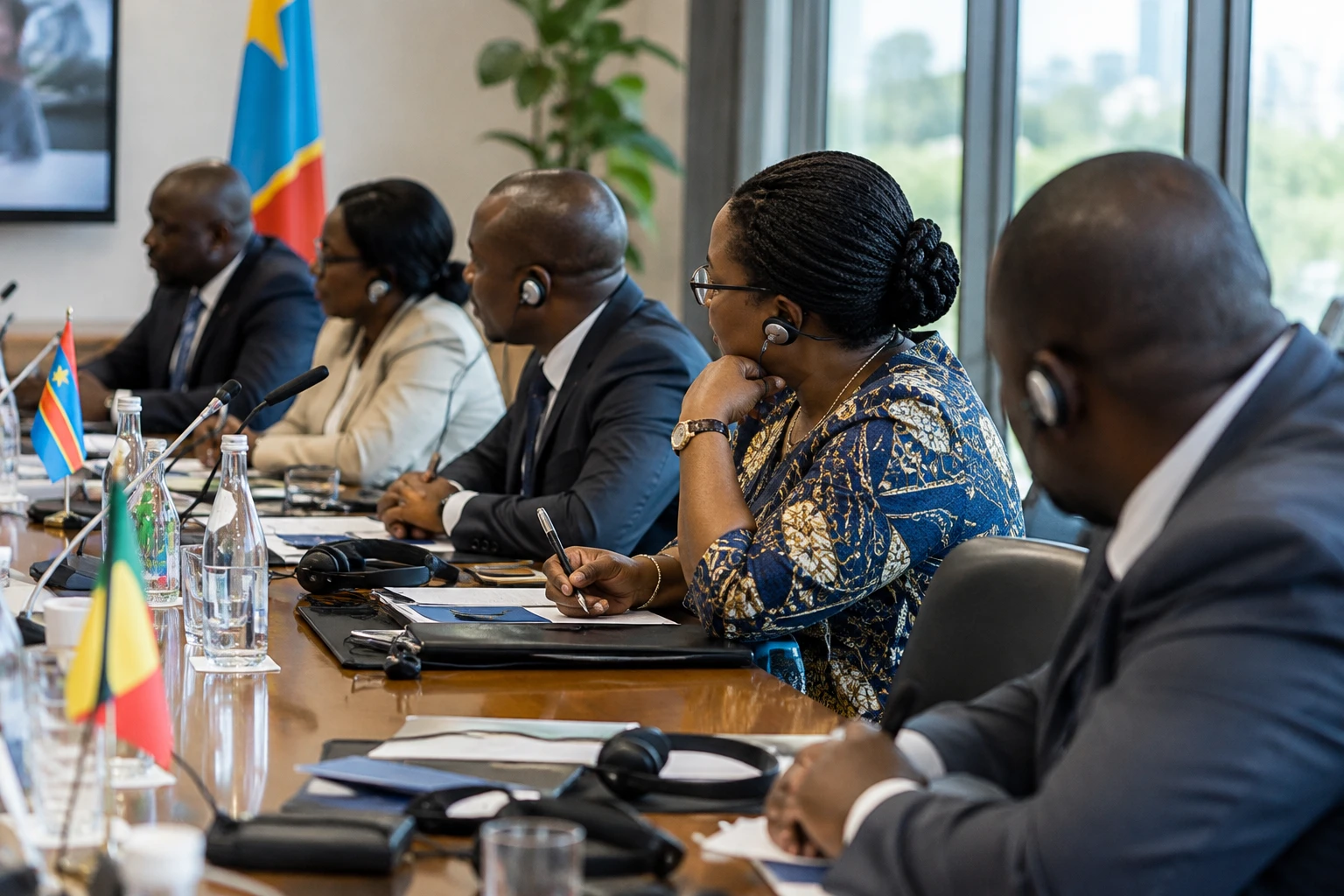
In the Democratic Republic of the Congo, the war in the east and political dialogue are now playing out on two interconnected fronts: that of arms and that of institutions. In Kinshasa, President Félix Tshisekedi has called on his majority to close ranks, as his predecessor Joseph Kabila has taken the lead of a politico-military movement linked to the AFC-M23.
An eastern crisis at the heart of power
The meeting on Saturday 24 October between the head of state and parliamentarians from the Sacred Union comes amid mounting tensions. The AFC-M23, a politico-military coalition fighting the government and controlling territory in the east, announced on 12 October the creation of the Front for the Refoundation of the Nation (FRN), led by Joseph Kabila. The movement says it intends to fight the government by all means, including force, according to its declaration. The announcement has been reported by Congolese media and international news agencies.
The DRC, a vast Central African country whose capital is Kinshasa, is a member of the Southern African Development Community (SADC) and the East African Community (EAC). These regional organisations are involved in diplomatic and security efforts around the Great Lakes crisis. The African Union has also appointed facilitators to the process. On 9 October, Félix Tshisekedi received them in Kinshasa to discuss the implementation of peace initiatives and the situation in the east.
The new alliance comes after the M23 took Goma in January 2025, a turning point in a long-running conflict fuelled by political, security and regional tensions. Kinshasa accuses Kigali of supporting the rebellion; Rwanda denies the accusations. The parties’ responsibilities and accounts should therefore be attributed to them, rather than presented as established facts without independent evidence.
Tshisekedi accuses Kabila while projecting confidence
Addressing elected representatives from his coalition, Félix Tshisekedi accused his predecessor of supporting a force taking up arms against the country he led from 2001 to 2019. The president also said intelligence services had been warning him for more than two years. He said Joseph Kabila’s stance showed, in his view, that he had “never loved” the Congo. These are the head of state’s accusations; on their own, they do not constitute independent proof of the alleged facts.
Félix Tshisekedi also portrayed military pressure and sanctions as factors that had, in his view, led Kigali to seek a Congolese façade for the offensive. This interpretation is disputed amid a crisis in which the parties accuse one another. The president nevertheless sought to reassure, saying the situation was “under control”. This political formulation is not, on its own, enough to assess the military situation in the affected territories.
For the government, Kabila’s presence at the head of the FRN raises the political stakes of the war. Kinshasa no longer refers to the former president only as a presumed supporter of the armed opposition: he now appears as the leader of a coalition that explicitly claims to resort to force. But this development does not mean that all opposition figures or all former members of his camp support the movement.
Parliamentary majority: unity, spending and internal tensions
The head of state has urged MPs and senators from the Sacred Union to remain united. He has also called on them to cut spending to fund the war effort and the projects of his five-year term. The instruction confronts the majority with a concrete trade-off: supporting security spending while defending public policies on which residents depend, particularly in provinces far from the capital.
This mobilisation comes as a censure motion targets the agriculture minister, who is accused of mismanagement. A censure motion is a parliamentary procedure through which elected representatives can call for a minister to leave office. The dispute is a reminder that the Sacred Union is not a bloc without tensions: its members must reconcile solidarity with the president and scrutiny of the government. At this stage, the motion remains a political challenge and is not sufficient to establish the minister’s guilt.
The call to tighten belts also raises the question of how the burden is shared. The financial effort does not fall equally on institutions, urban households and people in rural areas or the east, who are already facing the consequences of the conflict. The government will therefore need to explain how it will fund security without diverting resources intended for essential services and announced projects over the long term.
National dialogue: a test of credibility
Félix Tshisekedi has announced that officials for the national dialogue will soon be appointed, with co-ordinating teams in the provinces and two African Union co-facilitators. Launched in August, the process is presented as a forum for discussion on peace, cohesion and the refoundation of the state. Its scope will, however, depend on the composition of delegations, the issues admitted for discussion and the space given to political, social and provincial voices.
The question is particularly delicate given that Kabila’s movement now describes itself as engaged in an armed struggle. The president had said that those continuing to fight would be excluded from the dialogue. It remains to be seen whether political or social representatives associated with different perspectives will be able to take part, and under what conditions. Congolese actors have already expressed reservations about the process’s management and inclusiveness. Dialogue can help de-escalate tensions only if it is seen as more than a meeting controlled by the government.
The timetable announced by the head of state is the next milestone. The appointment of organisers and the effective launch of provincial co-ordination will need to be followed, alongside whether African Union initiatives and diplomatic processes move towards verifiable commitments on the ground. For Congolese people, the stakes will be measured in the safety of the population and the possibility of debate without political competition turning into violence.
Asked about the period after 2028, Félix Tshisekedi reiterated a position he had already expressed publicly: he would not seek another term, but would accept one “if the people want it”. In a context where debate about institutions and political deadlines can fuel tensions, this statement does not resolve the question of succession. Rather, it is a reminder that stability will also depend on respect for the constitutional timetable and rules accepted by the different actors.



