Algeria
 Egypt
 Libya
 Morocco
 Sudan
 Tunisia
 Benin
 Burkina Faso
 Cabo Verde
 Côte d'Ivoire
 Ghana
 Guinea
 Guinea-Bissau
 Liberia
 Mauritania
 Niger
 Nigeria
 Senegal
 Sierra Leone
 The Gambia
 Togo
 Cameroon
 Central African Republic
 Chad
 DR Congo
 Equatorial Guinea
 Gabon
 Republic of the Congo
 São Tomé and Príncipe
 Burundi
 Comoros
 Djibouti
 Eritrea
 Ethiopia
 Kenya
 Madagascar
 Malawi
 Mauritius
 Mozambique
 Rwanda
 Seychelles
 Somalia
 South Sudan
 Tanzania
 Uganda
 Angola
 Botswana
 Eswatini
 Lesotho
 Namibia
 South Africa
 Zambia
 Zimbabwe
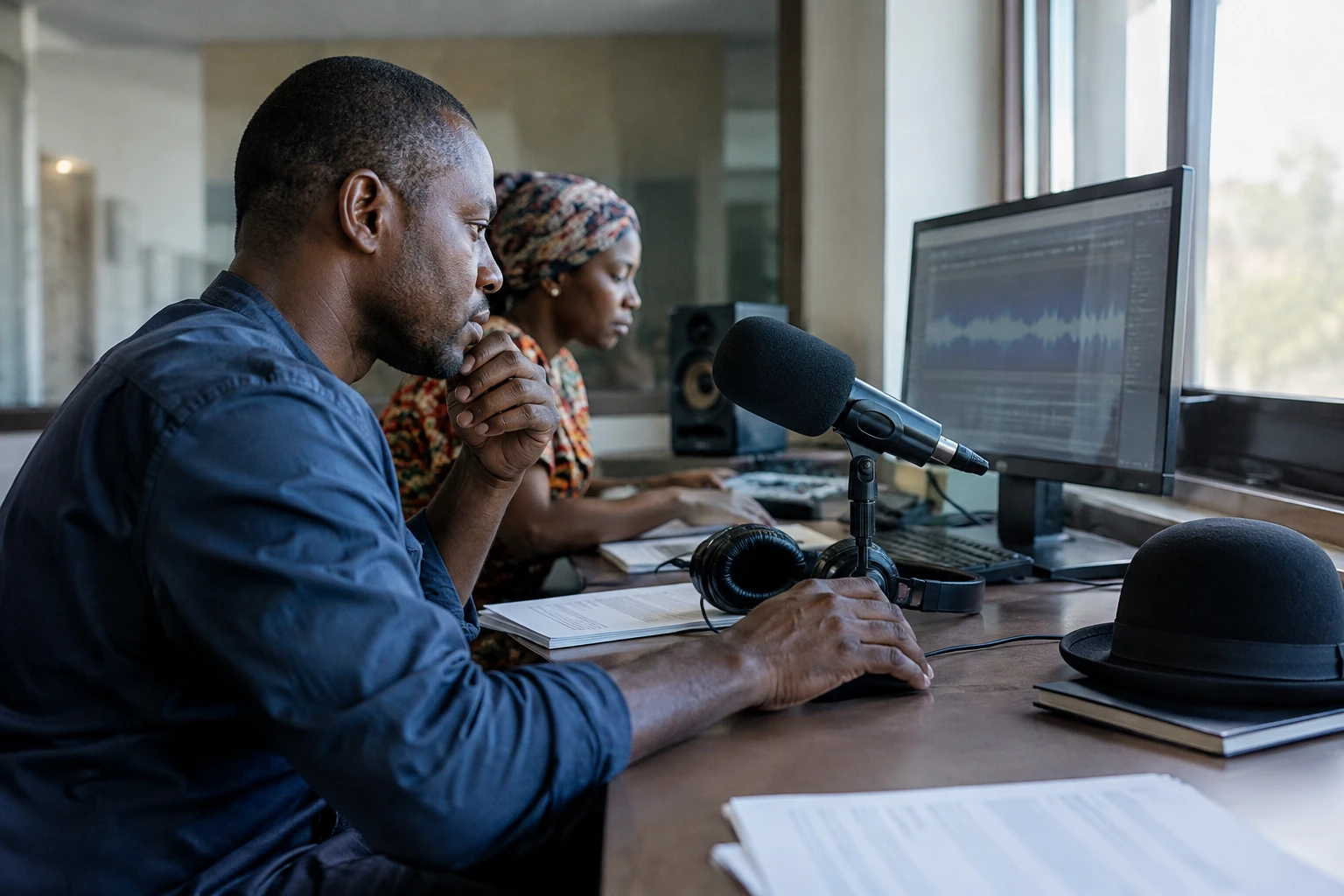
His voice accompanied listeners in Africa and its diaspora for years. In Bamako, the death of Benson Diakité also recalls the careers of Malian journalists who carried the continent’s stories between studios, cultures and borders.
From Mandé to international airwaves
Abdoulaye Benson Diakité died on Friday 23 October 2026 in Bamako, Mali. A journalist and presenter, he built a significant part of his career at Radio France Internationale (RFI), while maintaining close ties with the cultural and media life of his country.
Born in Bancoumana, in the Mandé region, he worked at RFI for around 15 years. Alongside Amobé Mévégué, he presented “Plein Sud”, a programme devoted to African cultures and societies. He also presented “Diaspora” and “Signe des temps”. RFI and the archives of France’s National Audiovisual Institute attest to his presence on air and his work on these programmes.
These programmes connected listeners on the continent with those living elsewhere. They made space for artists, debate and the experiences of the diaspora, without reducing Africa to a single narrative. Cross-border radio was then a major forum for the circulation of ideas, long before the rise of social media.
A return to Mali, between media and institutions
After his time at RFI, Diakité returned to Mali. He joined the communications team of President Amadou Toumani Touré, first as a technical adviser, then as a special adviser responsible for relations with international media. He explained that his return had been at the head of state’s request.
This career spanning a newsroom and the presidential institution highlights a feature of Mali’s media landscape: information professionals can move from broadcasting to public communications roles. These roles are not interchangeable. Journalism involves informing and questioning; institutional communications convey the position of an authority. The distinction remains essential if the public is to understand the messages and responsibilities involved.
Diakité also continued to work in culture and media in Mali, particularly television. His career therefore did not end with his time in Paris: he returned to a national media landscape where debate, creativity and the passing on of knowledge address diverse audiences, from Bamako to the other regions.
A death amid a strained media landscape
Diakité’s death comes at a difficult time for journalism in Mali. Relations between the transitional authorities and several media outlets, particularly international ones, have become strained in recent years. Restrictions and suspensions have limited the presence of some news organisations. In this context, the careers of journalists who have worked for both Malian and international audiences take on particular significance.
This context, however, does not define either the profession or the Malian media. Journalists, presenters and producers continue to work in an environment where public trust, fact-checking and access to a plurality of voices are crucial. Diakité’s professional legacy also lies in this movement between different settings: he brought African subjects to international audiences, then contributed his experience to institutions and media in his country.
His career is also a reminder that a cultural programme is a form of journalism. It connects artists, audiences and stories often absent from major political headlines. Through “Plein Sud” and “Diaspora”, Diakité helped make these exchanges part of the daily radio experience of many listeners.
A legacy that reaches beyond the studios
His colleagues remember his knowledge, kindness and bowler hat, which became a recognisable trademark. But a journalist’s legacy is also measured by the spaces they helped open up. In Diakité’s case, this included a radio station where African cultures and diasporas could tell their own stories.
This dimension extends beyond Mali’s borders. In West Africa, languages, mobility and media networks connect audiences across several countries. RFI was one such link, while national radio and television remain central to informing people about the realities closest to them. The challenge is to preserve media capable of engaging with these audiences without erasing local voices.
The death of Benson Diakité, announced in Bamako on 23 October, marks the passing of a figure known to several generations of listeners and media professionals. RFI planned to rebroadcast that evening, at 21:10 GMT, a programme of “En sol majeur” devoted to him by Yasmine Chouaki. This radio broadcast extends, through memory and words, the bond he had built with his listeners.
Sources consulted: Journal du Mali on the death and career of Benson Diakité ; interview on his return to Mali and his roles in the presidency ; RFI archives on Benson Diakité ; INA listing for an episode of “Plein Sud”.