Algeria
 Egypt
 Libya
 Morocco
 Sudan
 Tunisia
 Benin
 Cabo Verde
 Côte d'Ivoire
 Ghana
 Guinea
 Guinea-Bissau
 Liberia
 Mali
 Mauritania
 Niger
 Nigeria
 Senegal
 Sierra Leone
 The Gambia
 Togo
 Cameroon
 Central African Republic
 Chad
 DR Congo
 Equatorial Guinea
 Gabon
 Republic of the Congo
 São Tomé and Príncipe
 Burundi
 Comoros
 Djibouti
 Eritrea
 Ethiopia
 Kenya
 Madagascar
 Malawi
 Mauritius
 Mozambique
 Rwanda
 Seychelles
 Somalia
 South Sudan
 Tanzania
 Uganda
 Angola
 Botswana
 Eswatini
 Lesotho
 Namibia
 South Africa
 Zambia
 Zimbabwe
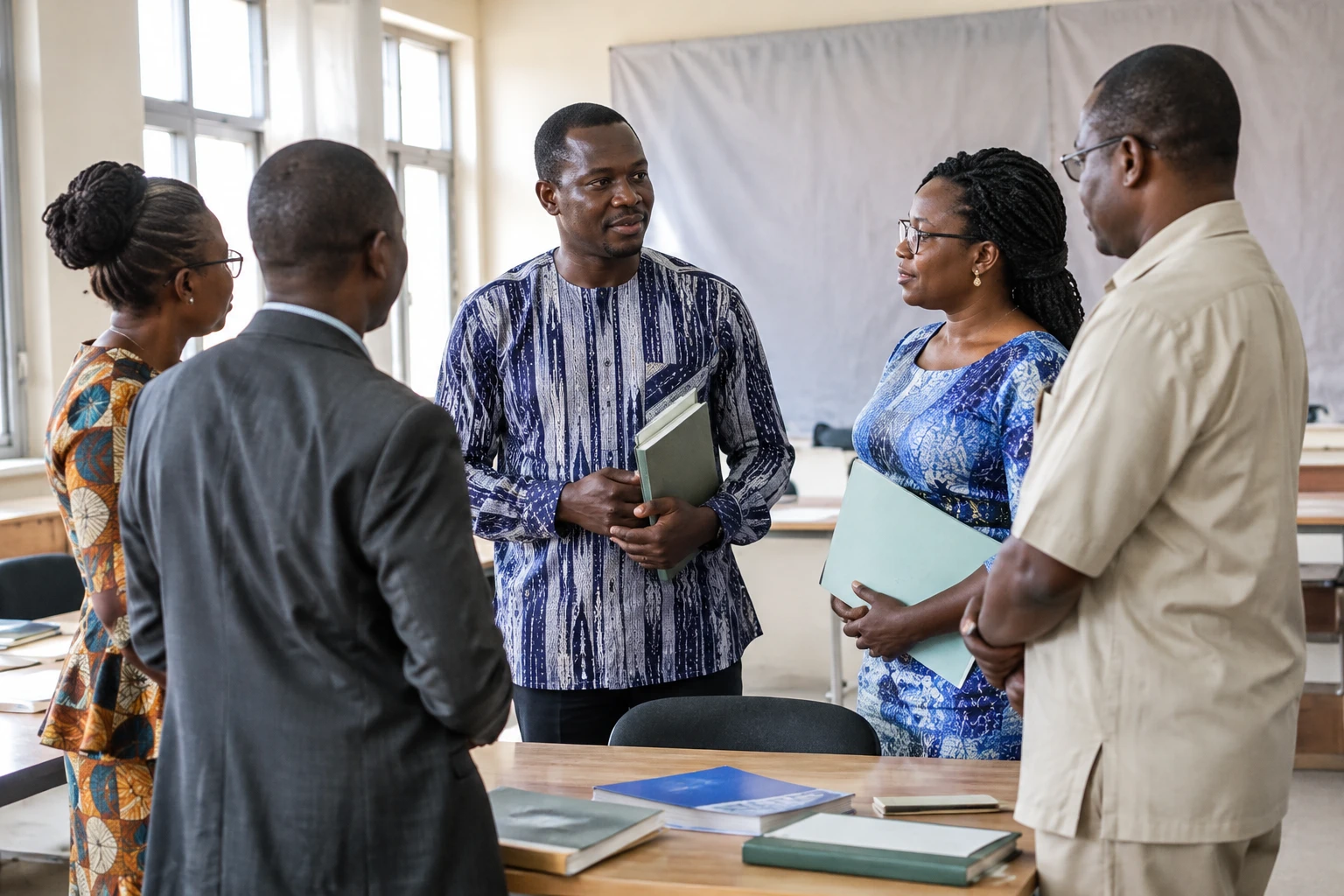
A school textbook does more than convey dates and definitions. It also teaches pupils how to name their country, its history and its challenges. In Burkina Faso, a reform launched at the start of the school year in October 2026 has made these words a matter of sovereignty and pedagogical debate.
Reclaiming words, reshaping the narrative
Since the start of the school year, changes have been made to history, geography and civics in Burkinabè middle and high schools. Guidance notes were circulated to teachers ahead of a complete rewrite of the textbooks, according to information reported by several media outlets.
Terms describing colonisation are among the first to be affected. “Colonisation” becomes “imperialist invasion”; “coloniser”, “invader”; and “explorer”, “spy”. The pre-colonial and post-colonial periods are now presented as the periods before and after the invasion. Decolonisation is recast as the “liberation of Africa”.
In geography, “landlocked country” is to give way to “continental country”. The term “ethnic groups” is being replaced by “sociocultural groups”. The words “poor”, “indebted”, “small” and “with an unfavourable climate” are being removed from the school vocabulary targeted by the reform. Civics and moral education is becoming citizenship and patriotism education.
Content is also changing. New topics cover African knowledge and skills, the Burkinabè revolutions and the Haitian Revolution. The narrative is to give greater prominence to African experiences and national references. However, the extent of some omissions, particularly lessons devoted to Europe and the triangular trade, has raised questions about the overall balance of the curricula.
A reform tied to a broader political project
The Minister of Secondary Education, Moumouni Zoungrana, has defended the revision, denouncing formulations he considers demeaning and narratives that, in his view, diminish pupils. The government places the initiative within the Popular Progressive Revolution and its stated ambition of intellectual sovereignty.
On 17 October 2026, in Kaya, the authorities also launched the NEKRE Pact, a broader framework for overhauling the school system. The official project highlights national languages, the country’s history and endogenous knowledge. It also addresses access to education, learning conditions, the role of teachers and the link between education and jobs. The revision of courses is therefore part of an undertaking that goes beyond textbook vocabulary.
This approach responds to a legitimate question: who chooses the reference points and words through which a society teaches its past? Observers interviewed by Deutsche Welle say curricula should better reflect the realities experienced by African peoples. But placing local experiences at the centre does not require reducing history to a single narrative. The quality of the work will also depend on comparing sources, the accuracy of facts and the freedom teachers have to explain debates.
Between national affirmation and classroom demands
Changes in vocabulary can make visible power relations that have long been downplayed. They can also alter how pupils understand the slave trade, colonial conquest and independence. To achieve this, new terms must be accompanied by clear definitions, a range of historical documents and teaching that distinguishes established facts from interpretations.
Another challenge is very practical: the reform must reach classrooms, in Ouagadougou as well as in the regions. Teachers need textbooks to be available, training and sufficiently clear guidance. Access to a functioning school and teaching resources remains crucial for pupils, particularly in areas where continuity in education has been disrupted by insecurity or population displacement.
It will also be important to monitor how rules on sociocultural categories are applied. Replacing “ethnic groups” with “sociocultural groups” may help avoid reducing complex identities to fixed categories. However, banning all counting or data must not prevent rigorous study of the country’s diversity. Nuance matters as much as the choice of words.
A debate that extends beyond Burkina Faso
The overhaul of the school system is taking place amid regional realignment. Burkina Faso, Mali and Niger left ECOWAS, the Economic Community of West African States, on 29 January 2025 and formed the Confederation of Sahel States. The Burkinabè authorities are thus aligning the national narrative with a political direction that emphasises autonomy and Sahelian references.
The reform also echoes a continental debate: how can African histories, long organised around frameworks inherited from colonisation, be taught without replacing one simplistic narrative with another? The answer will lie in the final content, teacher training and the place given to African sources and documented controversies.
The next step will therefore be less symbolic than pedagogical. The NEKRE Pact sets out a broad ambition; textbooks, lessons and available resources will show how it translates for pupils. That is where the reform’s ability to strengthen knowledge of the past while giving young Burkinabè the tools to question it will be measured.