Algeria
 Egypt
 Libya
 Morocco
 Sudan
 Tunisia
 Benin
 Burkina Faso
 Cabo Verde
 Côte d'Ivoire
 Ghana
 Guinea-Bissau
 Liberia
 Mali
 Mauritania
 Niger
 Nigeria
 Senegal
 Sierra Leone
 The Gambia
 Togo
 Cameroon
 Central African Republic
 Chad
 DR Congo
 Equatorial Guinea
 Gabon
 Republic of the Congo
 São Tomé and Príncipe
 Burundi
 Comoros
 Djibouti
 Eritrea
 Ethiopia
 Kenya
 Madagascar
 Malawi
 Mauritius
 Mozambique
 Rwanda
 Seychelles
 Somalia
 South Sudan
 Tanzania
 Uganda
 Angola
 Botswana
 Eswatini
 Lesotho
 Namibia
 South Africa
 Zambia
 Zimbabwe
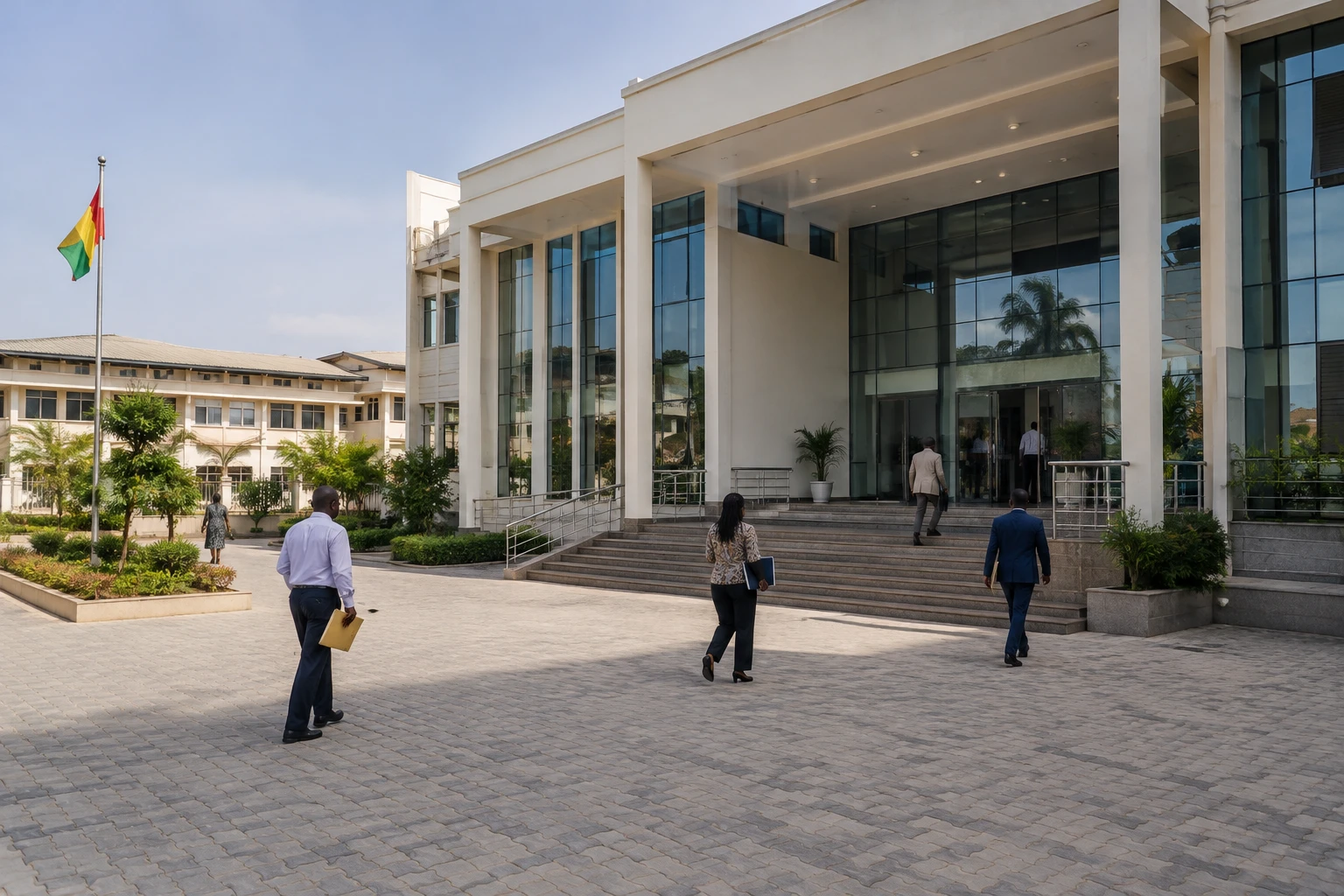
When an institution tasked with ensuring respect for the Constitution is itself at the centre of a public funds case, the stakes go beyond the amount involved. In Guinea, the verdict delivered in Conakry on 21 October raises a direct question: how can institutions be made to scrutinise their own management with the same rigour?
A case involving the running of the Constitutional Court
The Court for the Repression of Economic and Financial Crimes (CRIEF), a specialised court for economic and financial offences, has sentenced Mohamed Lamine Bangoura, former president of the Constitutional Court, to seven years in prison. The judgment concerns the management of public funds intended for the running of the institution while he was at its head.
The case concerns a sum of 20 billion Guinean francs. The CRIEF found Bangoura guilty of corruption, illicit enrichment, misappropriation of public funds and money laundering. He had pleaded not guilty and had been in detention since December 2022.
The sentence also includes a fine of two billion Guinean francs and five years’ disqualification from standing for election. The court ordered the confiscation of his assets in Guinea and Senegal for the benefit of the Guinean state. These elements of the judgment were reported by several Guinean media outlets, including the Guinean Press Agency and Guinee7.
Two other former Constitutional Court officials, Amadou Diallo, a former vice-president, and Sidiki Sylla, a former administrative and finance director, were each sentenced to ten years in prison and fined five billion Guinean francs. They are on the run. The CRIEF has issued arrest warrants. The three men must also jointly pay 41 billion Guinean francs to the state in compensation.
A criminal sentence, but compensation still to be recovered
The sentence establishes criminal liability. It does not, by itself, guarantee that the funds will be recovered. The two co-defendants who were absent must be found, and the confiscation orders enforced. Recovery will therefore also depend on legal and administrative steps, particularly where assets are located outside Guinea.
The 41 billion Guinean francs claimed collectively exceeds the 20 billion at the heart of the case. These are two separate figures: the first is the compensation ordered by the court, while the second is the public money at issue in the case. Presenting them as a single sum would blur the significance of the judgment.
The individual sentence imposed on Bangoura is lighter than the prosecution’s demands. In June, it had sought ten years in prison and a fine of 50 billion Guinean francs. The gap is a reminder that the sentence sought by the prosecution is not the final decision: that rests with the judges at the end of the trial.
A test of the credibility of Guinea’s institutions
The Constitutional Court plays an essential role in interpreting the basic law and overseeing certain electoral processes. A case involving its former president therefore brings the accountability of senior officials to the fore. The verdict can be assessed not only by the sentences handed down, but also by the enforcement of the decisions and respect for judicial safeguards.
The CRIEF was established in 2021, after the National Committee of Reconciliation and Development seized power. Its mission is to deal with economic and financial offences. Since then, its proceedings against former public officials have formed part of a broader debate: should the credibility of the fight against corruption be judged both by the force of prosecutions and by the independence, transparency and fairness of hearings?
This question concerns institutions and citizens alike. For the state, effective recovery of the funds will affect its ability to finance public services. For Guineans, the judgment’s practical impact will also depend on clear information about the sums involved, the assets seized and the follow-up to the arrest warrants. The case is a reminder that public money allocated to an institution is meant to support its operations, not remain an accounting abstraction.
A regional stake in confidence in justice
Guinea is part of ECOWAS, the Economic Community of West African States. The regional organisation also monitors political transitions and electoral processes. In this context, the ability of national courts to hear cases involving former senior officials affects confidence in the rule of law beyond Guinea’s borders.
Follow-up on the case will need to cover several steps: enforcement of the sentence, locating the two convicted men who are on the run, implementing the confiscations in Guinea and Senegal, and then recovering the compensation. In Conakry and across the regions, it is this enforcement that will show whether the verdict turns a judicial conviction into effective financial accountability.