Algeria
 Egypt
 Libya
 Morocco
 Sudan
 Tunisia
 Benin
 Burkina Faso
 Cabo Verde
 Côte d'Ivoire
 Ghana
 Guinea
 Guinea-Bissau
 Liberia
 Mali
 Mauritania
 Niger
 Nigeria
 Senegal
 Sierra Leone
 The Gambia
 Togo
 Cameroon
 Central African Republic
 DR Congo
 Equatorial Guinea
 Gabon
 Republic of the Congo
 São Tomé and Príncipe
 Burundi
 Comoros
 Djibouti
 Eritrea
 Ethiopia
 Kenya
 Madagascar
 Malawi
 Mauritius
 Mozambique
 Rwanda
 Seychelles
 Somalia
 South Sudan
 Tanzania
 Uganda
 Angola
 Botswana
 Eswatini
 Lesotho
 Namibia
 South Africa
 Zambia
 Zimbabwe
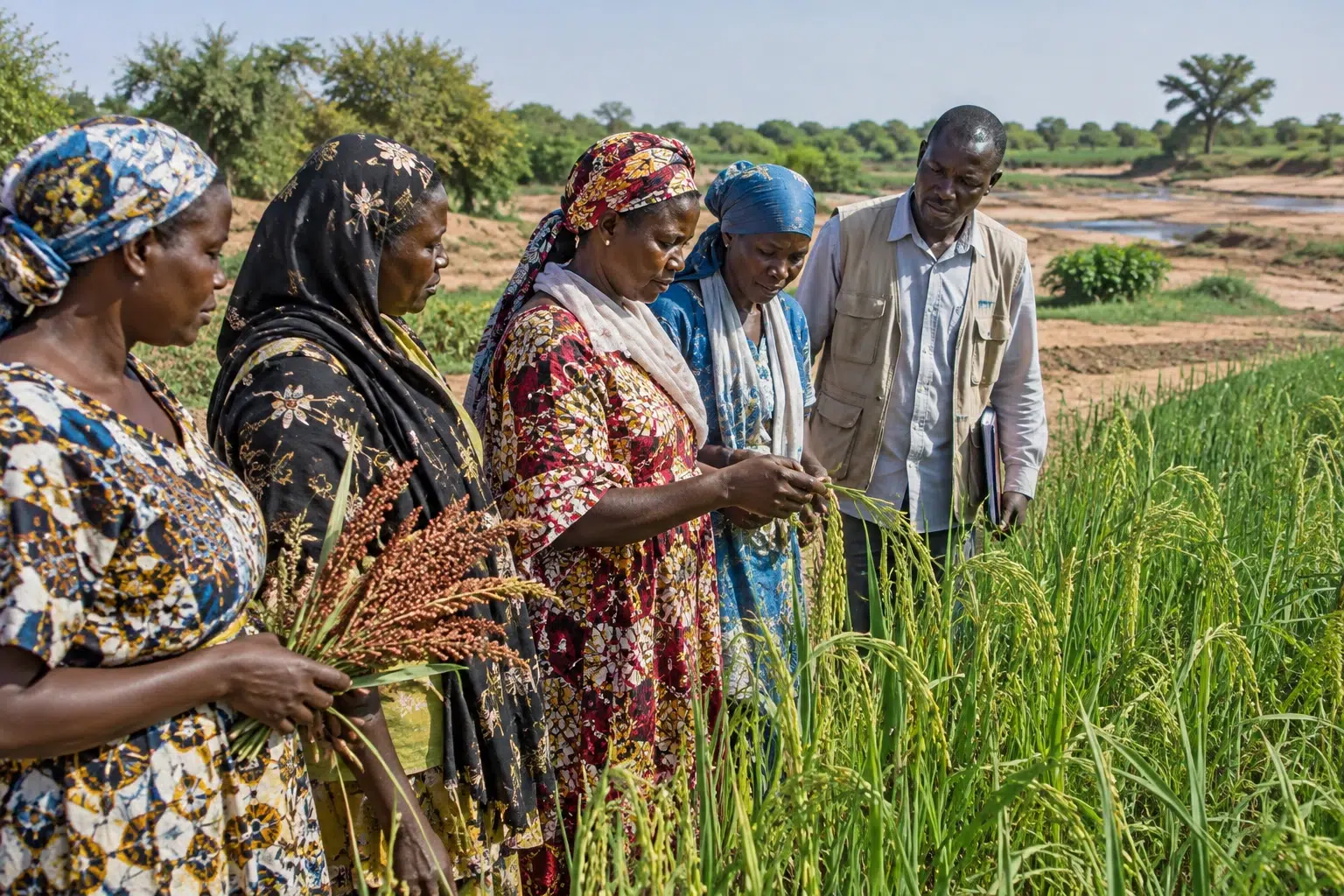
In Pala, in south-western Chad, the question is no longer simply which crop to sow. Women farmers must also contend with unpredictable rainfall, longer dry spells and fields that do not always retain enough water.
Crop choices shaped by water availability
In this area of Mayo-Kebbi Ouest province, women farmers organise themselves into groups to share the cost of renting land. Habiba Fatalé, who leads one of these groups, says she has partly abandoned maize, which was once well suited to her plots. On the advice of the local association Respirons de l’air naturel, the group tried red millet and rice.
The results have been mixed. According to Habiba Fatalé, the red millet produced a satisfactory harvest, while the rice has suffered from a lack of water. The wadis — temporary waterways that fill mainly during the rains — are dry on the plots she points out. This observation describes a local situation; on its own, it is not enough to establish the outcome of the entire farming season.
The contrast is a reminder that adaptation is not simply a matter of changing seeds. One crop may better withstand a dry spell, while another remains dependent on a regular supply of water. Agronomic advice and observation of the soil are therefore as important as the choice of crops.
Maria Mama Bouba, a member of the same group, describes seasons that are harder to predict. She says rainfall is sometimes concentrated into short periods and the dry season is getting longer. She also points to the difficulty of obtaining the ingredients needed to make organic fertiliser. Access to these inputs, to land and to technical support directly affects producers’ decisions.
An agricultural region exposed to extremes
Mayo-Kebbi Ouest lies in Chad’s Sudanian zone, in the south of the country. Rainfall there is generally higher than in the Sahelian and desert regions of the north, but this difference does not guarantee a regular season. The Chad National Meteorological Agency’s 2024 seasonal forecast bulletin noted, among other things, a risk of long dry spells late in the season, around flowering time, in several agricultural areas.
National records also show that a farming season cannot be summed up as “too little rain” everywhere. In August 2024, the Meteorological Agency reported heavy rains that flooded rice fields in some localities, while other bulletins reported rainfall in both Mayo-Kebbi provinces. The alternation of rainfall deficits, intense rain and dry spells can therefore weaken crops, even in the south. Observations from Pala should be viewed in the context of this variability, rather than presented as an account of the entire province.
Across the Sahel and West Africa, the regional AGRHYMET centre recorded moderate to heavy rainfall in Chad’s far south in May 2024, but lower precipitation in the Sahelian zone and the centre of the country. These regional data do not precisely measure conditions in each field in Pala; they nevertheless confirm that conditions vary considerably between areas and over time.
Women at the heart of adaptation, but with limited means
The group enables women farmers to pool a major expense: the cost of renting land. It also facilitates the sharing of experience and advice. The association Respirons de l’air naturel says it visits plots, documents difficulties and then consults its agronomists. This link between field observations and expertise can help adjust practices, but it cannot replace available water, equipment or accessible inputs.
Choosing a crop also involves economic risk. If a variety is more drought-resistant but sells for less, or if a promising crop fails for lack of water, the consequences fall on households that depend on their harvests. Women farming in groups can share some costs; they still have no control over the weather, access to credit or how markets are organised.
This reality reflects wider challenges in Chad, where agriculture depends heavily on rainfall and supports a significant share of livelihoods. The World Bank describes the sector as exposed to droughts, floods, displacement and constraints on access to resources. This is a reason to avoid a single-cause explanation: crop losses are not always due solely to climate change. Infrastructure, advisory services, water management and access to land also matter.
An issue extending beyond Pala’s fields
The case of Pala is part of a regional question: how can crops be safeguarded in an area where rainfall patterns are becoming difficult to anticipate and periods of excess water can follow dry spells? Chad is a member of the Central African Economic and Monetary Community (CEMAC), which brings six countries together for economic and monetary cooperation. Seasonal variability also affects neighbouring agricultural areas, although responses must remain tailored to each region.
Practical measures are already under way in the country. In 2025, the FAO and the World Food Programme reported providing agricultural equipment to producer organisations in the provinces of Mayo-Kebbi Est and Mayo-Kebbi Ouest. These initiatives do not meet every need, but they show that adaptation also depends on production resources, support and local organisations’ capacity to act.
In Pala, red millet performed better than rice this year, according to the women farmers interviewed. This finding is valuable for their future decisions, but it is no guarantee for seasons to come. The challenge will be to make agronomic advice accessible, improve water management and monitor local weather data. For these producers, resilience depends on striking a balance: adapting crops without making them bear the cost of climate uncertainty alone.
Background sources: Chad National Meteorological Agency’s 2024 seasonal forecasts, national agro-hydro-meteorological bulletin, AGRHYMET regional monitoring, the World Bank’s overview of Chad and food resilience programme in the Mayo-Kebbi provinces.