
 Algeria
 Egypt
 Libya
 Morocco
 Sudan
 Tunisia
 Benin
 Burkina Faso
 Cabo Verde
 Côte d'Ivoire
 Ghana
 Guinea
 Guinea-Bissau
 Liberia
 Mali
 Mauritania
 Niger
 Nigeria
 Senegal
 Sierra Leone
 The Gambia
 Togo
 Cameroon
 Central African Republic
 Chad
 Equatorial Guinea
 Gabon
 Republic of the Congo
 São Tomé and Príncipe
 Burundi
 Comoros
 Djibouti
 Eritrea
 Ethiopia
 Kenya
 Madagascar
 Malawi
 Mauritius
 Mozambique
 Rwanda
 Seychelles
 Somalia
 South Sudan
 Tanzania
 Uganda
 Angola
 Botswana
 Eswatini
 Lesotho
 Namibia
 South Africa
 Zambia
 Zimbabwe
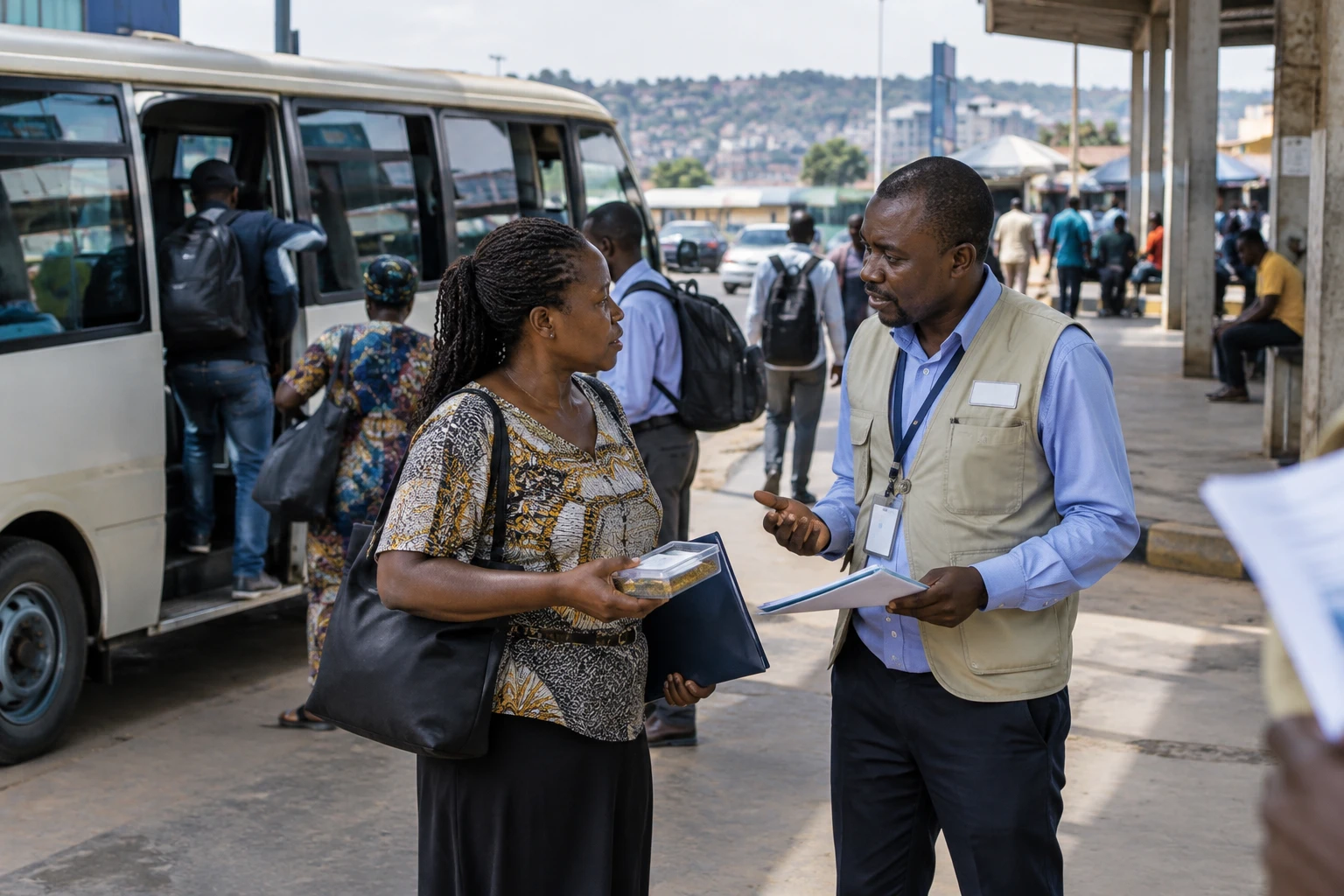
For cooperatives and traders selling Congolese artisanal gold, the choice between declaring their transactions and seeking an outlet outside official channels also depends on costs and procedures. In Kinshasa, DRC Gold Trading is asking the tax authorities to adjust the rules to make legal sales more attractive. The stakes go beyond state revenue: they also concern the place of producers in the value chain.
Formalising gold in a region with porous borders
The Democratic Republic of the Congo has numerous artisanal mining areas, particularly in the east of the country. Some of the gold extracted crosses borders without being recorded as a Congolese export. United Nations Group of Experts reports have for several years documented discrepancies between volumes declared by the DRC and those imported or re-exported by neighbouring countries. They establish that trafficking exists, but do not automatically validate every estimate put forward by operators.
Regional networks include traders based in Uganda and Burundi. In its work on natural resources, the UN Security Council has also examined the difficulties of monitoring and tracing Congolese artisanal gold. These findings provide context for the tax debate, but cannot in themselves confirm the annual figure DRC Gold Trading is putting forward today.
The DRC is a member of the Southern African Development Community (SADC), while dynamics in the east of the country also involve the Great Lakes region. Efforts to combat smuggling therefore depend not only on Congolese controls: transit countries and export markets also have a role to play.
A tax request, with no proposed rates announced
On 9 October 2026, DRC Gold Trading chief executive Joseph Kazibaziba met Barnabé Muakadi, director general of the Directorate General of Taxes. According to accounts published in the DRC, discussions focused on corporate income tax (IBP) and value-added tax (VAT), two levies that may apply to the activities of operators in the sector.
The state-owned company wants the rules applying to traders and cooperatives to be eased or adapted. It has not, however, made public the specific measures it is proposing. The standard rates cited in the available information are 30% for IBP and 16% for VAT. These rates alone are not enough to determine the actual burden borne by each operator: that depends in particular on their activity and tax regime.
DRC Gold Trading says that 75 tonnes of gold leave Congolese territory illicitly each year, with a value close to $10bn. This figure must remain attributed to the company: the studies it cites are not identified in the information made public, and the independent sources consulted do not confirm this precise estimate. UN reports corroborate the existence of clandestine flows and trade discrepancies, but not this annual total of 75 tonnes.
An earlier figure helps illustrate the uncertainty. In 2024, DRC Gold Trading referred to more than 50 tonnes and $5bn a year. The move to current estimates of 75 tonnes and $10bn cannot be interpreted as a real increase in trafficking without a comparable calculation method and verifiable data. The figures put forward carry weight in the debate, but do not represent established losses in public revenue.
Bringing transactions into the legal channel
The company’s argument is based on a trade-off: if legal sales cost too much or make operations more complicated, traders may prefer other outlets. Better-adapted taxation could therefore attract more declared volumes. But the impact will depend on the practical conditions: levies retained, speed of payments, access to buying points, controls and guarantees offered to cooperatives.
Formalisation is not simply a matter of lowering taxes. It also requires the ability to identify the origin of gold, verify transactions and track it through to export or sale to a domestic buyer. Without these controls, a tax measure could reduce revenue on volumes already declared without bringing back those that evade the system.
The effects would not be the same for everyone. Traders and cooperatives could benefit from lower costs, while the state would have to compare any reduction in levies with the additional revenue expected. For artisanal producers, access to a nearby buyer and reliable payments may matter as much as the tax rate. In remote mining areas, distances, roads and security can also make the official channel less accessible than in Kinshasa or major centres.
DRC Gold Trading is also seeking to expand its purchasing network. The company says it operates in nine provinces and has about a dozen branches. It is targeting sales of between 15 and 18 tonnes in 2026. It said it exported 3.5 tonnes in 2025; this company figure should not be confused with national statistics, which may cover a different scope.
The next test: volumes, controls and transparency
For Kinshasa, the challenge is to strike a balance between tax competitiveness and funding public services. For regional actors, it is a matter of better co-ordinating traceability and border controls. UN reports and official export data can inform this work, provided that identical periods and categories are compared.
What happens next will depend first on the DGI’s response and the possible content of a reform. It will then be necessary to see whether recorded volumes increase, whether tax revenues follow suit and whether cooperatives genuinely gain access to approved buyers. Lower taxation could help formalise the sector; its effectiveness can only be judged on the basis of published, verifiable results, not the stated objective alone.
For further reading, readers can consult the Congolese account of the tax discussions and the estimates put forward by the company, information on legal exports and DRC Gold Trading’s target, and the Security Council’s work on the illicit trade in Congolese gold and other minerals.



