Algeria
 Egypt
 Libya
 Morocco
 Sudan
 Tunisia
 Benin
 Burkina Faso
 Cabo Verde
 Côte d'Ivoire
 Ghana
 Guinea
 Guinea-Bissau
 Liberia
 Mali
 Mauritania
 Niger
 Nigeria
 Senegal
 Sierra Leone
 The Gambia
 Togo
 Cameroon
 Chad
 DR Congo
 Equatorial Guinea
 Gabon
 Republic of the Congo
 São Tomé and Príncipe
 Burundi
 Comoros
 Djibouti
 Eritrea
 Ethiopia
 Kenya
 Madagascar
 Malawi
 Mauritius
 Mozambique
 Rwanda
 Seychelles
 Somalia
 South Sudan
 Tanzania
 Uganda
 Angola
 Botswana
 Eswatini
 Lesotho
 Namibia
 South Africa
 Zambia
 Zimbabwe
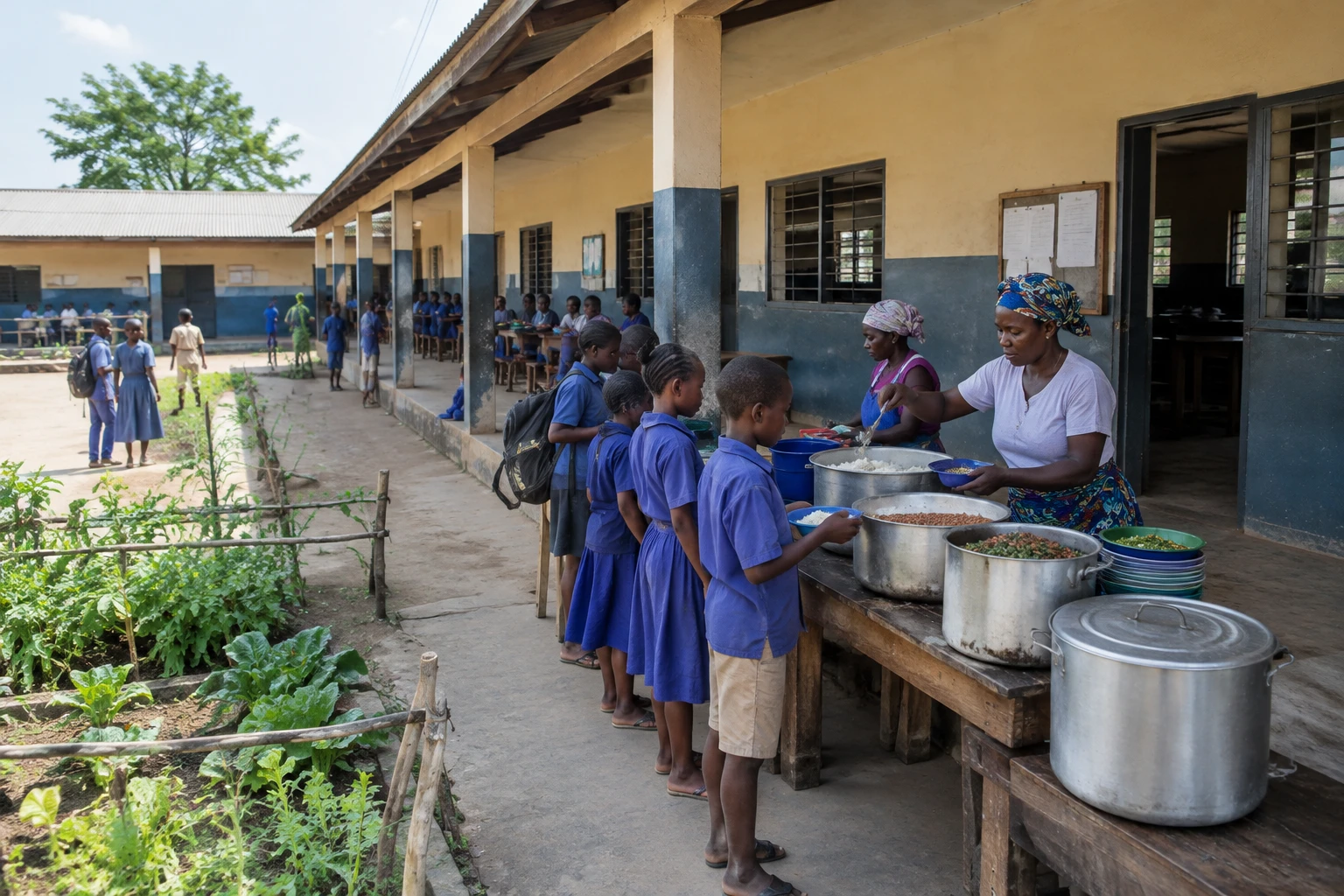
In Betokomia, in the north-west of the Central African Republic, a meal served at school connects three very practical issues: attendance, children’s nutrition and market opportunities for farmers. But sustaining this chain beyond partner funding remains a challenge.
At school, meals are also part of the school day
“We eat rice, beans and vegetables prepared by our mothers,” says Dokare Delicia, a pupil in Betokomia. The school canteen has now become part of daily life at her school. For families, it can ease an expense and give children an additional reason to come to school.
The World Food Programme (WFP) says it supports meals for more than 250,000 children at 335 schools in the Central African Republic. This figure describes the scope of the organisation’s support. It does not mean that all pupils in the country benefit from a school canteen.
At Gbako-Malekpa, headteacher Ghislain Modeste Ngame reports that enrolment has risen from 475 to 857 pupils. This is his observation about the school; on its own, it is not enough to show that meals are the sole cause. Attendance also depends on the distance to school, household resources, the availability of teachers and security.
A national policy to expand
The programme is part of a national ambition announced in March 2024 by the government and WFP: to reach 400,000 pupils by 2027, up from 150,000 in 2023. The scheme, known as “home-grown school feeding”, seeks to bring school procurement closer to the harvests of small-scale producers.
In the Central African Republic, a Central African country whose capital is Bangui, this approach gives school canteens a role that extends beyond the classroom. They can create regular demand for food grown nearby, provided producers can supply sufficient volumes and transport their harvests.
WFP describes an approach in which local procurement should also benefit women, particularly in meal preparation, packaging, quality control and transport. The benefits, however, depend on the contracts actually awarded, the prices agreed and cooperatives’ ability to meet schools’ needs.
This link between education and agriculture reflects a wider continental concern. African School Feeding Day, established by the African Union, highlights programmes that combine meals at school with local production. But stated objectives alone do not guarantee a continuous supply or sustainable funding.
Food needs remain high
The programme’s reach must also be viewed against the scale of need. According to the IPC analysis published in June 2026 and reported by the FAO, about two million people were expected to face acute food insecurity at “crisis” level or worse between April and August 2026. Of these, nearly 262,000 were classified as being in an emergency situation.
This assessment is consistent with the broad estimate cited by WFP, but specifies the period and methodology: the IPC classifies levels of acute food insecurity, whereas the general expression “facing food insecurity” can encompass different situations. Conflict, displacement and reduced access to farmland are among the factors identified by the FAO.
The effects vary across the country. In rural areas, families often depend on harvests and markets that can be difficult to reach. At schools, the absence of a regular meal can affect pupils’ day. In Bangui, the constraints and supply routes may differ from those in remote prefectures.
School canteens therefore replace neither education services, household incomes nor emergency aid. They can nevertheless provide practical support, both for the children who receive meals and for producers selected as suppliers. Their impact depends on the regularity of meals, their nutritional quality and the transparency of procurement.
Funding, the programme’s next test
In 2024, the Central African authorities announced a target of expanding coverage to 400,000 pupils by 2027. To achieve this, partners and the state must maintain resources, while local supply chains must be able to deliver the necessary food. Expanding the programme is therefore not simply a matter of adding schools to a list: it requires storage, transport, monitoring and coordination with producers.
Across Central Africa, the Central African experience raises a question shared by public policies in the region: how can a programme supported by external aid become a sustainable service, funded and managed with national capacity? The answer will depend on the continuity of meals, the actual share of local procurement and access for pupils in remote areas.
For families in Betokomia, the issue is most visible at mealtime and in children’s attendance at school. For policymakers, it is broader: ensuring that school meals remain accessible when funding or harvests fluctuate, without breaking the link with Central African producers.
Sources for verification: field data on schools and beneficiaries, announcement of the national programme and its 2027 target, FAO-IPC analysis of food insecurity in 2026, Central African context for school canteens and local sourcing.