Algeria
 Egypt
 Libya
 Morocco
 Sudan
 Tunisia
 Benin
 Burkina Faso
 Cabo Verde
 Côte d'Ivoire
 Guinea
 Guinea-Bissau
 Liberia
 Mali
 Mauritania
 Niger
 Nigeria
 Senegal
 Sierra Leone
 The Gambia
 Togo
 Cameroon
 Central African Republic
 Chad
 DR Congo
 Equatorial Guinea
 Gabon
 Republic of the Congo
 São Tomé and Príncipe
 Burundi
 Comoros
 Djibouti
 Eritrea
 Ethiopia
 Kenya
 Madagascar
 Malawi
 Mauritius
 Mozambique
 Rwanda
 Seychelles
 Somalia
 South Sudan
 Tanzania
 Uganda
 Angola
 Botswana
 Eswatini
 Lesotho
 Namibia
 South Africa
 Zambia
 Zimbabwe
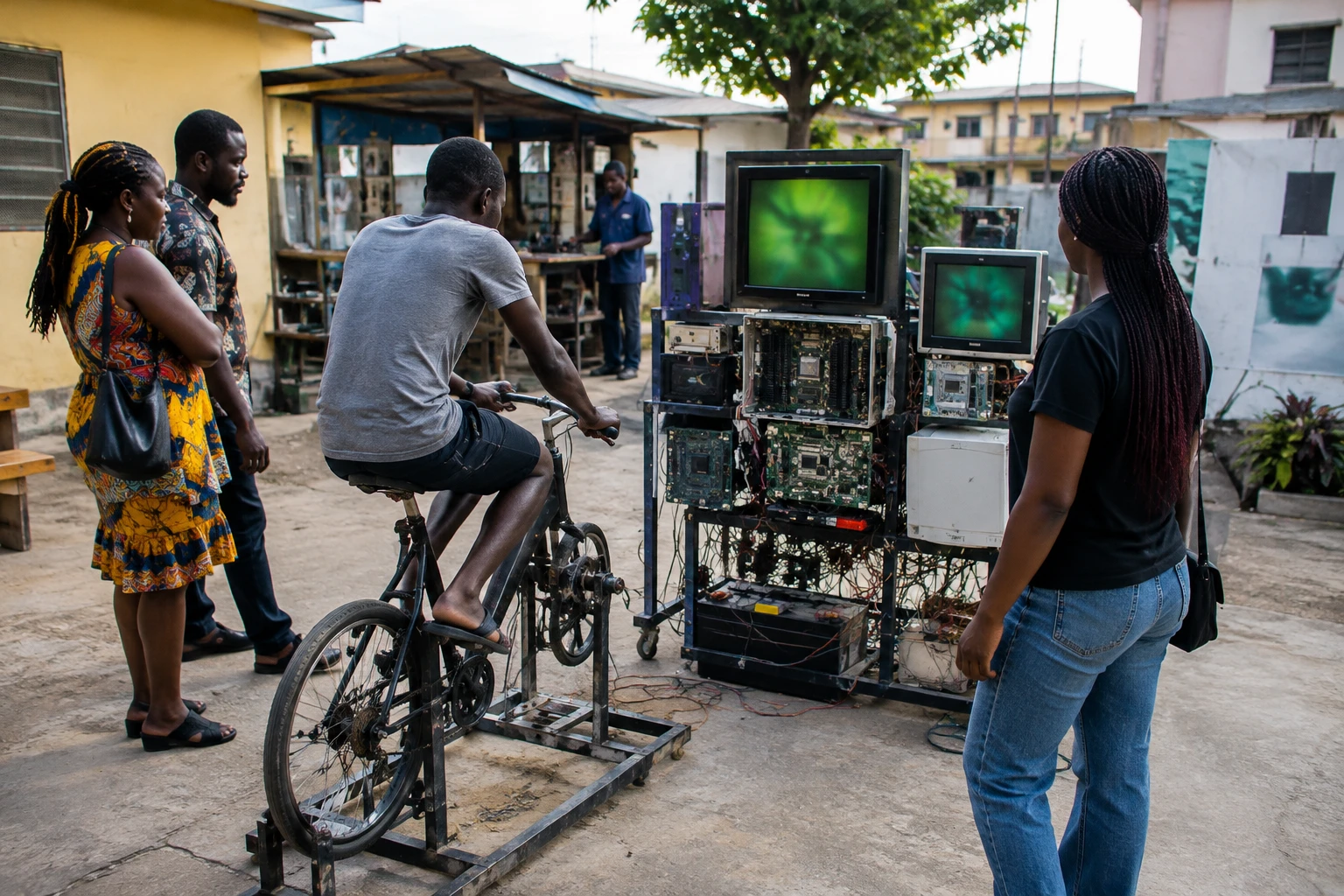
A screen stays dark until a visitor starts pedalling. Then green signs appear, powered by human effort. At Les Grandes Locos, Ghanaian artist Akwasi Bediako Afrane turns old electronic devices into a tangible question: who powers technology, and what happens to it when we stop using it?
Learning to work with what is available in Kumasi
Born in 1990 in Kumasi, in the Ashanti Region, the artist grew up in the Ahinsan neighbourhood. As a child, he made objects from salvaged materials before playing with them alongside others. He says this experience shaped his practice. It grounds his work in an everyday relationship with objects, rather than an abstract opposition between art and waste.
Afrane is currently pursuing a doctorate in the Department of Painting and Sculpture at Kwame Nkrumah University of Science and Technology in Kumasi. He cites several Ghanaian artists among his influences, including Karî’kachä Seid’ou, Dorothy Amenuke, Ibrahim Mahama and El Anatsui. These references point to a diverse art scene in which materials, collective gestures and local histories can become ways of thinking about the present.
At the 18th Lyon Biennale of Contemporary Art, running from 19 September to 13 December 2026, his installation bears the official title CERBERUS T-26: Dance of Dialogue. This year, the Biennale explores movement and passage between different worlds. Afrane’s work fits within this framework without being limited to a demonstration about recycling.
A machine that depends on its visitors
The installation takes the form of a labyrinth assembled from screens, circuit boards, servers, printers and cables. The devices produce their own sounds, lights and movements. Afrane amplifies them to make perceptible an activity often hidden behind the smooth casings of digital objects.
Bicycles are built into the installation. Visitors have to pedal to fully activate the experience and make green signs appear on the screens. The artist alludes to Matrix and questions our role in the digital ecosystem: we use devices, power them, then replace them without always knowing what they contain or how they absorb our use.
Participation is not simply an interactive effect. For Afrane, circuit boards also offer a possible image of society. Each component depends on the others to make the device work. Similarly, human connections and cooperation make collective life possible. The installation makes this idea physical: without a visitor’s contribution, some elements remain inactive.
This principle extends into two projects carried out with residents and institutions in the Lyon metropolitan area. At Saint-Jean-de-Dieu hospital, workshops brought patients and staff together to explore the economics of care. In Écully, residents, volunteers and local stakeholders worked on responsible consumption and reuse. The Biennale says these collaborations helped shape the installation.
Reuse, trade and responsibility
The word “waste” does not mean the same thing everywhere. In the interview provided, Afrane explains that devices considered scrap in Europe can arrive in Ghana as second-hand goods intended for repair, resale or use. This change of perspective is essential: a used device is not automatically unusable. But reuse alone does not solve the problem of equipment that is genuinely beyond repair.
In Ghana, the sector combines repair, resale and materials recovery. Research into this economy describes the role of repairers and recyclers, particularly in Accra: some devices are restored and returned to local use, while components that cannot be reused may end up in less safe processing channels. These activities provide incomes and make equipment accessible, but they also expose workers and the environment to harm when processing is poorly regulated.
The country has a legal framework covering hazardous and electronic waste. The 2016 law provides, among other things, for a fund dedicated to its management, research, public information and support for treatment facilities. The existence of these rules does not mean that all devices follow a safe route. Rather, it underlines that repair, collection and recycling are also matters of public policy, employment and health.
The work thus avoids two shortcuts. The first would reduce used devices to mere imported scrap. The second would celebrate reuse without considering the risks of handling toxic components. The line between use value and environmental danger depends on the condition of the equipment, working conditions and local repair options.
From artistic gesture to regional issue
The project is a reminder that a device’s lifespan is not determined only when its owner parts with it. It also depends on manufacturers’ decisions, trade rules, collection systems and the work of those who repair or dismantle equipment. Responsibility therefore cannot rest solely with Ghanaian consumers or informal-sector workers.
This issue goes beyond Ghana. In West Africa, sales, repair and recovery networks link several economies, while equipment crosses borders. ECOWAS, the regional organisation of West African states, offers a possible framework for considering rules on the movement of goods and environmental cooperation. But the installation does not claim to offer a technical solution: it stages the dependencies and choices that digital systems tend to make invisible.
In Lyon, the effort required to switch on a screen ultimately shifts the perspective. Technology no longer appears autonomous: it depends on resources, energy, labour and human relationships. For Afrane, the dialogue announced in the title is not limited to machines. It also concerns the people who design, use and repair them, and those who inherit their remains.