Algeria
 Egypt
 Libya
 Morocco
 Sudan
 Tunisia
 Benin
 Burkina Faso
 Cabo Verde
 Côte d'Ivoire
 Ghana
 Guinea-Bissau
 Liberia
 Mali
 Mauritania
 Niger
 Nigeria
 Senegal
 Sierra Leone
 The Gambia
 Togo
 Cameroon
 Central African Republic
 Chad
 DR Congo
 Equatorial Guinea
 Gabon
 Republic of the Congo
 São Tomé and Príncipe
 Burundi
 Comoros
 Djibouti
 Eritrea
 Ethiopia
 Kenya
 Madagascar
 Malawi
 Mauritius
 Mozambique
 Rwanda
 Seychelles
 Somalia
 South Sudan
 Tanzania
 Uganda
 Angola
 Botswana
 Eswatini
 Lesotho
 Namibia
 South Africa
 Zambia
 Zimbabwe
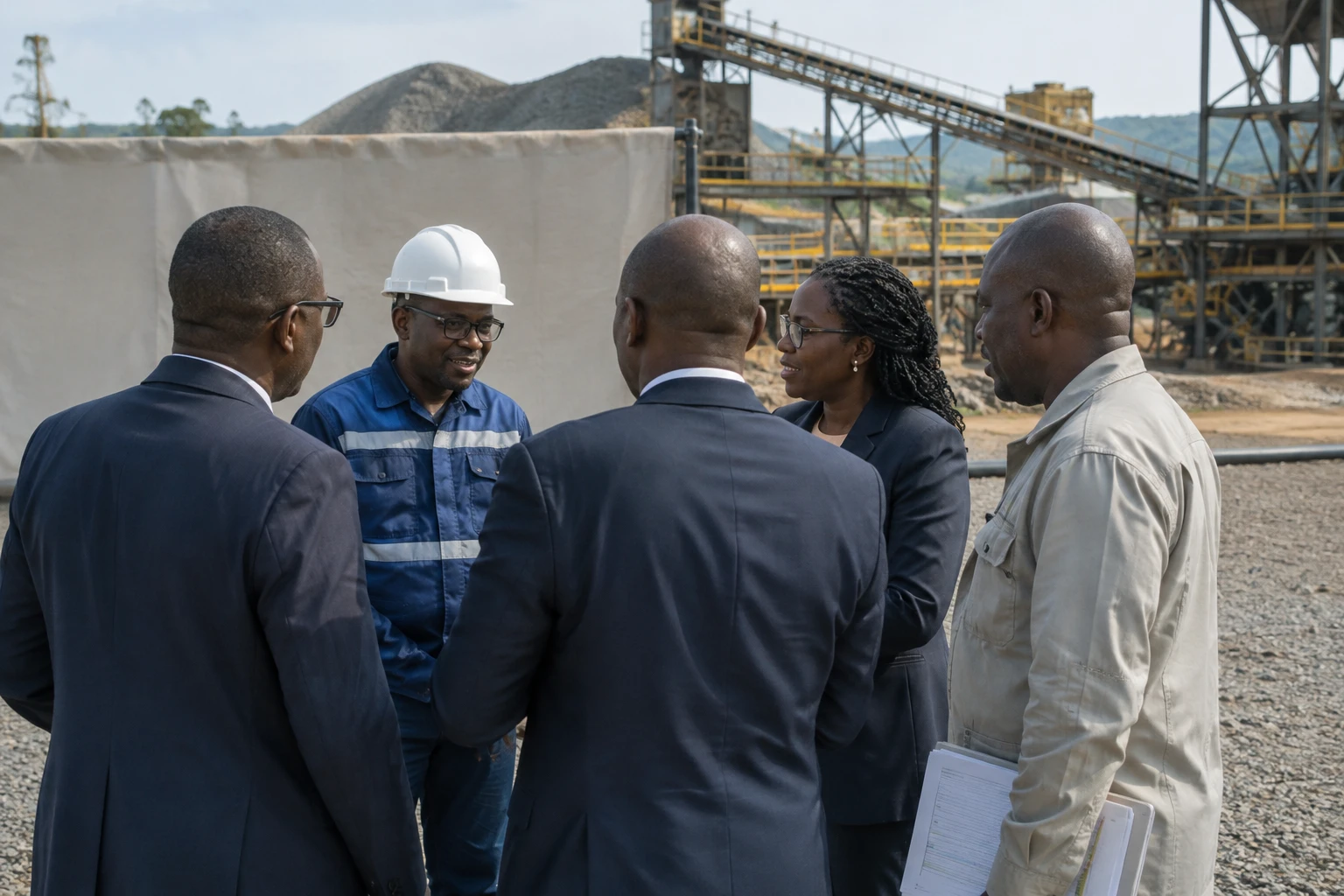
At Siguiri, the next increase in production will depend less on a stated target than on specific work: opening new areas, obtaining permits and adapting the processing plant. For Guinea, the stakes go beyond the volume of gold extracted. They also concern the share of value retained in the country.
A historic mine faces a new milestone
Located in the Kankan region, about 850 kilometres north-east of Conakry, the Siguiri mine has been in operation since 1998. It is 85% owned by the AngloGold Ashanti group and 15% by the Guinean state. The company describes it as its only operation in Guinea.
The site produced 289,000 ounces of gold attributable to AngloGold Ashanti in 2025, or about nine tonnes. Published by the group in its operational data, this figure represents the company’s share based on its ownership stake. It should therefore not be confused with the mine’s total production.
A government note reporting a visit by Mines Minister Bouna Sylla, made on the Sunday before its publication on 13 October 2026, refers to a target of 400,000 ounces a year by 2030. That figure represents nearly 12.4 tonnes. In the absence of a detailed technical timeline published alongside it, this remains an ambition announced by the authorities, not production already secured.
Block 3, a key component but not yet operational
Expected growth rests in particular on Block 3, a new mining area within the Siguiri concession. AngloGold Ashanti says in its 2025 annual report that its development has been approved. In the first half of 2026, the permitting process was nearing completion and construction of an access road was under way.
The group also reported plans to improve its processing facilities. But the public information reviewed does not yet confirm that all this work has been completed, or that it will be enough to reach 400,000 ounces a year. The updated timetable, investment committed and expected contribution from Block 3 therefore remain points to be clarified.
This distinction matters. Announced capacity is not the same as actual production: ore must be mined, processed consistently and tailings managed safely. The group’s annual report also mentions rehabilitation work on the tailings storage facility after a seepage incident in the second half of 2025, as well as a study for a new facility. These are among the practical conditions for expansion.
Benefits also depend on what happens around the mine
At national level, gold complements a mining economy in which bauxite and iron ore also play a major role. Higher production could boost public revenue, subcontractors’ activity and jobs linked to the operation. But its effects will depend on contracts, local procurement, taxation and revenue-sharing, as much as on the number of ounces produced.
Benefits are not automatically distributed equally. Skilled jobs and industrial contracts may go to established companies, while communities near the site expect accessible employment, services and lasting investment. Artisanal and informal gold-mining activities, meanwhile, operate according to different dynamics and are distinct from industrial mining. Available data do not make it possible here to quantify the expected gains for Siguiri’s residents.
Local processing is another part of this strategy. In June 2026, the Guinean presidency announced that the Nimba Gold Refinery, located in the municipality of Gbessia in Conakry, was expected to contribute to refining gold mined in the country. The aim is to retain more stages of the value chain within national borders. Its impact will nonetheless depend on its actual capacity, operating rules and how they are applied to producers.
An expanding sector under regional scrutiny
Siguiri is no longer the only project shaping Guinea’s gold-mining future. At Kiniéro, in Kouroussa prefecture, PDI Gold says it carried out its first gold pour in late 2025, then reached commercial production in 2026. The group is also developing the Bankan project, which is expected to produce an average of about 250,000 ounces a year over an initial period of 12 years. The project remains subject to permits and its construction schedule.
These initiatives illustrate investors’ interest in Guinea’s gold-bearing region. They also bring the debate back to the state’s requirements: revenue, local jobs, compliance with environmental obligations and processing in-country. As a member of ECOWAS — the Economic Community of West African States — Guinea is pursuing its mining policy in a region where several countries are seeking to capture more value from their resources.
The next milestone to watch is therefore less a new target than a set of evidence: Block 3 permits, progress on construction, the operation of facilities and benefits that can be measured in practice. For Guineans, the outcome will be judged as much by Siguiri’s production as by public revenue, jobs and the value added retained in the country.