Algeria
 Egypt
 Libya
 Morocco
 Sudan
 Tunisia
 Benin
 Burkina Faso
 Cabo Verde
 Côte d'Ivoire
 Ghana
 Guinea-Bissau
 Liberia
 Mali
 Mauritania
 Niger
 Nigeria
 Senegal
 Sierra Leone
 The Gambia
 Togo
 Cameroon
 Central African Republic
 Chad
 DR Congo
 Equatorial Guinea
 Gabon
 Republic of the Congo
 São Tomé and Príncipe
 Burundi
 Comoros
 Djibouti
 Eritrea
 Ethiopia
 Kenya
 Madagascar
 Malawi
 Mauritius
 Mozambique
 Rwanda
 Seychelles
 Somalia
 South Sudan
 Tanzania
 Uganda
 Angola
 Botswana
 Eswatini
 Lesotho
 Namibia
 South Africa
 Zambia
 Zimbabwe
As Simandou gathers pace, Guinea faces a tight budget equation: funding infrastructure and public services without letting debt grow faster than revenue. Yet the figures cited for the 2025 accounts do not tally. The latest World Bank data consulted put the deficit at 4.1% of GDP and debt at an estimated 47.9%, rather than the 8.9% and 51.5% sometimes reported.
Figures must be distinguished by date and scope
In its latest economic overview of Guinea, the World Bank estimates that the budget deficit narrowed from 4.9% of GDP in 2024 to 4.1% in 2025. Public debt, meanwhile, is estimated to have reached about 47.9% of GDP in 2025. The institution then projects a gradual decline in the deficit to 3% and in debt to 44.8% of GDP by 2028. These figures differ sharply from projections of an 8.9% deficit and 51.5% debt attributed to the World Bank in other figures circulating for the year. The World Bank’s economic overview of Guinea provides the latest available series consulted.
The discrepancy may result from different publication dates, revisions or calculation methods. A budget deficit is the shortfall between revenue and spending over a given period. Debt, by contrast, is the accumulated borrowing and is often compared with gross domestic product (GDP), the value of national output. Without documents detailing the methods behind each estimate, it would be unwise to present the conflicting figures as equivalent.
The World Bank update also places the economy in a period of expansion: growth is estimated to have reached 7.3% in 2025, driven in particular by mining, services and agriculture. It notes, however, that this growth does not automatically translate into jobs or more evenly distributed incomes. Its 2026 economic report on Guinea emphasises the challenge of turning mineral wealth into more diversified activity.
The budget trade-offs behind Simandou
Guinean government documents shed light on the pressures facing the state. In its presentation of the draft supplementary finance law for 2025, the Budget Ministry cited a 22.4% upward revision to revenue, to 43,063bn Guinean francs, and spending of 53,394bn. It put the deficit at 4% of GDP, compared with 3.1% in the initial budget. This document is a revised forecast presented by the government, not a final account of annual outturn.
The ministry attributed the revision to several factors: investments financed through government securities, payment of arrears and spending linked to the transition timetable. It also flagged the postponement of budget support expected from the International Monetary Fund and the World Bank. To finance the deficit, the draft provided for the issuance of treasury bills, bonds and other public securities. The presentation of the revised budget to the National Transitional Council sets out these choices and their assumptions.
Domestic borrowing enables the government to raise funds in Guinean francs, but it comes at a cost: interest takes up an increasing share of spending, and government securities can compete with credit for businesses. Guinea’s Budget Ministry said interest payments on domestic debt were rising sharply in its forecasts. For households, the impact is indirect: each increase in debt servicing reduces the room available for infrastructure, education, health or social transfers unless revenue growth offsets the burden.
Mining’s promise does not settle the question of who benefits
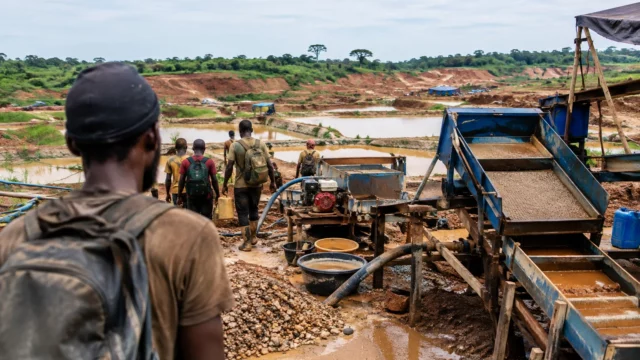
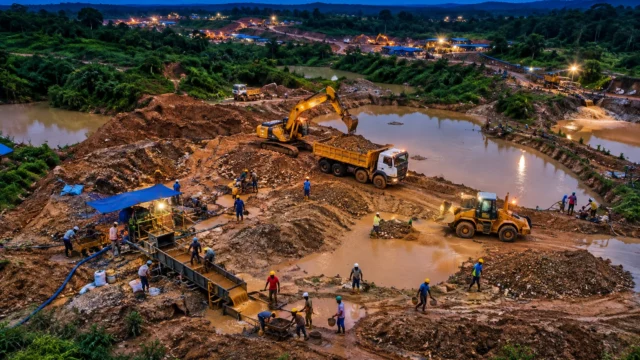
Simandou could boost export revenue and public receipts as iron ore production begins. But rising exports alone do not guarantee stable tax revenue, widespread employment or contracts for Guinean businesses. The challenge also lies in making public spending more effective and developing sectors that create jobs beyond mining.
The effects will vary by location and occupation. Areas crossed by mining and rail infrastructure may gain new economic activity, but may also face pressure on land, transport and services. In Conakry, management of the national budget and public financing remains at the heart of the trade-offs. In rural areas, agriculture remains an important source of activity: the World Bank estimates that it accounts for about one-third of Guinea’s GDP and more than 60% of employment.
The debate also matters across West Africa. Guinea is a member of the Economic Community of West African States (ECOWAS), whose economies are seeking to fund infrastructure and services while keeping borrowing under control. For regional partners, how Conakry manages mining revenue, domestic debt and public investment will matter as much as the volume of ore exported.
The next indicators: revenue, debt and jobs
The World Bank believes Guinea could sustain strong growth as Simandou ramps up, but highlights the need to improve public financial management, revenue mobilisation and job creation outside mining. In June 2026, it also announced a partnership framework with Guinea for 2027-2033, including a project focused on domestic revenue mobilisation and public expenditure management.
The next budget outturn data will show whether mining revenue translates into a lasting reduction in the deficit and debt. They will also show who benefits from the investment: the state and its infrastructure, local businesses, workers or communities near the projects. Until then, discrepancies between estimates are a reminder that any debt or deficit percentage should always be accompanied by its date, source and calculation method.