Algeria
 Egypt
 Libya
 Morocco
 Sudan
 Tunisia
 Benin
 Burkina Faso
 Cabo Verde
 Côte d'Ivoire
 Ghana
 Guinea
 Guinea-Bissau
 Liberia
 Mali
 Mauritania
 Niger
 Nigeria
 Sierra Leone
 The Gambia
 Togo
 Cameroon
 Central African Republic
 Chad
 DR Congo
 Equatorial Guinea
 Gabon
 Republic of the Congo
 São Tomé and Príncipe
 Burundi
 Comoros
 Djibouti
 Eritrea
 Ethiopia
 Kenya
 Madagascar
 Malawi
 Mauritius
 Mozambique
 Rwanda
 Seychelles
 Somalia
 South Sudan
 Tanzania
 Uganda
 Angola
 Botswana
 Eswatini
 Lesotho
 Namibia
 South Africa
 Zambia
 Zimbabwe
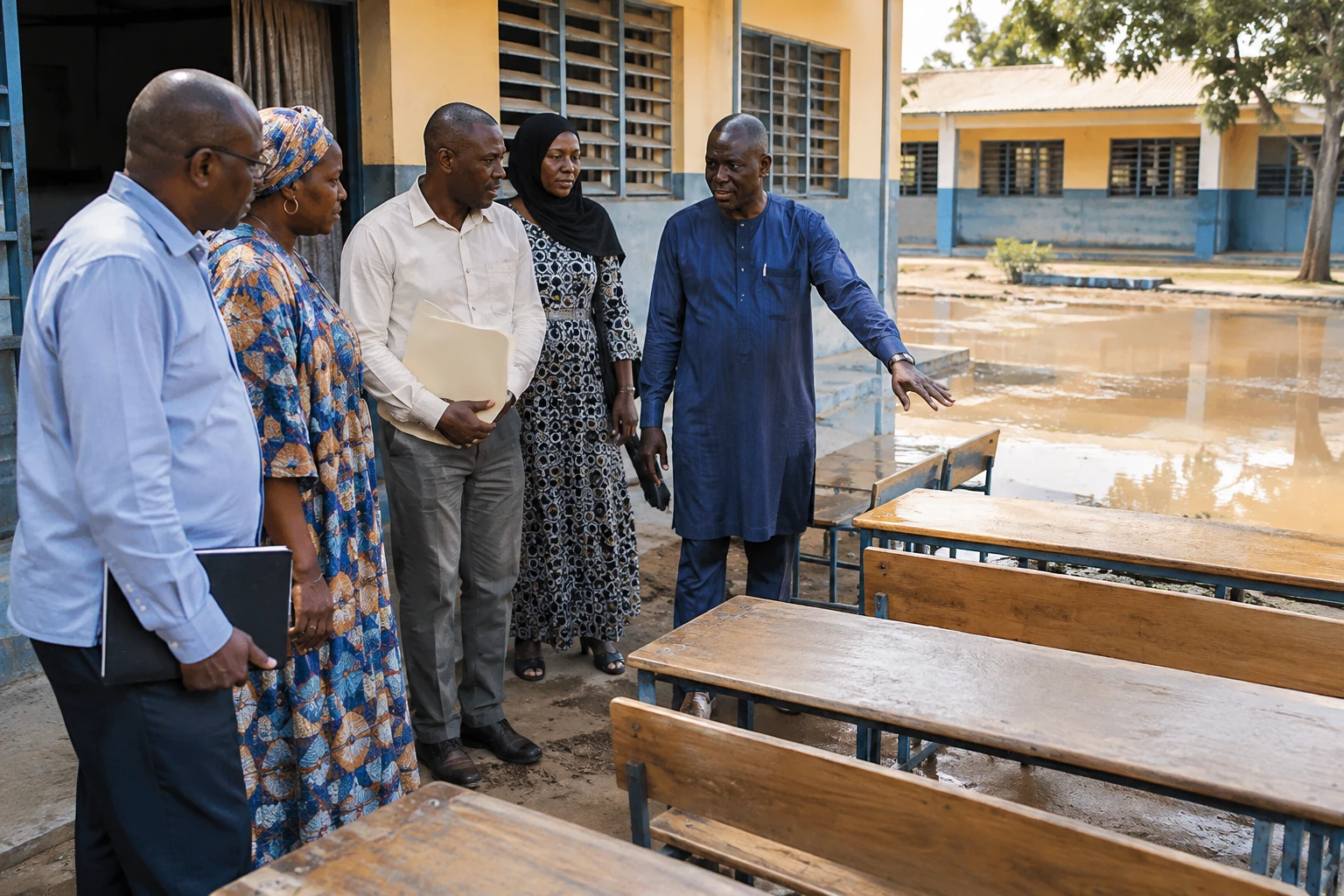
The start of the school year is not measured solely by the number of schools opening their doors. In Dakar, water still present in some classrooms is a reminder that a national date does not guarantee safe learning conditions everywhere.
A national return, very different local situations
In Senegal, pupils were due to return to classes on Wednesday 7 October. The Ministry of National Education ultimately postponed the start of term until Monday 12 October, to allow more time to clean and repair schools affected by the rains. The decision applied across the country.
But the official timetable did not mean that all schools were ready on the same day. In Parcelles Assainies, in northern Dakar, playgrounds and classrooms remained flooded. At the Unité 15 primary school, muddy water had reportedly reached nearly 50 centimetres. The desks used by some 300 pupils had been taken outside to dry. The school was therefore unable to accommodate them under normal conditions.
At Unité 18, a pumping operation was also under way on 12 October. About 500 pupils were affected. The situation was less difficult at other schools in the neighbourhood, but some parents preferred to wait before enrolling their children, as they were unsure about the condition of the premises.
These local observations form part of a national picture that is still evolving. The Senegalese Press Agency (APS) reports that around 644 schools had been identified as affected in an initial survey, out of nearly 30,000. Senegalese Radio and Television (RTS), for its part, says that nearly 7% of schools were still experiencing difficulties linked to flooding on the day classes resumed, citing the Minister of National Education. These figures relate to different points in time and scopes: they are not a definitive, directly comparable count.
Intense rainfall puts infrastructure under pressure
Rain at the beginning of October hit Dakar and its suburbs shortly before the return to school. According to the APS, the Dakar-Yoff weather station recorded 137.5 millimetres of rainfall in 24 hours on 4 October. The agency, attributing the figure to the National Agency for Civil Aviation and Meteorology (ANACIM), describes it as the third-highest daily total recorded at that station since 1981.
Dakar’s outskirts were also affected. In parts of Keur Massar, Guédiawaye, Mbao and Pikine, schools still needed cleaning or repairs. The situation varies from one school to another, and sometimes from one classroom to another. Schools with accessible premises can resume lessons; those where water is still standing or equipment has been damaged must wait, even when the start of term has officially been declared.
Minister Moustapha Mamba Guirassy said on 12 October that the return to school was broadly under way, while acknowledging that some schools remained affected. RTS reported the statement following a supervisory tour of several schools in the capital and its suburbs. A few days earlier, the ministry had justified the postponement on the grounds of pupil safety and the continuation of clean-up operations.
This distinction is essential for families. A damp classroom, a still-flooded playground or unusable toilets are not merely a scheduling problem. Such conditions can expose children to health risks and make it harder for teachers to attend. In neighbourhoods where travel is already disrupted by floodwaters, the journey to school can itself become an obstacle.
Beyond pumping, the question of keeping education going
Emergency operations can remove water, but they do not necessarily address the causes of repeated flooding. The state of drains, the management of rainwater and the location of schools all affect how quickly a school can reopen. The problem therefore goes beyond the Ministry of Education: it also involves local authorities, sanitation services and the bodies responsible for risk prevention.
For pupils, a delay of a few days does not have the same effect everywhere. Families able to keep a child at home have room to manoeuvre that parents whose livelihoods depend on a prompt return to the school day may not have. Delays also affect teachers and schools, which must put equipment back in place and organise learning after an interruption. The practical consequences will therefore depend on how long each school remains closed and what measures are taken to make up missed lessons.
The difficulty is also recurring. In October 2025, the APS had already reported that schools affected by flooding had to be drained before the start of term. This precedent does not prove that the same schools or causes are involved this year. It nevertheless shows that preparations for the school year in Senegal must take account each season of risks that can prevent classes from opening as planned.
A Senegalese issue with regional implications
The 2026-2027 school year highlights the potential gap between a uniform national decision and unequal local realities. The immediate challenge for the authorities is to reopen schools without exposing pupils to dangerous conditions. In the longer term, the aim is to reduce interruptions to lessons, particularly in urban neighbourhoods where flooding recurs regularly.
This issue extends beyond Dakar. West African states face the need to adapt infrastructure and maintain public services during intense weather events. ECOWAS, the region’s economic community, provides a framework for co-operation; but the work to be carried out in Senegalese schools depends first and foremost on budgetary choices and action by national and local authorities.
In the coming days, the key question will not simply be whether classes have resumed in the country. It will also be how many schools remain closed, when pupils will actually be able to return to their classrooms and how lost teaching hours will be made up. The real impact of the start of term will be judged at this level, school by school.
For corroboration, consult the APS report on Dakar’s schools, the statement carried by the APS on the nationwide postponement and the RTS report on the start-of-term situation.