
 Algeria
 Egypt
 Libya
 Morocco
 Sudan
 Tunisia
 Benin
 Burkina Faso
 Cabo Verde
 Côte d'Ivoire
 Ghana
 Guinea
 Guinea-Bissau
 Liberia
 Mali
 Mauritania
 Niger
 Nigeria
 Senegal
 Sierra Leone
 The Gambia
 Togo
 Cameroon
 Chad
 DR Congo
 Equatorial Guinea
 Gabon
 Republic of the Congo
 São Tomé and Príncipe
 Burundi
 Comoros
 Djibouti
 Eritrea
 Ethiopia
 Kenya
 Madagascar
 Malawi
 Mauritius
 Mozambique
 Rwanda
 Seychelles
 Somalia
 South Sudan
 Tanzania
 Uganda
 Angola
 Botswana
 Eswatini
 Lesotho
 Namibia
 South Africa
 Zambia
 Zimbabwe
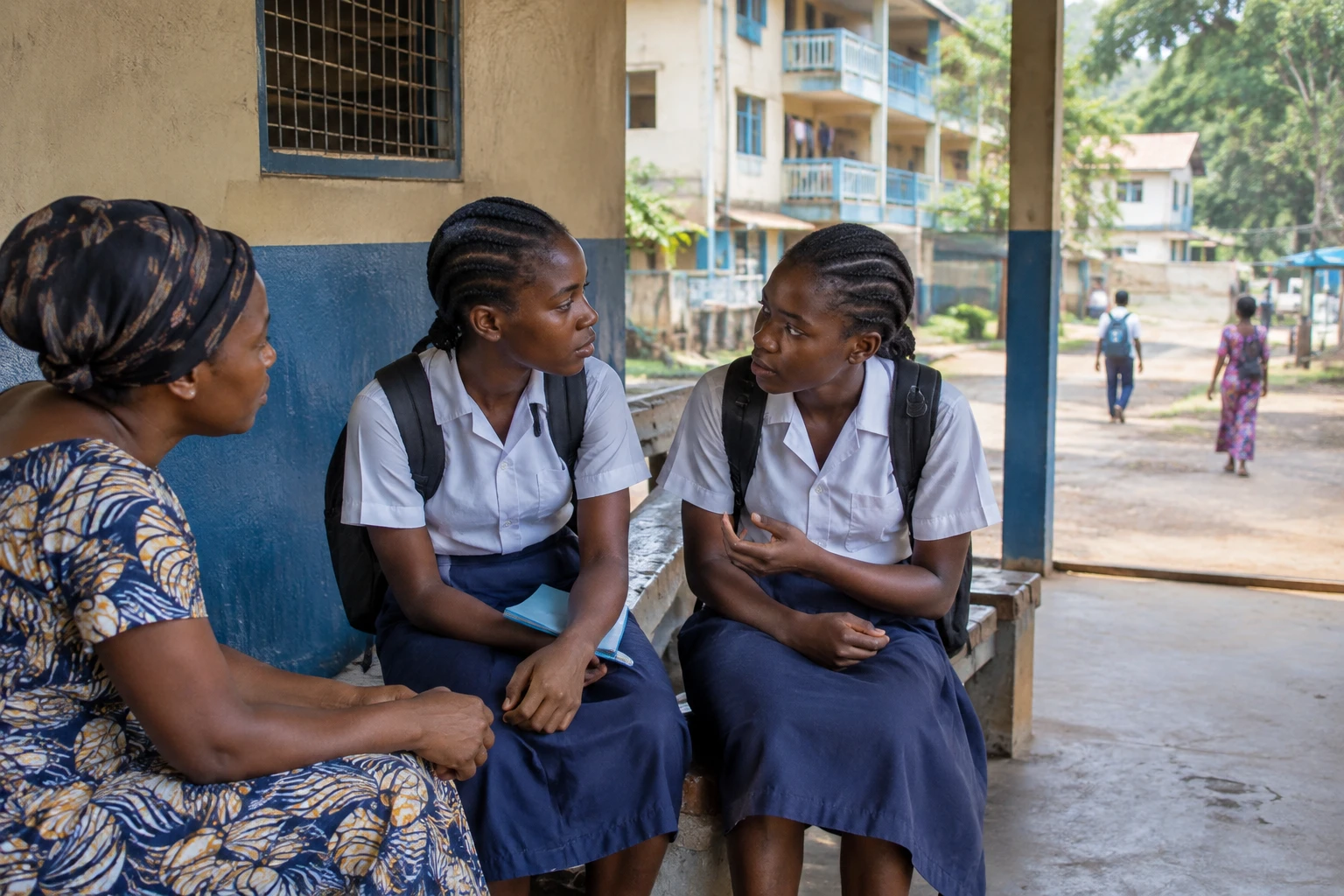
In KM5, in Bangui’s 3rd arrondissement, some teenage girls have to defend a choice already recognised by law: not to marry. For them, being able to continue school and decide later whom to build their lives with is no abstract matter. It is a question of freedom, but also of safety and the future.
In Bangui, plans to study face family decisions
Accounts collected in the neighbourhood trace two paths, without claiming to sum up all the situations experienced in the Central African Republic. Sophonie says her parents wanted to marry her off at 14 to an older man. She left her village to join an aunt in Bangui. “Since then, I live with stress every day,” she says.
Nafissatou, 17, is also refusing a marriage her parents had in mind. She is asking to continue her studies and choose her spouse once she is an adult. Their words highlight a tangible tension: family decisions can weigh heavily on teenage girls, even as their schooling and consent are at stake.
These accounts alone cannot measure the scale of the phenomenon. They do, however, serve as a reminder that child marriages are not always registered with the civil authorities. They may also take the form of an informal union, making it harder to count them and for institutions to intervene.
A widespread practice despite the legal age being set at 18
The Central African Family Code sets the minimum age for marriage at 18 for both girls and boys. An exemption may nevertheless be granted on serious grounds by the president of the court of first instance, at the request of the public prosecutor’s office. The general rule is therefore clear, but the existence of an exception and the difficulty of enforcing the law underscore the importance of protection mechanisms.
Available data give an indication of the scale of the issue, while requiring caution. According to a UNICEF analysis published in 2022, 61% of young women aged 20 to 24 in the Central African Republic had been married or entered into a union before the age of 18. The proportion was 26% before the age of 15. These figures relate to previous generations: they are not a count of marriages celebrated this year.
Differences between living environments and levels of education also matter. In the data presented by UNICEF, unions before the age of 18 were more common among young women living in rural areas than among those in cities. They were also more common among those who had not attended school. This contrast does not mean that teenage girls in cities are safe: the accounts from KM5 show that pressure can also be felt in the capital.
Alphonse Ribard, a community leader involved in efforts to combat these unions, points to the lack of reliable national statistics and cites financial or material motives behind some family decisions. This local observation is not enough to establish a recent national increase. Rather, it is a reason not to present a trend as certain without comparable data series.
Prevention also takes place in schools and local services
In May 2024, the Central African authorities approved a national strategy to combat child marriage for 2024-2027, with support from UNICEF and the United Nations Population Fund. Its existence marks an institutional step. Its effectiveness will depend on implementation: informing families, protecting teenage girls at risk, ensuring access to school and supporting girls affected.
In Bangui, associations, community leaders, social services and schools can help identify situations involving coercion and direct a teenage girl towards appropriate protection. But the response cannot rest solely on girls, who would be expected to resist their families on their own. Adults and institutions also have a responsibility to uphold consent and the law.
Schooling plays an important role, although it is no guarantee on its own. When a teenage girl can continue her studies, she retains more options for shaping her future. By contrast, an early union can interrupt her education and reduce her autonomy. Needs vary from one situation to another: a girl in Bangui does not necessarily have access to the same services as a teenager living far from administrative centres.
A Central African issue within a regional movement
International Day of the Girl Child, marked by the United Nations every 11 October, highlights girls’ rights and the particular obstacles they face. In the Central African Republic, the issue goes beyond annual awareness-raising: it is about making the rights to education, protection and choice of spouse a reality.
The issue also concerns Central Africa. The Central African Republic is a member of CEMAC, the Central African Economic and Monetary Community. This regional organisation is not the authority responsible for resolving individual marriage cases, but cooperation between states and institutions can help share practices in child protection and data collection.
The next step to watch is concrete: measure the results of the 2024-2027 strategy and check whether teenage girls can actually access remedies when a marriage is imposed on them. Reliable national figures remain essential to distinguish real trends from local impressions. In KM5 and elsewhere, Sophonie and Nafissatou’s demands already raise the central question: does the written rule protect girls when their family makes decisions for them?
For the legal framework, see the Central African Family Code. Regional data are detailed in UNICEF’s analysis of child marriage in West and Central Africa. The Central African strategy for 2024-2027 was announced in Bangui in May 2024.



