Algeria
 Egypt
 Libya
 Morocco
 Sudan
 Tunisia
 Benin
 Burkina Faso
 Cabo Verde
 Côte d'Ivoire
 Guinea
 Guinea-Bissau
 Liberia
 Mali
 Mauritania
 Niger
 Nigeria
 Senegal
 Sierra Leone
 The Gambia
 Togo
 Cameroon
 Central African Republic
 Chad
 DR Congo
 Equatorial Guinea
 Gabon
 Republic of the Congo
 São Tomé and Príncipe
 Burundi
 Comoros
 Djibouti
 Eritrea
 Ethiopia
 Kenya
 Madagascar
 Malawi
 Mauritius
 Mozambique
 Rwanda
 Seychelles
 Somalia
 South Sudan
 Tanzania
 Uganda
 Angola
 Botswana
 Eswatini
 Lesotho
 Namibia
 South Africa
 Zambia
 Zimbabwe
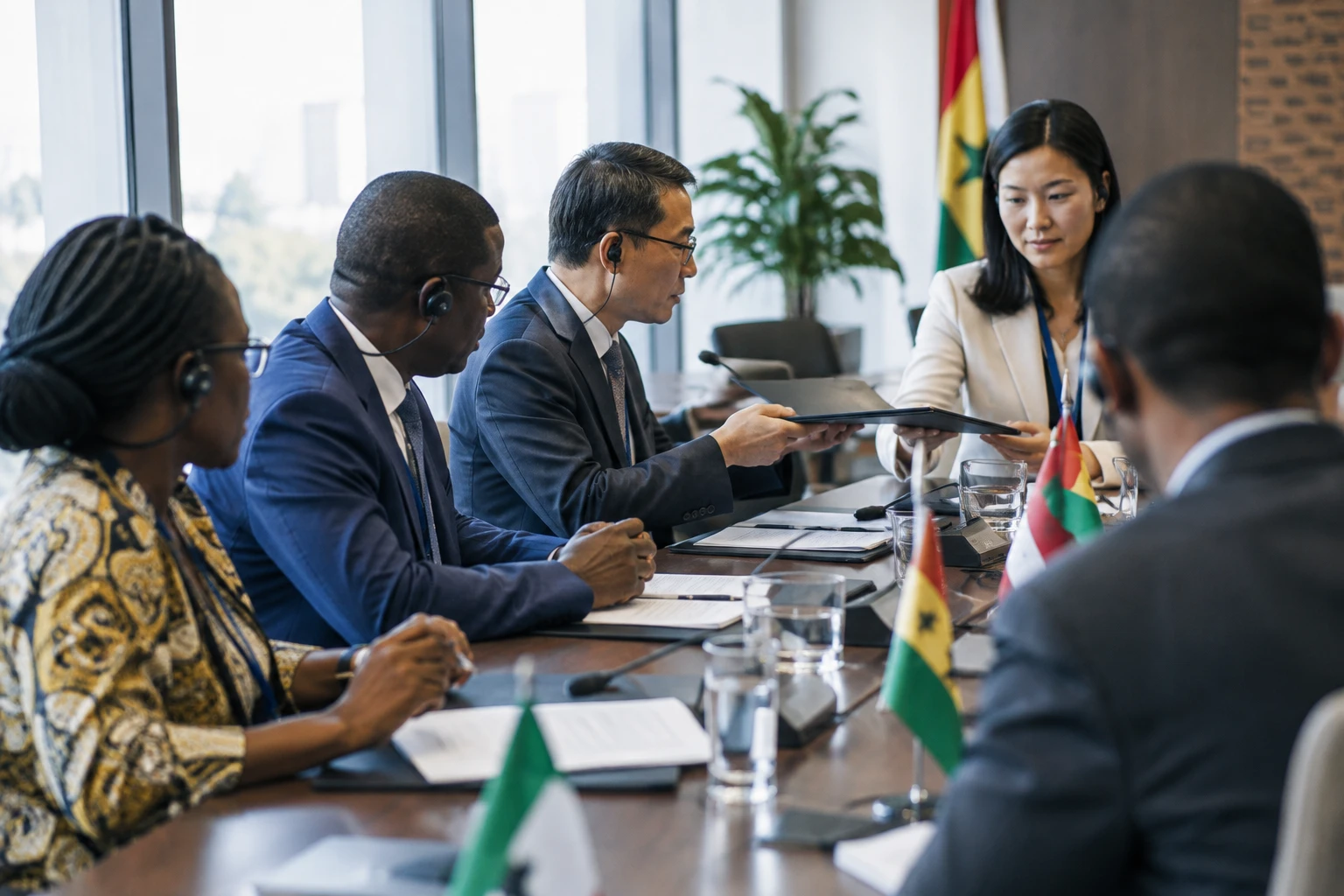
For Ghana, moving closer to the BRICS does not yet mean joining their circle of full members. Accra is first seeking partner status, a formula that opens up areas for cooperation without conferring the same rights as full membership.
The distinction matters for a country seeking new markets and investment while saying it intends to preserve its existing relationships. The move also forms part of a West African trend: Nigeria has been a partner of the group since January 2025.
A phased application backed by India
On 6 October 2026 in Accra, Foreign Minister Samuel Okudzeto Ablakwa announced that the government had approved a Ghanaian application to the BRICS. Four days later, during the television programme “Key Points”, he specified that Ghana would first seek partner-country status rather than immediate full membership.
The formal application has yet to be submitted. The minister said his government was preparing the dossier and would seek the group members’ support. Ghana has already requested backing from India, whose foreign minister, Subrahmanyam Jaishankar, was visiting Accra on 6 October. New Delhi holds the BRICS presidency in 2026. Jaishankar said he supported Ghana’s aspirations, while noting that the decision rested collectively with the members.
The mechanism does not therefore amount to automatic membership. Partner status was created at the 2024 Kazan summit. Partners can take part in some group activities, but do not have the same status as the eleven full members. The rotating presidency conveys the applicable principles and criteria to the interested state, after which its expression of interest is submitted to the members.
BRICS leaders met in New Delhi on 12 and 13 September 2026. Their declaration recognises the contribution of partner countries and announces that China will hold the presidency in 2027. It does not, however, set a public timetable for considering Ghana’s application. At this stage, no approval date can be taken for granted.
Economic opportunities, but no automatic gains
Accra presents the move as a way to broaden its economic options. According to Ablakwa, trade between Ghana and India rose from about $3 billion in 2024 to nearly $7 billion. These figures, cited by the minister, indicate the importance attached to India as a partner; on their own, they do not guarantee future growth in exports or investment.
The government wants to attract capital, support industrialisation and increase the value added from the country’s resources. For trade with BRICS economies to serve these goals, concrete projects will be needed: accessible financing, skills transfers, commercial opportunities and measurable benefits for Ghanaian businesses.
The potential impact would not be the same for everyone. Large companies and export-focused businesses could be the first to seize new markets or partnerships. Small businesses, rural producers and informal-sector workers would benefit only if these relationships led to local value chains, jobs and broader access to markets. The diplomatic announcement does not yet make it possible to measure these effects.
The minister stresses complementarity rather than a break with existing partners. Ghana intends to maintain its ties with the International Monetary Fund, the World Bank and its bilateral partners while diversifying its relationships. It is thus seeking greater room for manoeuvre as the country looks to finance its economic transformation.
West African significance, but not yet a regional movement
Nigeria’s precedent gives the application a regional dimension. Abuja secured partner status in January 2025. That same month, a Ghanaian lawmaker speaking in parliament had already raised the possible implications of Nigeria’s admission for cooperation in West Africa and within ECOWAS, the Economic Community of West African States.
This proximity does not mean the two countries will follow the same path. Nigeria has argued that the partnership should deliver tangible results and that its BRICS ties should also serve regional trade. If Ghana’s application succeeds, Accra and Abuja could bring West African interests into more international discussions. But regional coordination does not automatically follow from two national initiatives.
The BRICS themselves do not form a homogeneous bloc. They bring together eleven members, including China, India, Brazil and South Africa, whose priorities sometimes differ. The decision to approach India underlines that Ghanaian diplomacy is not simply about aligning with Beijing or another power. Accra emphasises its freedom to diversify its partnerships.
The authorities link this approach to the legacy of Kwame Nkrumah and the historic relationship between Ghana’s first president and Indian Prime Minister Jawaharlal Nehru, both associated with the Non-Aligned Movement. This reference sheds light on the government’s diplomatic narrative; the current initiative will, however, be judged by the terms of cooperation and its economic results.
For West Africa, the application therefore remains a signal, not proof of a collective shift. The next step will be the formal submission of Ghana’s dossier, followed by its consideration by the members. Until then, practical questions remain: which sectors could benefit from new partnerships, what conditions would accompany them, and what place would be given to regional priorities?