Algeria
 Egypt
 Libya
 Morocco
 Sudan
 Tunisia
 Benin
 Burkina Faso
 Cabo Verde
 Côte d'Ivoire
 Ghana
 Guinea
 Guinea-Bissau
 Liberia
 Mali
 Mauritania
 Niger
 Nigeria
 Senegal
 Sierra Leone
 The Gambia
 Togo
 Cameroon
 Central African Republic
 Chad
 DR Congo
 Equatorial Guinea
 Gabon
 Republic of the Congo
 São Tomé and Príncipe
 Burundi
 Comoros
 Djibouti
 Eritrea
 Ethiopia
 Kenya
 Malawi
 Mauritius
 Mozambique
 Rwanda
 Seychelles
 Somalia
 South Sudan
 Tanzania
 Uganda
 Angola
 Botswana
 Eswatini
 Lesotho
 Namibia
 South Africa
 Zambia
 Zimbabwe
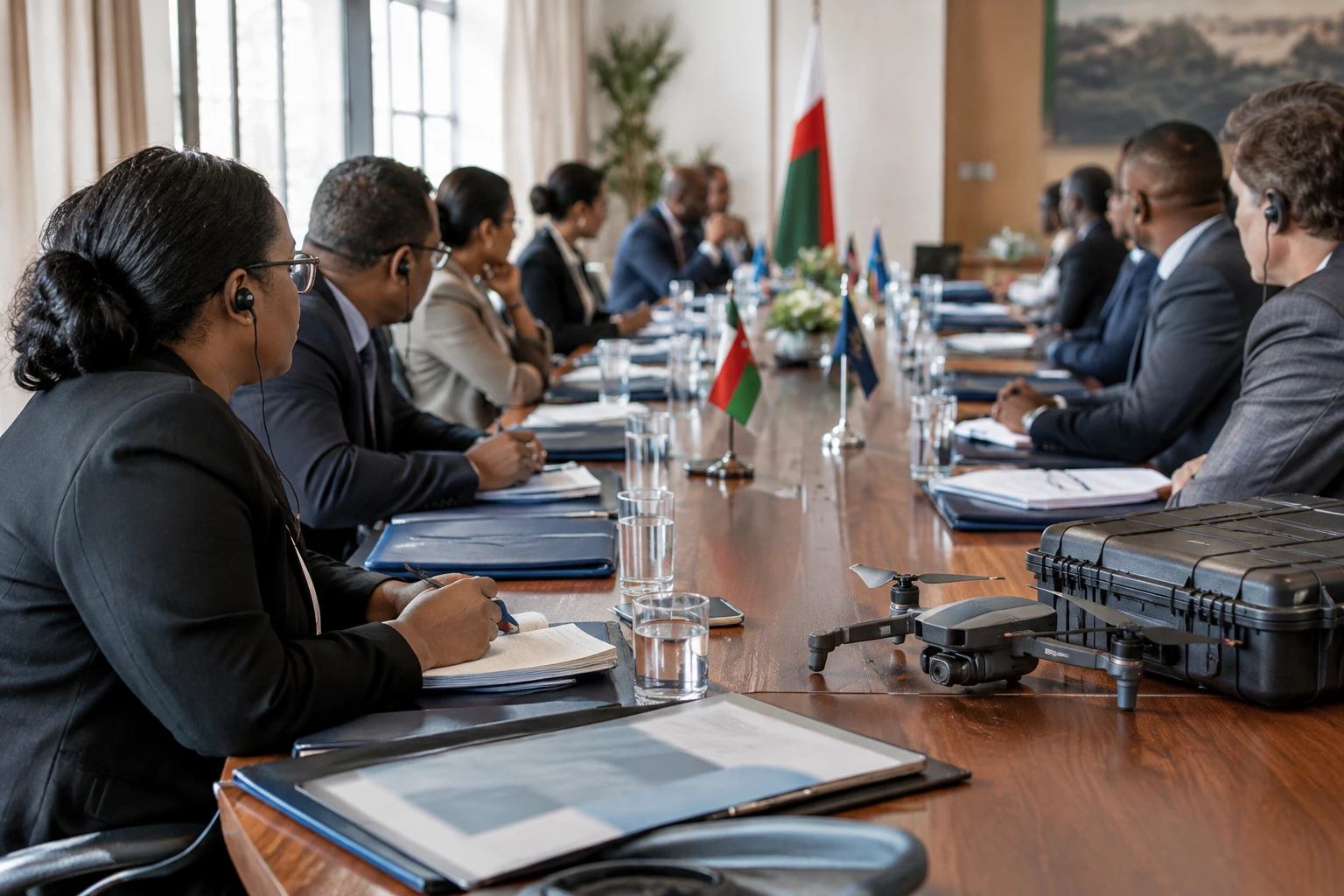
On an island where monitoring coastlines and remote areas requires significant resources, drones could meet practical needs. But their arrival also raises a political question: how can Madagascar strengthen its capabilities without reducing defence cooperation to competition between foreign powers?
The answer is taking shape amid diplomatic diversification. Antananarivo maintains relations with several partners, including France and Russia. For the Malagasy authorities, the stated aim is to expand cooperation while preserving national sovereignty. For residents, the value will depend above all on how the equipment is used and maintained, and on its contribution to the security of the country.
Drones to monitor the coastline and remote areas
On 5 and 6 October 2026, Catherine Vautrin, France’s minister for the armed forces and veterans, visited Madagascar. On 6 October, a drone cooperation agreement was signed in Ambohibao, near Antananarivo, according to information published by the Malagasy media outlet Moov. The visit was also reported by the Malagasy daily Newsmada.
The programme envisages 120 aircraft, according to Moov. Twenty are intended to help monitor territorial waters and the coastline in the south of the country. Around 100 others would be used for aerial reconnaissance, particularly in areas that are difficult to access. The announced timetable targets delivery in December 2026, with a possible delay until early January 2027. These figures and deadlines are reported by the local press; they describe a planned programme, not equipment that has already been handed over.
The agreement also provides for Malagasy military personnel to be trained to pilot and handle the aircraft. This component is as important as the equipment: it is intended to enable the national forces to use them autonomously. The document was signed by Madagascar’s chief of defence staff, General Démosthène Pikulas, and France’s defence representative in Madagascar, Colonel Emmanuel Deveaud, according to Moov.
The stated uses include maritime surveillance, tackling illegal activities at sea, and monitoring areas affected by cattle theft and insecurity. A drone can transmit images and help identify a situation; it cannot replace teams on the ground, intervention capabilities or the authorities responsible for enforcing the law. Its effectiveness will therefore depend on maintenance, communications and the forces’ ability to act on the information gathered.
Cooperation amid a political transition
This sequence is part of the “Refoundation”, the political process launched after Andry Rajoelina left office in October 2025 and Michaël Randrianirina came to power. The authorities have announced a 24-month transition timetable. In February 2026, at a meeting in Paris, the French and Malagasy presidents had included security and defence among areas of cooperation, while also referring to respect for the sovereignty of both states. The joint French-Malagasy statement also linked the partnership to the continuation of the political process and the organisation of free and transparent elections.
France has a long-standing relationship with Madagascar and a regional military presence in the south-west Indian Ocean, notably from Réunion. The two countries are also members of the Indian Ocean Commission, a regional organisation that promotes cooperation between island states. For Antananarivo, this proximity could facilitate training and coordination. However, it is part of a relationship shaped by a colonial past and continuing disagreements, notably over the Scattered Islands.
At the same time, Madagascar is developing its ties with Moscow. In June 2026, Madagascar’s foreign ministry described a partnership with Russia covering security, energy, health and education, among other areas, following visits by delegations to Moscow. This official account alone does not make it possible to assess the practical scope of the projects. It nevertheless confirms Antananarivo’s stated intention to diversify its partners rather than rely on a single one.
Sovereignty will be measured by how the drones are used
For the Malagasy forces, the main expected benefit is a better understanding of maritime and land areas that can be difficult to monitor. Coastal communities could be affected by efforts to tackle illegal activities at sea; in rural regions, surveillance of areas affected by cattle theft has also been cited. But, in the information consulted, the authorities have not yet made public the programme’s detailed cost, its rules of use or the safeguards planned for handling the data collected.
These questions are crucial. Who will control the images? How much will maintenance, spare parts and continuing training cost? Will the aircraft be used only for the missions announced? The answers will depend on the terms of the agreement and the resources actually transferred. Without these details, it is premature to conclude that the programme will durably strengthen the armed forces’ autonomy.
For France, the cooperation consolidates a partnership in a strategic area, crossed by shipping routes and close to its Indian Ocean territories. For Madagascar, accepting French assistance does not mean giving up relations with Russia or other states. The government presents its diplomacy as pragmatic and open to several partnerships. Its real room for manoeuvre will be judged by the country’s ability to negotiate the terms, train its personnel and maintain the equipment itself.
A test for partnerships in the Indian Ocean
Madagascar belongs to the Southern African Development Community, or SADC, and the Indian Ocean Commission. Monitoring waters and tackling illegal activities extend beyond its borders: they concern trade, marine resources and the security of coastal states. Useful cooperation could therefore complement regional exchanges, provided it does not replace collective mechanisms.
The next observable step will be the announced delivery of the drones, followed by their entry into service and the training of Malagasy military personnel. The transition timetable and national debates on oversight of the armed forces will also need to be followed. The issue is therefore neither simply a rivalry between Paris and Moscow nor merely an equipment donation: it tests Madagascar’s ability to turn several partnerships into capabilities that it controls, that are transparent and that serve its population.