Algeria
 Egypt
 Libya
 Morocco
 Sudan
 Tunisia
 Benin
 Burkina Faso
 Cabo Verde
 Côte d'Ivoire
 Ghana
 Guinea
 Guinea-Bissau
 Liberia
 Mali
 Mauritania
 Niger
 Nigeria
 Sierra Leone
 The Gambia
 Togo
 Cameroon
 Central African Republic
 Chad
 DR Congo
 Equatorial Guinea
 Gabon
 Republic of the Congo
 São Tomé and Príncipe
 Burundi
 Comoros
 Djibouti
 Eritrea
 Ethiopia
 Kenya
 Madagascar
 Malawi
 Mauritius
 Mozambique
 Rwanda
 Seychelles
 Somalia
 South Sudan
 Tanzania
 Uganda
 Angola
 Botswana
 Eswatini
 Lesotho
 Namibia
 South Africa
 Zambia
 Zimbabwe
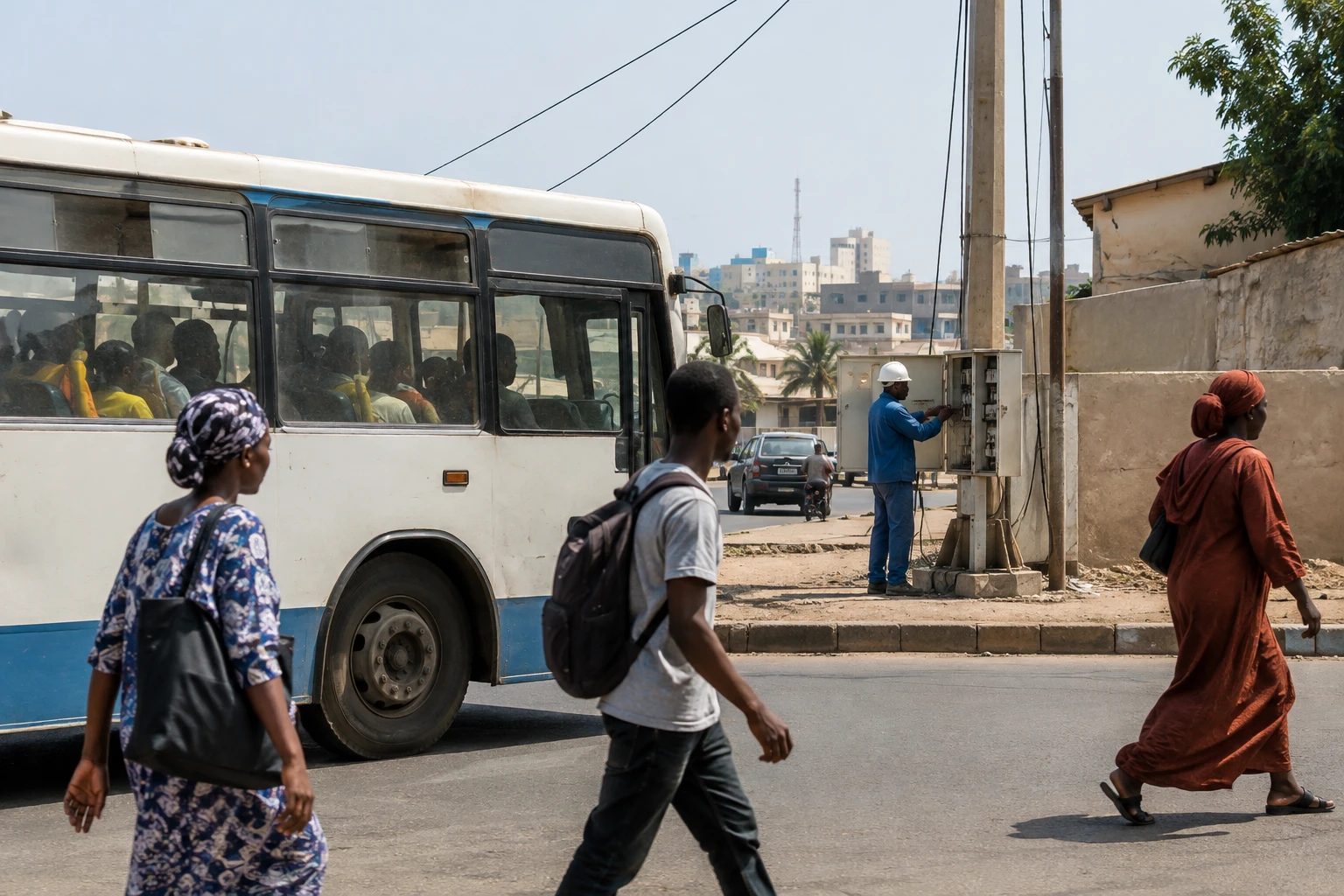
For families and small businesses, access to electricity is measured not only by the number of poles installed. It also depends on the regularity of supply, its cost and the ability to connect remote areas. In Senegal, the new financial commitments announced in Dakar add momentum to the goal of universal electrification by 2029. But they do not yet guarantee that the works will be funded and completed.
A revised target after the 2025 deadline
On 6 October 2026, the Senegalese state convened technical and financial partners, financial institutions and companies in Dakar. This second round table follows the first, held in 2021 around a target of universal access by 2025. That initial deadline was not met. The country has since moved the target to 2029 and drawn up a new completion strategy.
The national context has changed, but significant disparities remain. In 2024, the electricity access rate stood at 86.2% nationwide, according to official data. It was 98.21% in urban areas, compared with 69.84% in rural areas. In other words, the national average masks a substantial gap between cities and rural areas.
The current strategy identifies 6,471 localities without identified funding. It estimates that FCFA 395.8 billion in residual investment will be needed between 2025 and 2029. The needs are therefore not limited to electricity generation: power must also be delivered, and solutions chosen to suit the distances involved and the size of the villages.
Commitments exceed needs, but still need to be delivered
At the end of the 6 October meeting, announced commitments totalled FCFA 998 billion, or about $1.7 billion. Technical and financial partners announced FCFA 181 billion. Private companies, for their part, declared investment commitments of FCFA 817 billion. The Senegalese Press Agency and the Ministry of the Economy reported the same amounts.
The announced total is therefore well above the FCFA 395.8 billion in residual needs estimated by the strategy. However, comparing these figures is not enough to conclude that the programme is funded. An announced commitment is not necessarily an immediate disbursement or a project ready to start. The Ministry of the Economy itself emphasised the need to monitor commitments, execute mobilised funding and ensure financial sustainability.
The previous round table is a reason for caution. In 2021, FCFA 237 billion in partner funding was mobilised, while private-sector proposals exceeded FCFA 1,200 billion, according to the assessment presented by the authorities. These categories are not directly comparable with the new announcements: a proposal or investment promise is not the same as funding that has actually been secured. The new exercise will therefore have to be assessed on the basis of contracts, disbursements and completed works.
The plan combines several solutions to meet its target. Some localities can be connected to the national grid. Others, further away, are targeted for solar mini-grids or home solar systems. The choice must be made locality by locality, according to population and distance from the existing or planned grid.
Connecting localities does not settle the whole question
The next step is to turn the announcements into executable projects. The official timetable provides for funding to be consolidated in 2026, new projects to begin in 2027, works to continue in 2028 and completion in 2029. Programmes already under way must also progress: the strategy identifies 6,571 localities covered by projects due to be completed by 2027.
This deadline will test coordination between the Ministry of Energy and Petroleum, the Senegalese Rural Electrification Agency, Senelec, private operators and local authorities. Companies can bring capital and delivery capacity. But the state will have to clarify responsibilities, monitor progress and ensure that installations are maintained after they enter service.
The day-to-day impact will vary across regions. In rural areas, a connection can improve lighting in homes, health and education services, as well as some economic activities. In cities, the challenge also concerns service quality and the network’s capacity to meet demand. Across the system, connecting more users without strengthening networks and maintenance risks widening the gap between theoretical access and reliable service.
Senegal’s electricity system still relies heavily on petroleum products, which accounted for 72.47% of national generation in 2024. Solar and wind power are growing, but their combined share remained at 13.39% that year. Expanding solar mini-grids can help electrify isolated localities. It does not, however, replace the investment needed in transmission, distribution and the stability of the network as a whole.
A Senegalese challenge that extends beyond its borders
The issue also concerns West Africa. Senegal is a member of ECOWAS, the Economic Community of West African States, and its electricity grid has been interconnected with Guinea’s since 2024. These exchanges can expand supply options and improve grid stability. They do not absolve the country of the need to improve access in its own territories or guarantee continuity of service to users.
At the regional level, Senegal’s experience highlights a shared challenge: aligning announced funding, infrastructure built and people’s needs, particularly outside major urban centres. The next figures to watch will therefore be concrete: what share of the FCFA 998 billion will be contracted and then disbursed, how many localities will actually be connected, and will the installations remain operational after they enter service?
The announcements of 6 October give Senegal potential resources exceeding the quantified need for localities that still lack identified funding. The outcome will now depend on converting them into verifiable investment. In 2029, the assessment will not be summed up by a national rate: it will also show whether households and businesses, from cities to rural areas, have access to affordable and sufficiently reliable electricity.
For reference data, consult the Senegalese strategy for universal access to electricity, the results published by the Senegalese Press Agency and information from the Ministry of the Economy, Finance and Planning.