Algeria
 Egypt
 Libya
 Morocco
 Sudan
 Tunisia
 Benin
 Burkina Faso
 Cabo Verde
 Côte d'Ivoire
 Ghana
 Guinea
 Guinea-Bissau
 Liberia
 Mauritania
 Niger
 Nigeria
 Senegal
 Sierra Leone
 The Gambia
 Togo
 Cameroon
 Central African Republic
 Chad
 DR Congo
 Equatorial Guinea
 Gabon
 Republic of the Congo
 São Tomé and Príncipe
 Burundi
 Comoros
 Djibouti
 Eritrea
 Ethiopia
 Kenya
 Madagascar
 Malawi
 Mauritius
 Mozambique
 Rwanda
 Seychelles
 Somalia
 South Sudan
 Tanzania
 Uganda
 Angola
 Botswana
 Eswatini
 Lesotho
 Namibia
 South Africa
 Zambia
 Zimbabwe
When an outage disrupts an international connection, the effects can quickly extend beyond telecommunications: payments, administrative procedures, business exchanges and online services all depend on an available network. For landlocked Mali, having several transmission routes is therefore a practical issue of digital continuity.
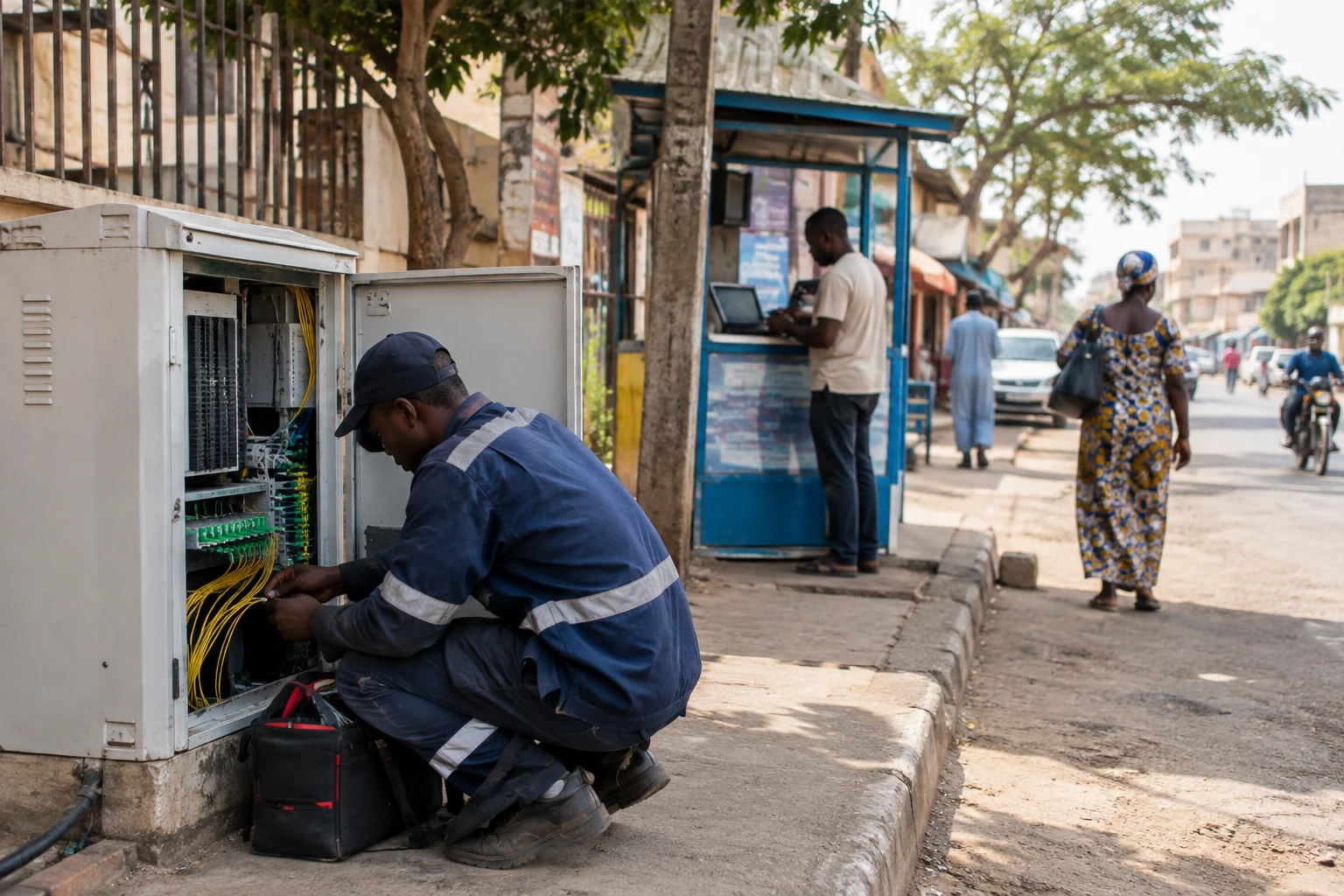
A new fibre-optic link between Mali and Senegal adds to these routes. It connects the two countries’ public backbone networks and gives Malian traffic an additional path to international infrastructure accessible from Senegal’s coast.
Cross-border link commissioned at Kidira-Diboli
The Malian Transmission and Broadcasting Company (SMTD-SA) and Sénégal Numérique (SENUM-SA) inaugurated their interconnection on Monday 5 October 2026, in the border area of Kidira-Diboli. The Senegalese Press Agency (APS) and the African Press Agency (APA) both reported that the link had entered service.
The connection directly links the optical fibre networks of the two public operators. It is part of the West African Network of National Backbones (ROA-BN), which brings together infrastructure managers from several countries to develop cross-border connections.
A backbone carries large volumes of data between local networks and exchange points or gateways to the global internet. In Mali, SMTD-SA’s national infrastructure comprises more than 3,500 kilometres of fibre, according to information published by APA. The new link gives this network an additional route via Senegal.
This route can carry traffic to submarine cables connected to Senegal and then to international connections, including via Cape Verde and Portugal. It does not mean that Mali now has direct access to a submarine cable: the country remains dependent on land links with its neighbours to reach this infrastructure.
Redundancy matters for service and cost
The main expected benefit is redundancy. If an incident affects another land corridor, operators will be able, subject to capacity and technical agreements, to reroute some traffic through the new link. This could reduce the risk of a single outage disrupting international communications for an extended period.
The connection does not, however, guarantee an immediate reduction in prices for users or a uniform improvement in service quality. These outcomes will depend on the capacity actually available, the wholesale terms offered to operators, traffic management and equipment maintenance. The link’s commissioning creates a technical possibility; in itself, it says nothing about the prices or speeds offered to households and businesses.
The benefits may vary between users. Internet service providers and mobile operators could have an additional backup route. Government agencies and businesses that depend on services hosted abroad could benefit from greater continuity if traffic is actually rerouted in the event of an outage. For residents of cities and rural areas alike, the impact will also depend on the quality and coverage of local networks, which an international link does not address.
The connection could also broaden transit options for Malian digital businesses. But an additional physical route alone is not enough to guarantee local content hosting, affordable access or data protection. These issues also depend on investment, competition between operators and the rules governing infrastructure management.
Bilateral project with regional ambitions
The link implements an agreement between SMTD-SA and Sénégal Numérique, signed at a regional workshop held in Senegal on 9 and 10 April 2026. APS had reported on the ROA-BN discussions at the time, which focused on strengthening cooperation and interconnecting fibre networks in West Africa. Sénégal Numérique also says that nine countries took part in the workshop, which focused on the 2026–2030 roadmap.
The regional dimension is important: a network connecting several countries can multiply the available routes and limit dependence on a single corridor. For Mali, cooperation with Senegal shows that cross-border digital infrastructure can move forward despite differing political and institutional paths in West Africa. It is first and foremost a partnership between public operators; its scope will depend on the continuity of their cooperation and on opening up capacity to other players.
The project comes as countries in the region seek to connect their national infrastructure more effectively and develop digital exchanges. The ROA-BN aims to make these networks more interoperable — able to work together under compatible technical rules. Progress towards this ambition will be measured by connections that are actually operational, the capacity offered and the range of available routes, not just by project announcements.
Next step: measuring benefits for users
For Mali, the new route between Kidira and Diboli is therefore an infrastructure advance, but not a complete solution to difficulties accessing the internet. It will be necessary to monitor the link’s capacity, its use by internet service providers and how operators respond to an interruption on another corridor.
Across West Africa, the challenge is to turn national networks, sometimes designed separately, into a more resilient whole. The next connections announced by the ROA-BN will show whether this cooperation delivers more choice for operators and more reliable services for the public. In Bamako and across the regions, the ultimate benefit will depend on how this international capacity feeds through to the networks people use every day.
Sources consulted for cross-checking: Senegalese Press Agency report on the inauguration, African Press Agency report on the Mali-Senegal link, Malian government statement on the interconnection and Sénégal Numérique’s overview of the regional workshop.