
 Algeria
 Egypt
 Libya
 Morocco
 Sudan
 Tunisia
 Benin
 Burkina Faso
 Cabo Verde
 Côte d'Ivoire
 Ghana
 Guinea
 Guinea-Bissau
 Liberia
 Mali
 Mauritania
 Niger
 Nigeria
 Senegal
 Sierra Leone
 The Gambia
 Togo
 Cameroon
 Central African Republic
 Chad
 Equatorial Guinea
 Gabon
 Republic of the Congo
 São Tomé and Príncipe
 Burundi
 Comoros
 Djibouti
 Eritrea
 Ethiopia
 Kenya
 Madagascar
 Malawi
 Mauritius
 Mozambique
 Rwanda
 Seychelles
 Somalia
 South Sudan
 Tanzania
 Uganda
 Angola
 Botswana
 Eswatini
 Lesotho
 Namibia
 South Africa
 Zambia
 Zimbabwe
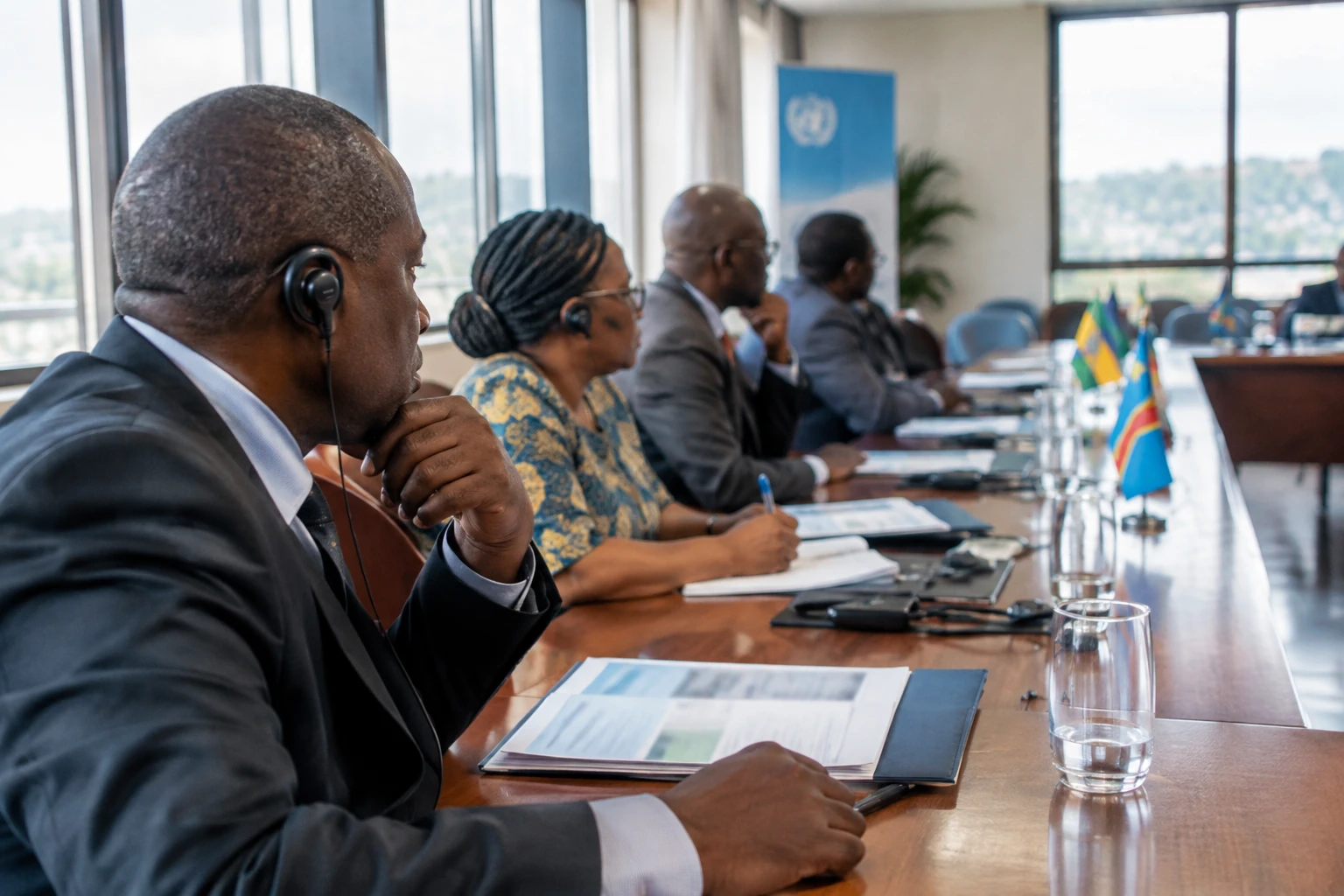
In eastern Democratic Republic of the Congo, mediation is measured not only by the meetings it organises. It is also judged by what happens on the same day in territories where civilians live according to the shifting front lines. This week, African Union consultations in Goma coincided with reports of fresh clashes in Masisi territory.
Mediation tested on the ground
On 5 October 2026, a delegation from the African Union (AU) Panel of Facilitators met officials from the Congo River Alliance/March 23 Movement (AFC/M23) in Goma. The panel was led by former Ethiopian president Sahle-Work Zewde. Former Kenyan president Uhuru Kenyatta and former Botswana president Mokgweetsi Masisi also took part in the consultations.
The delegation also held talks with MONUSCO, the United Nations mission in DR Congo, the UN Office for the Coordination of Humanitarian Affairs, the International Committee of the Red Cross and the regional verification mechanism. The AU presents these discussions as support for its mediation efforts in eastern Congo. In its statement of 7 October, it said participants discussed the political process, the security and humanitarian situation, and measures that could build confidence.
The panel urged the parties to honour their ceasefire commitments strictly, co-operate with verification mechanisms and avoid actions that could undermine the process. It also stressed the need to protect civilians, ensure humanitarian access and maintain essential services, including education. These calls set out objectives. They do not, however, amount to a peace agreement or prove that violence has decreased.
The day after the consultations, fighting was again reported in Masisi. Radio Okapi reported on 7 October that clashes between the AFC/M23 and opposing forces, including Wazalendo fighters, were continuing. The information available does not make it possible to independently establish a death toll or specify all the locations affected here. These details must therefore remain attributed, and no toll can be presented as confirmed.
Parallel processes, the same problem of trust
AU mediation is taking place in an already crowded diplomatic landscape. Talks in Doha, held with Qatar’s support, bring Kinshasa and the AFC/M23 together. They are in addition to regional initiatives and discussions between DR Congo and Rwanda. These tracks do not cover exactly the same issues or involve the same actors: talks with the armed movement do not replace those concerning relations between states.
A recent precedent illustrates how difficult it is to turn texts into action. In July 2025, Kinshasa and the AFC/M23 signed a declaration of principles in Doha as a step towards a broader agreement. The parties subsequently missed the 18 August deadline to conclude that agreement and accused each other of violations. In 2026, the announced creation of a ceasefire monitoring mechanism was intended to allow alleged violations to be examined. But the existence of a mechanism is not enough: it must be able to function, establish the facts and secure the parties’ co-operation.
Distrust is therefore both political and practical. Each side disputes the other’s conduct and may interpret incidents in line with its own interests. In this context, mediators can facilitate exchanges, but they do not control chains of command or decisions taken on the ground. The immediate test is whether allegations can be verified and a resumption of fighting prevented, rather than simply whether more meetings can be held.
What the fighting means for residents
For residents of Masisi, uncertainty first means making urgent choices: stay at home, seek refuge elsewhere or try to continue daily activities despite insecurity. Fighting can also obstruct travel and access to healthcare, markets and humanitarian aid. The consequences vary according to the village, available roads and proximity to clashes. Without verified data for this period, it would be imprudent to cite a number of displaced people or casualties.
The effects are not the same for everyone. Families living near combat zones are directly exposed to gunfire and forced displacement. In urban centres, residents may face disruptions to supply routes and the arrival of people seeking safety. Traders and rural producers, meanwhile, depend on roads that are sometimes cut off or too dangerous to use. Humanitarian organisations must also be able to reach people without being blocked by the fighting.
This reality is a reminder that protecting civilians cannot remain a formula in a statement. It depends on verifiable actions: allowing aid through, safeguarding essential infrastructure, enabling investigations into incidents and following through on announced commitments. The AU explicitly called for humanitarian access and the protection of schools and other essential services. Implementation remains in the hands of the actors concerned.
An issue that extends beyond North Kivu
DR Congo is a member of the Southern African Development Community (SADC) and the East African Community (EAC), two regional organisations involved in efforts to resolve the crisis. The AU is seeking to co-ordinate these efforts and support an African political framework. This co-ordination matters: when initiatives overlap without a shared timetable or mechanism, parties can favour the forum most advantageous to them and delay difficult compromises.
The crisis also has a regional dimension, not least because relations between Kinshasa and Kigali weigh on discussions and security in the Great Lakes region. DR Congo’s neighbours have an interest in reducing tensions, but their involvement must not override Congolese sovereignty or the voices of communities directly affected. In its statement, the AU panel reaffirmed DR Congo’s unity and territorial integrity, while calling for these principles to translate into tangible improvements for the population.
The next step will therefore be less about another statement and more about a series of checks: are the parties honouring their commitments? Can the mechanisms establish the facts when a violation is reported? Can aid reach the areas concerned? According to the organisation’s statement, the panel’s consultations will be relayed to the AU mediator and the Congolese government. In Masisi as in Goma, the credibility of diplomacy will depend on the answers to these questions.
The meetings in Goma have kept a channel of dialogue open between the mediators and the AFC/M23. But the fighting reported in Masisi is a reminder of the distance between mediation and a lasting lull in violence. For people in eastern Congo, the immediate stakes are tangible: being able to travel, receive aid and live without every political commitment being put to the test at once by fresh violence.



