Algeria
 Egypt
 Libya
 Morocco
 Sudan
 Tunisia
 Benin
 Burkina Faso
 Cabo Verde
 Côte d'Ivoire
 Guinea
 Guinea-Bissau
 Liberia
 Mali
 Mauritania
 Niger
 Nigeria
 Senegal
 Sierra Leone
 The Gambia
 Togo
 Cameroon
 Central African Republic
 Chad
 DR Congo
 Equatorial Guinea
 Gabon
 Republic of the Congo
 São Tomé and Príncipe
 Burundi
 Comoros
 Djibouti
 Eritrea
 Ethiopia
 Kenya
 Madagascar
 Malawi
 Mauritius
 Mozambique
 Rwanda
 Seychelles
 Somalia
 South Sudan
 Tanzania
 Uganda
 Angola
 Botswana
 Eswatini
 Lesotho
 Namibia
 South Africa
 Zambia
 Zimbabwe
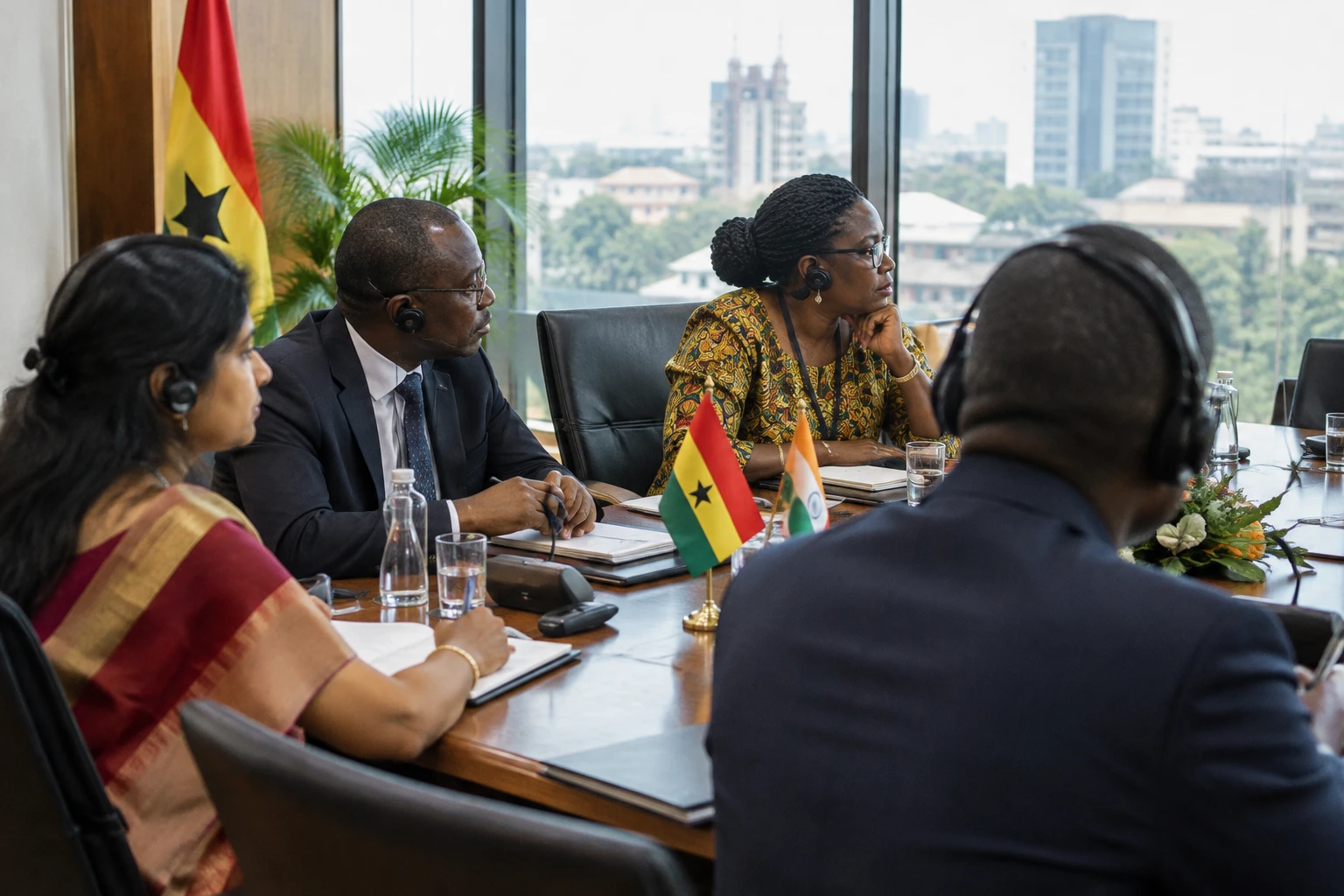
For Accra, joining the BRICS would not mean breaking with its current partners, but would be an attempt to widen its room for manoeuvre. The Ghanaian government wants to formalise its application to a group that has grown larger, while acknowledging that the decision does not rest with Ghana alone.
An application to prepare, not membership secured
On 6 October 2026 in Accra, Foreign Minister Samuel Okudzeto Ablakwa announced that the Cabinet had approved the principle of submitting a formal application for membership. He was speaking alongside his Indian counterpart, Subrahmanyam Jaishankar, who was visiting Ghana. The application has not yet been submitted, and no timetable has been given. The Ghana News Agency reports that the government is now preparing the move.
Accra has already sought New Delhi’s support. Jaishankar said he backed Ghana’s aspirations, but recalled that membership was subject to collective consideration by the members. Indian support is therefore a diplomatic signal, not a promise of entry. The group decides by consensus, and Ghana will have to convince all its members. An AFP dispatch published by Arab News confirms this caveat.
The acronym BRICS today refers to a cooperation forum of eleven states: Brazil, Russia, India, China, South Africa, Egypt, Ethiopia, Iran, the United Arab Emirates, Saudi Arabia and Indonesia. The group holds political and economic consultations, but does not operate as a customs union that automatically gives its members a common market or trade benefits. Brazil’s BRICS presidency outlines the group’s membership and evolution.
The recent expansion gives Ghana’s move a tangible African context. South Africa has been a member since 2011; Egypt and Ethiopia joined in 2024. Nigeria and Uganda, meanwhile, have been granted the separate status of partner countries. This category allows cooperation with the BRICS, but is not equivalent to full membership. The distinction matters: Ghana has not yet publicly specified which status it is seeking.
Accra seeks additional economic options
John Dramani Mahama’s government presents the initiative as a way to diversify external relations and attract partnerships that can support investment, employment and industrialisation. Ablakwa stressed that Ghana did not intend to abandon its existing relationships, particularly with the International Monetary Fund and the World Bank. The stated aim is to add interlocutors, not replace existing ones.
This clarification matters in a country seeking to consolidate its economy after a period of severe financial strain and debt restructuring. However, a policy of diversification guarantees neither new financing nor privileged access to markets. The BRICS is a forum for consultation among governments whose interests sometimes differ. For Accra, the benefits will depend above all on the specific agreements negotiated with each partner: productive investment, skills transfers, opportunities for businesses and local processing of raw materials.
The minister highlighted the desire to make better use of Ghana’s resources rather than simply exporting them in raw form. This issue affects the state, businesses and workers alike. Greater local processing could create jobs and retain more value in the country, but it requires infrastructure, financing, skills and sufficient demand. A diplomatic announcement does not resolve these constraints.
Engagement with India already illustrates the bilateral dimension of the initiative. Ablakwa named New Delhi, Beijing and Brasília among Ghana’s important economic partners. The Indian visit is also opening discussions in several sectors, but these forms of cooperation should be distinguished from the BRICS application: they can move forward independently of the group’s decision. For Ghanaian businesses, the challenge will be to turn announcements into contracts and local activity, beyond exchanges between capitals.
A regional and diplomatic calculation
Ghana remains rooted in West Africa and is a member of ECOWAS, the Economic Community of West African States. Any eventual BRICS membership would not replace this regional framework. Rather, it would add another diplomatic forum at a time when several African countries are seeking to strengthen their representation in discussions on global economic rules and international institutions.
This strategy also requires a careful balance. Accra wants to diversify its partnerships without giving the impression that it is choosing a side in rivalries between major powers. BRICS members do not always share the same priorities, and the group does not speak with one voice on every issue. For Ghana, expanding its relationships could widen its negotiating options, but would require it to defend its interests on a case-by-case basis.
The next step will be the formal submission of the application, followed by its consideration by the members. Until then, it will be important to see whether Accra clarifies the status it is seeking and which economic priorities it links to its application. The significance of the initiative will be measured less by the symbolism of an application than by the extent to which cooperation can support employment, industrialisation and greater value added in Ghana.