Egypt
 Libya
 Morocco
 Sudan
 Tunisia
 Benin
 Burkina Faso
 Cabo Verde
 Côte d'Ivoire
 Ghana
 Guinea
 Guinea-Bissau
 Liberia
 Mali
 Mauritania
 Niger
 Nigeria
 Senegal
 Sierra Leone
 The Gambia
 Togo
 Cameroon
 Central African Republic
 Chad
 DR Congo
 Equatorial Guinea
 Gabon
 Republic of the Congo
 São Tomé and Príncipe
 Burundi
 Comoros
 Djibouti
 Eritrea
 Ethiopia
 Kenya
 Madagascar
 Malawi
 Mauritius
 Mozambique
 Rwanda
 Seychelles
 Somalia
 South Sudan
 Tanzania
 Uganda
 Angola
 Botswana
 Eswatini
 Lesotho
 Namibia
 South Africa
 Zambia
 Zimbabwe
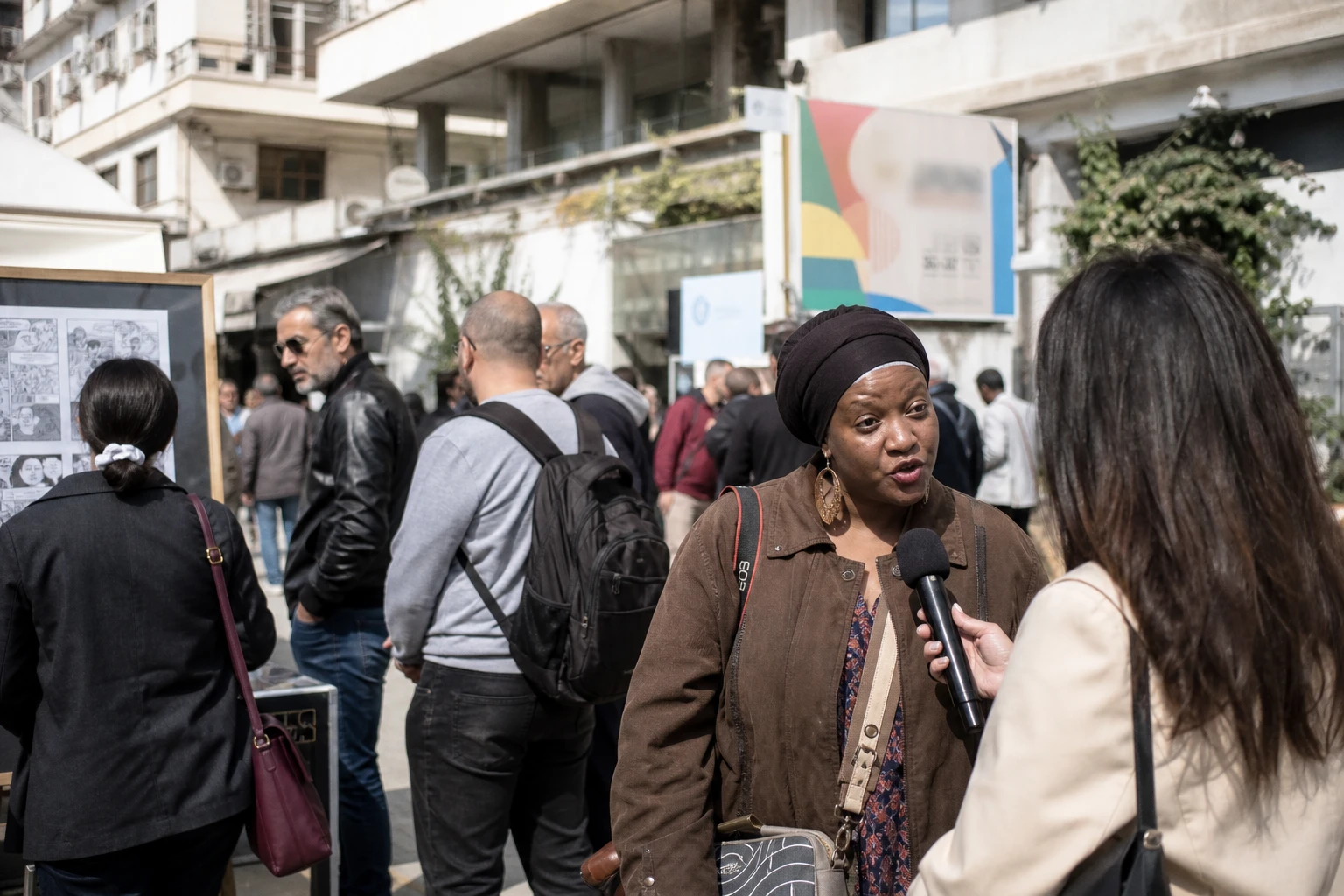
In Algiers, African comics were more than a simple exhibition feature. They took centre stage in the awards and debates about the future of the ninth art. Cameroonian Mezensi Nipanko and Tunisian Ahmed Touj came second and third in the international competition at the 18th Algiers International Comics Festival (FIBDA), while Congolese artist Jérémie Nsingi presented a different way to produce and distribute albums.
Algiers, a crossroads for African creativity
Held from 1 to 5 October 2026 at the Riadh El Feth esplanade, the 18th edition of FIBDA put the graphic novel at the heart of its programme. This long-form style of comics combines extended storytelling with broader literary and visual ambitions than a short narrative.
The Algerian festival brought together artists from 13 countries, including Algeria, Tunisia, Egypt, the Democratic Republic of the Congo, Palestine, Japan, the United States and several European countries. The programme included exhibitions, workshops, professional meetings and competitions for different age groups.
FIBDA is part of an Algerian cultural landscape seeking to bring local creativity into dialogue with African, Arab, European and Asian scenes. The presence of authors from Kinshasa, Yaoundé and Tunis gave this edition particular significance beyond the competition itself.
Algeria’s Ministry of Culture and Arts also highlighted the festival’s recognition on a UNESCO platform for monitoring cultural policies. This listing is not an artistic label, but it reflects an effort to document public policies relating to culture and creativity.
Two African authors on the international podium
In the international category, open to professional authors whose work has already been published, French artist Émilien Cousin won first prize. Cameroonian Mezensi Nipanko came second with Mirage. Tunisian Ahmed Touj took third place with Rose Blanche.
Two of the top three places therefore went to African creators. This result alone does not sum up the vitality of comics across the continent, but it gives tangible visibility to approaches that still struggle to circulate between national markets.
Cameroon illustrates the challenges of that circulation. Authors work in an environment where specialist publishers remain scarce, while festivals, social media and independent initiatives play an increasingly important role in promoting their work. The award in Algiers could help broaden that audience, without resolving the obstacles to production and distribution.
Tunisia, meanwhile, has a longstanding comics scene structured around several generations of illustrators, caricaturists and comic-book authors. The distinction awarded to Ahmed Touj highlights the place of Tunisian creativity in cultural exchanges between the Maghreb and the rest of the continent.
Publishing in the DRC despite the lack of a network
A discussion on comics in the Democratic Republic of the Congo shifted the debate. In Kinshasa, the problem is not limited to creating a story or drawing the panels. It also involves printing, sales, pricing and readers’ access to albums.
Jérémie Nsingi, an author, illustrator and animation film director, explained in Algiers how a generation of Congolese creators had been forced to work in a market weakened by the closure of bookshops and publishing houses. Authors kept their original artwork but lost the networks capable of publishing and selling it.
To overcome this problem, Nsingi has developed a self-publishing model since 2018. After discovering the capabilities of Chinese printing, he chose to produce high-quality albums at a cost he considered more affordable than some local options. His journey was documented in an interview published by Actualite.cd on Jérémie Nsingi’s self-publishing.
This strategy does not mean that Congolese publishing is disappearing. Rather, it shows that authors are combining several approaches: local printing, production abroad, occasional partnerships, direct sales and funding from sponsors or cultural events.
Work presented at literary events in Kinshasa confirms this trend. Self-published albums can be sold for less than imported books, making them more accessible to pupils, students and young professionals. The International City of Comics and Images recently described this local economy.
When authors go out to find their readers
In Kinshasa, Jérémie Nsingi and other authors also organise mini-festivals in schools. The events take place during breaks or at the end of the school day, with the agreement of school officials.
The approach responds to a simple reality: potential readers may know the characters or images, but not where to find the albums. In a city where specialist bookshops are rare and book prices weigh on families, meeting readers directly becomes a way to distribute the work.
This method turns the school into a temporary cultural venue. It allows authors to present their books, hear children’s reactions and explain their work. It also connects reading with everyday life, without relying entirely on a still-fragile commercial network.
A similar approach is documented by the Goethe-Institut, which notes that Nsingi launched school comic-book series as early as 2010 before setting up his own label in 2018. The artist is seeking to match production quality to local purchasing power while retaining a Congolese graphic identity.
A graphic identity between heritage and renewal
Congolese comics have a longer history than the current fragility of the market might suggest. Historical studies trace their first appearances in the country’s press to 1921, in an environment strongly influenced by Franco-Belgian traditions.
Jérémie Nsingi cites Barly Baruti and Bernard Mayo among his influences. However, he champions a personal approach, with more realistic characters and stories rooted in the urban and social realities of the DRC.
His next project imagines singer Gims as a superhero. The stated aim is not to produce a biography, but to use the artist’s fame to draw attention to situations in the Congo. An initial publication is planned in Kinshasa, followed by possible distribution in France and Belgium, though no final timetable has been set.
This use of well-known figures points to a search for bridges between popular culture, local storytelling and international distribution. It also raises a central question for African authors: how can they reach a broad audience without abandoning the places, languages, imaginations and experiences that shape their stories?
FIBDA as a barometer of the sector
Other festival competitions recognised Algerian creators in the best project and manga categories, as well as young participants under 16. The cosplay competition, chaired by American comic-book artist Alitha Martinez, and the manga workshops broadened the audience beyond traditional comics readers.
For African scenes, then, the stakes go beyond the awards. Festivals such as the one in Algiers serve as showcases, but also as meeting places for authors, publishers, institutions and readers. They can help foster collaborations, even as the circulation of albums remains constrained by production costs, copyright, sales networks and differences in purchasing power.
The next challenge will be to turn this occasional visibility into lasting exchanges between Algeria, Cameroon, Tunisia, the DRC and other African markets. The Algiers podium showed that the talent is there. Jérémie Nsingi’s journey, meanwhile, is a reminder that its future will also depend on the ability to build reading networks suited to local realities.