Algeria
 Egypt
 Libya
 Morocco
 Sudan
 Tunisia
 Benin
 Burkina Faso
 Cabo Verde
 Côte d'Ivoire
 Ghana
 Guinea
 Guinea-Bissau
 Liberia
 Mali
 Mauritania
 Niger
 Nigeria
 Senegal
 Sierra Leone
 The Gambia
 Togo
 Cameroon
 Central African Republic
 Chad
 DR Congo
 Equatorial Guinea
 Gabon
 Republic of the Congo
 São Tomé and Príncipe
 Burundi
 Djibouti
 Eritrea
 Ethiopia
 Kenya
 Madagascar
 Malawi
 Mauritius
 Mozambique
 Rwanda
 Seychelles
 Somalia
 South Sudan
 Tanzania
 Uganda
 Angola
 Botswana
 Eswatini
 Lesotho
 Namibia
 South Africa
 Zambia
 Zimbabwe
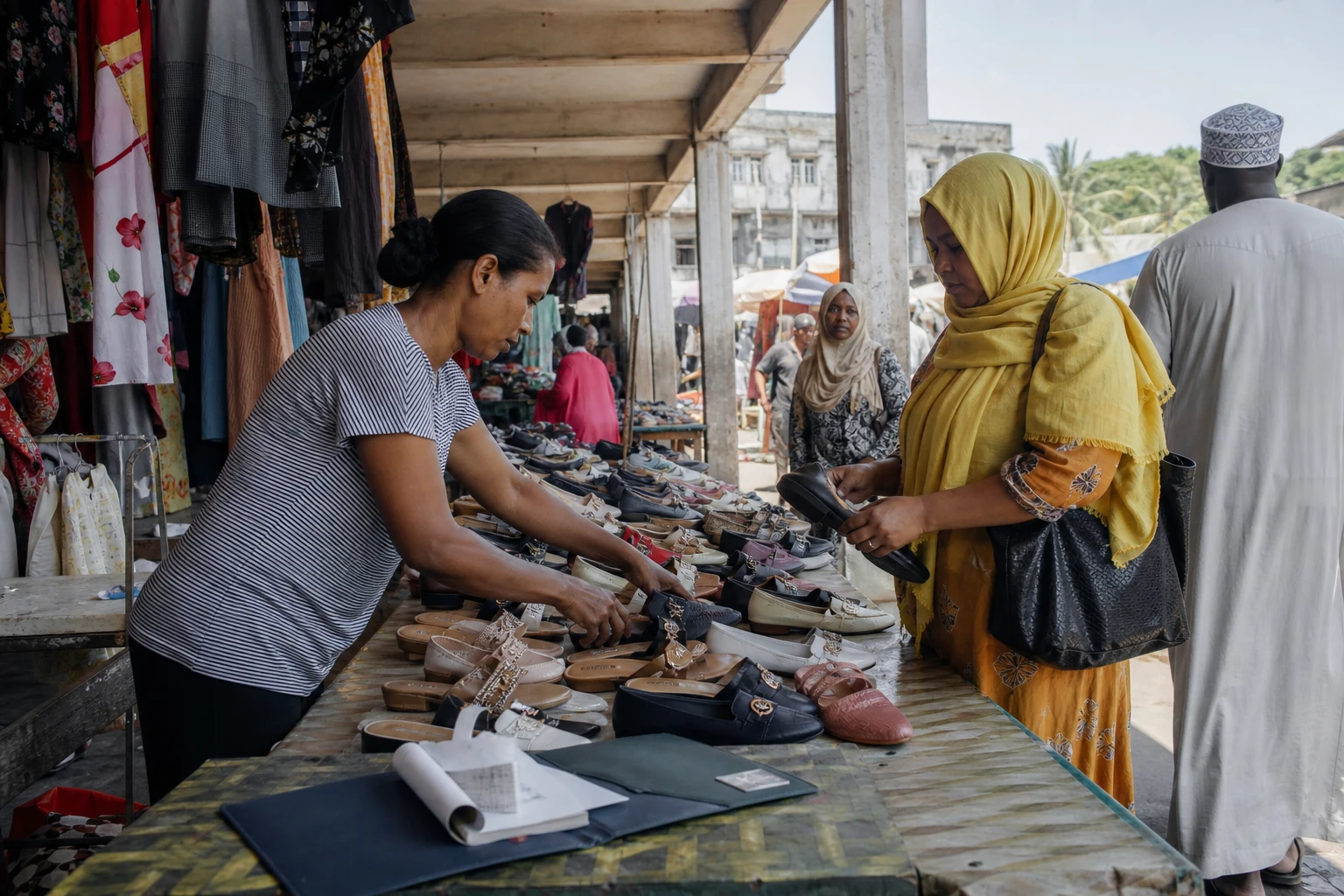
At Volo Volo, Moroni’s main market, uncertainty is spreading behind stalls selling shoes, clothes and everyday goods. A new Comorian law reserves certain small-trade activities for Comorians by birth. It could alter the economic balance in a sector where Malagasy nationals play a major role.
The law was published on 21 July 2026. It had not yet come into force when the accounts were gathered. Even so, its announcement is already worrying foreign traders who depend on this income to live in the Comoros and support their families back in Madagascar.
A reform framed as economic sovereignty
The disputed provision states that certain commercial or industrial activities in small trade may be reserved for Comorian nationals by origin. The law cites public order, food security and economic sovereignty as grounds.
This does not mean that all foreign businesses would be banned. Rather, it targets local activities that are generally accessible with limited capital and no particular qualifications. The precise list of occupations covered, along with the enforcement arrangements, will therefore be crucial in determining the reform’s real impact.
The new rule adds to an already demanding legal framework. Comorian law requires foreigners wishing to engage in commercial activity to obtain specific permits. The rules governing the residence and work of foreigners in the Comoros distinguish in particular between residence, salaried employment and setting up an economic activity.
However, the Investment Code adopted in 2020 affirms the freedom to invest for Comorians and foreigners alike, subject to sectors covered by specific regulations. The coexistence of a general principle of equality and sectoral restrictions has already prompted debate about the clarity of Comorian economic law.
Malagasy traders in Moroni fear a rupture
Malagasy nationals make up the largest foreign community living in the Comoros. Their presence is rooted in a long history of movement between the islands of the Indian Ocean. Family, commercial and maritime ties connect Madagascar, Anjouan, Mohéli and Grande Comore in particular.
According to figures cited in the accounts available, around 20,000 Malagasy people live in the Comoros. Not all work in small trade, but for some it is an essential source of income.
At Volo Volo, Larissa Razafitiana sells shoes. She says she earns enough to send between 50 and 100 euros each month to her family in Ambilobe, in northern Madagascar. For her, a ban on selling would mean more than the loss of a job. It would directly threaten an income shared between two countries.
“I’m really very afraid,” she says. The trader also claims that a visa application was refused on professional grounds, while other Malagasy nationals had reportedly been granted entry permits. Her account illustrates a broader difficulty: access to the labour market and small-scale trades depends on immigration status, administrative permits and the ability to invest.
The reform could also affect consumers. In urban markets, small traders provide a flexible and responsive distribution network. A sudden reduction in the number of stalls could limit supply in some neighbourhoods or push up prices. The impact will nevertheless depend on whether Comorian traders can take over the activities concerned.
Government defends priority for nationals
Supporters of the law present it as a measure of social justice. Their argument is simple: activities requiring little capital or few scarce skills should first benefit Comorian citizens, in a country where access to jobs remains difficult.
Hamidou Mhoma, vice-president of Nouvelle OPACO, believes foreigners should be encouraged to invest in sectors where the Comoros lacks capital or expertise. He rejects comparisons between the reform and the xenophobic violence seen elsewhere in the region. In his view, the aim is not to expel foreigners but to distinguish small trade from investment capable of creating new activity.
This position reflects an economic policy choice. The authorities are seeking to protect the local commercial space while remaining open to foreign employees and specialist investors. The key question will therefore be where to draw the line between small trade to be protected and foreign activity considered useful for development.
Dispute over nationality and equal treatment
The main criticism is not limited to foreign nationals. Some have also questioned the exclusion of people who have acquired Comorian nationality through naturalisation. By reserving the activities concerned solely for Comorians by birth, the law distinguishes between citizens according to the origin of their nationality.
This difference could create legal uncertainty for people who have lived in the country for a long time, in some cases for several years. It also raises a practical question: how will the authorities verify the origin of a trader’s nationality, and what safeguards will be available in the event of a dispute?
There is also an economic risk. If the law is enforced through swift inspections, without a transition period or retraining arrangements, the vendors affected could lose their stock, their pitch and their income. The impact would be greater for self-employed workers than for established businesses, which can move their operations into an authorised sector.
An issue extending beyond the archipelago
The Comoros lies at the crossroads of several regional spheres. The country takes part in the Indian Ocean Commission’s cooperation mechanisms, which bring together island states facing shared challenges: mobility, employment, maritime trade and the movement of people.
Moroni’s decision is part of a wider debate across the Indian Ocean and East Africa. Several governments are seeking to reserve certain activities for nationals while attracting foreign investment in sectors considered strategic. This policy can support local entrepreneurship. It can also leave migrant workers more vulnerable if the rules are enforced without dialogue or a transition period.
The next steps will therefore be decisive. The exact list of activities covered, the timetable for inspections and the treatment of traders already established will need to be made clear. The government will also have to specify the status of naturalised citizens and the conditions available to foreign investors.
In Moroni as in Antananarivo, the issue goes beyond the possible closure of a few stalls. It concerns economic rights, relations between two island societies and how the Comoros intends to manage its regional openness without giving up the protection of its citizens.