Algeria
 Egypt
 Libya
 Morocco
 Sudan
 Tunisia
 Benin
 Burkina Faso
 Cabo Verde
 Côte d'Ivoire
 Ghana
 Guinea
 Guinea-Bissau
 Liberia
 Mali
 Mauritania
 Niger
 Nigeria
 Senegal
 Sierra Leone
 The Gambia
 Togo
 Cameroon
 Central African Republic
 Chad
 DR Congo
 Equatorial Guinea
 Gabon
 Republic of the Congo
 São Tomé and Príncipe
 Burundi
 Djibouti
 Eritrea
 Ethiopia
 Kenya
 Madagascar
 Malawi
 Mauritius
 Mozambique
 Rwanda
 Seychelles
 Somalia
 South Sudan
 Tanzania
 Uganda
 Angola
 Botswana
 Eswatini
 Lesotho
 Namibia
 South Africa
 Zambia
 Zimbabwe
In Moroni, 12 November carries two distinct stories: the admission of Comoros to the UN and the archipelago’s political separation. Fifty years after that admission, Maore Day remains a moment of remembrance, but also a debate about ties between the people of the four islands and how to pursue a claim that Paris and Moroni do not share.
A founding date, a dispute still unresolved
The United Nations General Assembly admitted Comoros as a member state on 12 November 1975, under resolution 3385 (XXX). The UN had recalled the unity and territorial integrity of the archipelago, comprising Grande Comore, Anjouan, Mohéli and Mayotte. That wording has since informed the position of the Union of the Comoros, which claims sovereignty over Mayotte. The text of resolution 3385 (XXX) specifies the reference to the unity of the archipelago.
The dispute dates back to decolonisation. After Comorian independence was proclaimed on 6 July 1975, Mayotte remained under French administration. France cites the choice expressed by Mahorans in consultations held on the island and considers Mayotte part of the French Republic. It became a French département in 2011. Moroni disputes this interpretation and relies, in particular, on the view that the territory should be considered as a whole.
The positions are therefore not merely symbolic. They concern sovereignty, borders and the daily lives of families spread across the islands. The two governments have at times prioritised dialogue, without resolving the dispute. France defends Mayotte’s status while referring to continued exchanges with Moroni; the Union of the Comoros maintains its claim. The official French position on Mayotte sets out this differing interpretation.
In Moroni, remembrance also passes between generations
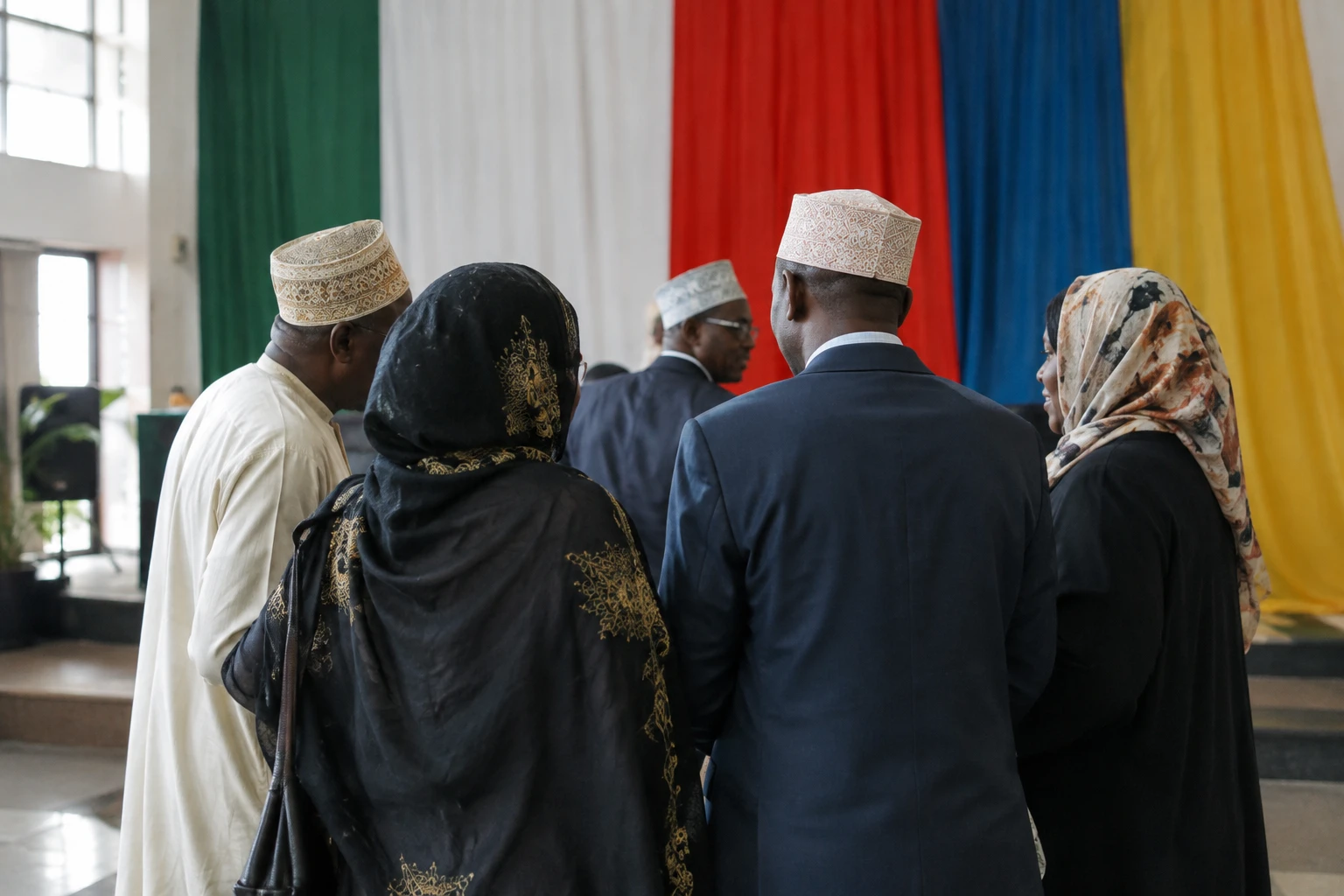
Students took part in commemorations at a ceremony held at the People’s Palace. Comorian officials and activists supporting the unity of the four islands brought Moroni’s claim back to the fore. Youssouf Moussa, described as a long-standing Mahoran independence activist, questioned the Comorian authorities about the diplomatic steps they had taken. His remarks, reported at the event, express an activist’s expectations; on their own, they do not amount to an assessment of government initiatives.
Mohamed Monjoin, president of the Maore Committee, stressed the decline in direct contact between young people from the islands. He noted that family relationships endure, but travel has become more difficult. His intervention shifts the debate beyond official statements: ties experienced in everyday life also matter to how younger generations understand the archipelago’s shared history.
This issue runs up against travel rules and the migration context. Since the Balladur visa was introduced in 1995 for Comorians wishing to travel to Mayotte, journeys between the islands have been tightly regulated. Irregular and dangerous sea crossings have led to fatal shipwrecks. The ceremony paid tribute to those who have died at sea, though no numerical toll was provided in the available information. Discussing these tragedies requires distinguishing established facts from estimates and not reducing Comorian mobility to a single security issue.
The consequences are uneven. For separated families, limited access can make visits and mutual support more difficult. For the authorities, the issue falls under both diplomacy and border management. In Mayotte, residents live under the French institutional framework and have their own debates about public services, identity and the island’s future. In Moroni, the territorial claim remains an important part of the national narrative. These realities coexist and cannot be reduced to a dispute between two governments.
Two strategies for the same claim
In a speech read on his behalf, President Azali Assoumani said he wanted to continue dialogue with Paris. The Maore Committee takes a harder line: it is calling for bilateral talks to stop and wants to take the issue further with external partners, notably the African Union, Russia and China, as well as before international courts. This divergence reflects an internal debate over how to advance the Comorian position, rather than a consensus on the strategy to pursue.
The continental framework gives the dispute added depth. The Organisation of African Unity, which became the African Union, adopted texts supporting the Comorian claim and calling for dialogue between Paris and Moroni. These positions underscore the importance of borders inherited from the colonial period in African debates. They do not, however, mean that a political or legal solution has been reached. An African Union decision on the question of Mayotte calls, in particular, for dialogue between the two states.
For Comoros, an island state in East Africa, the regional stakes are also practical: maintaining exchanges in a space where family ties, mobility and security concerns intersect. Maore Day can strengthen the memory of a shared history, but it cannot replace either negotiations or practical measures to facilitate relations between the islands. Resolving the dispute will depend on political choices that extend beyond annual ceremonies.
12 November thus remains a date with two meanings: the anniversary of Comoros’ admission to the UN and a moment for Moroni to reaffirm its claim. The question to watch is whether the governments can sustain useful dialogue while addressing the human consequences of travel restrictions. Between diplomacy, law and family ties, the future of the issue will also depend on the place given to people on both shores of the archipelago.