
 Algeria
 Egypt
 Libya
 Morocco
 Sudan
 Tunisia
 Benin
 Burkina Faso
 Cabo Verde
 Côte d'Ivoire
 Ghana
 Guinea
 Guinea-Bissau
 Liberia
 Mali
 Mauritania
 Niger
 Nigeria
 Senegal
 Sierra Leone
 The Gambia
 Togo
 Cameroon
 Central African Republic
 Chad
 Equatorial Guinea
 Gabon
 Republic of the Congo
 São Tomé and Príncipe
 Burundi
 Comoros
 Djibouti
 Eritrea
 Ethiopia
 Kenya
 Madagascar
 Malawi
 Mauritius
 Mozambique
 Rwanda
 Seychelles
 Somalia
 South Sudan
 Tanzania
 Uganda
 Angola
 Botswana
 Eswatini
 Lesotho
 Namibia
 South Africa
 Zambia
 Zimbabwe
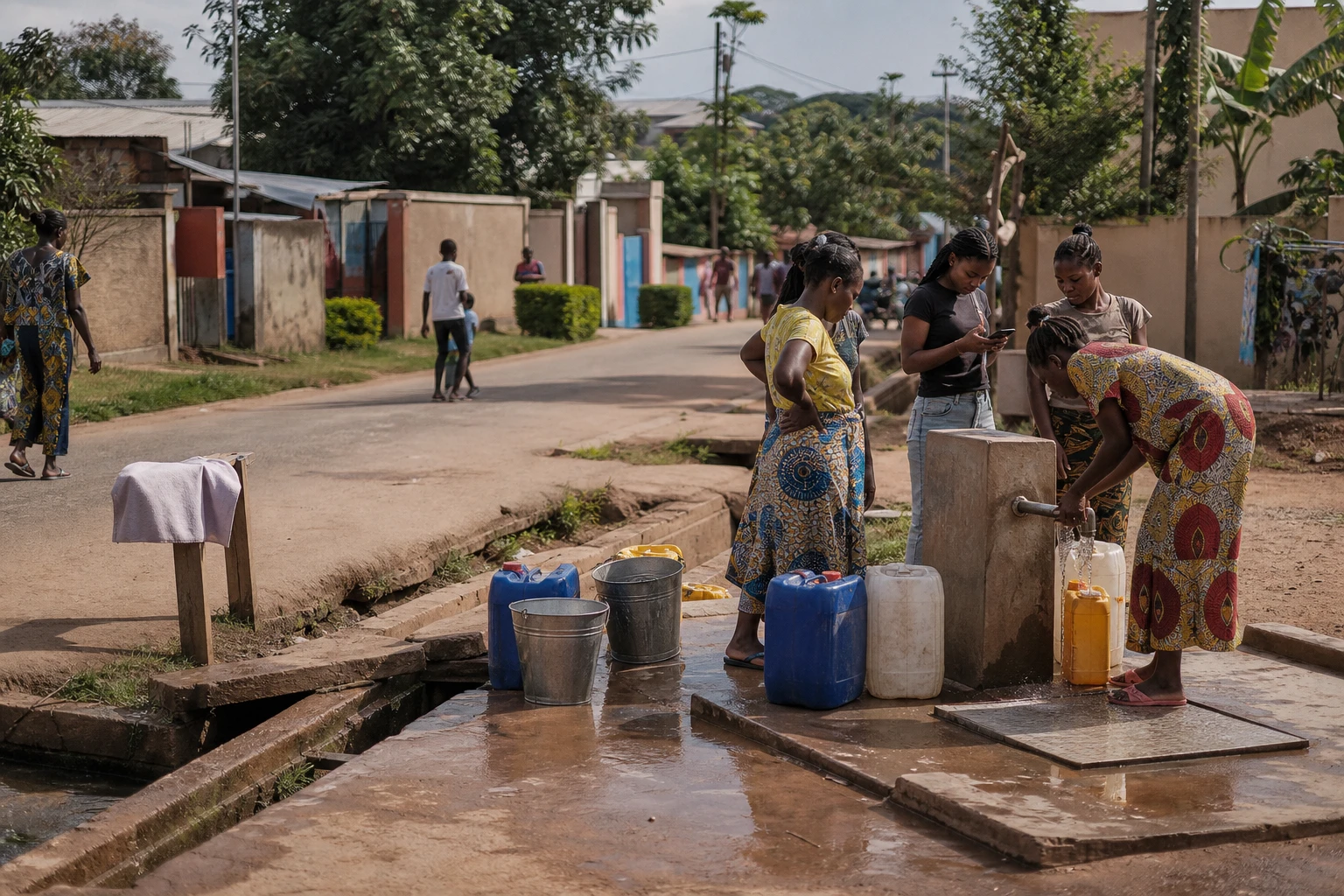
In Lubumbashi, access to drinking water still depends too often on another essential network: electricity. When the pumps stop, the taps fall silent too. In several neighbourhoods of the capital of Haut-Katanga, this vulnerability turns a technical outage into a daily burden for households.
A mining city facing shortages that disrupt household life
In Tshamalale neighbourhood, in the south of the Democratic Republic of the Congo, residents report repeated interruptions to the water supply. According to their accounts, water sometimes returns for only a few hours before disappearing again for several days.
This irregularity affects essential activities. Families have to organise bathing, cooking, laundry and cleaning around rare periods of supply. Some residents travel to boreholes or distant water points. Others store available water in buckets and jerrycans, with a risk of contamination if the containers are not properly cleaned.
In several households, the shortage also affects domestic activities and small gardens. Watering becomes difficult. Households that rely on a few crops around their homes see their plants dry out. The crisis is therefore not limited to the tap: it weighs on available time, daily expenses and family life.
Women and girls often bear a large share of the burden of fetching water. This extra work reduces the time available for studies, trade or paid activities. In outlying neighbourhoods, the distance to be covered adds to the pressure, especially when supply points are not secure or operate irregularly.
Kimilolo, a vulnerable point in the supply system
REGIDESO, the public company responsible for water distribution in the Democratic Republic of the Congo, links these disruptions to difficulties at the Kimilolo station. The facility is one of the main water-intake sites supplying Lubumbashi.
The provincial directorate cites power cuts that have affected pumping equipment. It also mentions the theft of electrical cables. Without a stable power supply, the machines cannot operate at a normal pace, even when water resources remain available.
This explanation points to a longstanding problem. In May 2023, REGIDESO’s provincial directorate had already said that load-shedding left some facilities without power for six to eight hours a day. It then reported difficulties at Kimilolo, Kasapa and the University of Lubumbashi site. Explanations published by Radio Okapi also linked the company’s difficulties to unpaid bills owed by several public institutions and state-owned companies.
The mechanism is straightforward. A water-intake station needs to run its pumps, treatment equipment and pumping systems. A prolonged outage reduces production. It also prevents reservoirs from being filled sufficiently. When electricity returns, pressure does not necessarily recover immediately across the whole city.
Interdependence between water, electricity and public finances
In Lubumbashi, water distribution is caught between several vulnerabilities. REGIDESO depends on the National Electricity Company, SNEL, to power its stations. SNEL, in turn, has to contend with ageing networks, high demand and competition between domestic, industrial and mining users.
This situation is particularly evident in Haut-Katanga. The province is home to significant mining activity, particularly copper and cobalt. Companies need a reliable power supply for their operations. Yet households, hospitals, schools and public services depend on the same infrastructure or on networks that remain insufficiently reinforced.
The problem is therefore not merely a local outage. It also concerns the ability of public companies to maintain their equipment, collect debts and invest in new facilities. In 2023, REGIDESO in Haut-Katanga estimated that public bodies and companies owed it several billion Congolese francs and several million dollars. These unpaid bills leave it with less room to repair pumps, replace cables and secure sites.
Funding alone, however, will not solve everything. Kimilolo’s facilities are also exposed to urban and environmental pressures. World Bank documents have for several years highlighted the vulnerability of this resource, as well as local concerns about protecting the groundwater table. The rehabilitation plan for Lubumbashi’s water supply stresses the importance of protecting water-intake areas and better regulating activities around them.
Technical solutions, but governance also needs strengthening
Civil society groups propose reducing the dependence of water stations on the main electricity grid. Installing stand-alone solar systems is one of the options under discussion. This could keep some pumps running during load-shedding, provided that batteries, regular maintenance and effective protection against theft are in place.
This option would not replace the investment needed in SNEL’s and REGIDESO’s networks. It would, however, provide backup power for the most critical equipment. The priority would be to guarantee a minimum service in densely populated neighbourhoods, health centres and schools.
Securing sites is another part of the effort. Cable theft and pressure on land around stations increase costs and slow down repairs. Protecting facilities must therefore involve provincial authorities, public companies and nearby communities. It must also be accompanied by clear information about works, supply hours and alternative water points.
An issue that extends beyond Lubumbashi
Lubumbashi’s situation illustrates a broader challenge for cities in the Democratic Republic of the Congo: urbanisation is advancing faster than water and electricity networks. Outlying neighbourhoods are the first to suffer drops in pressure, as they are often at the end of the network and have fewer alternatives.
At the regional level, the issue also concerns the Southern African Development Community, SADC, of which the Democratic Republic of the Congo is a member. Electricity exchanges and regional projects can improve energy availability, but they do not relieve cities of the need to maintain their own distribution networks.
For Lubumbashi, the next indicators will be tangible: the reliability of power at Kimilolo, equipment repairs, protection of the groundwater table and the opening of new supply points. Unless all these areas improve together, every power outage will continue to mean another wait at boreholes and unreliable taps in a major industrial city.



