
 Algeria
 Egypt
 Libya
 Morocco
 Sudan
 Tunisia
 Benin
 Burkina Faso
 Cabo Verde
 Côte d'Ivoire
 Ghana
 Guinea
 Guinea-Bissau
 Liberia
 Mali
 Mauritania
 Niger
 Nigeria
 Senegal
 Sierra Leone
 The Gambia
 Togo
 Cameroon
 Central African Republic
 Chad
 Equatorial Guinea
 Gabon
 Republic of the Congo
 São Tomé and Príncipe
 Burundi
 Comoros
 Djibouti
 Eritrea
 Ethiopia
 Kenya
 Madagascar
 Malawi
 Mauritius
 Mozambique
 Rwanda
 Seychelles
 Somalia
 South Sudan
 Tanzania
 Uganda
 Angola
 Botswana
 Eswatini
 Lesotho
 Namibia
 South Africa
 Zambia
 Zimbabwe
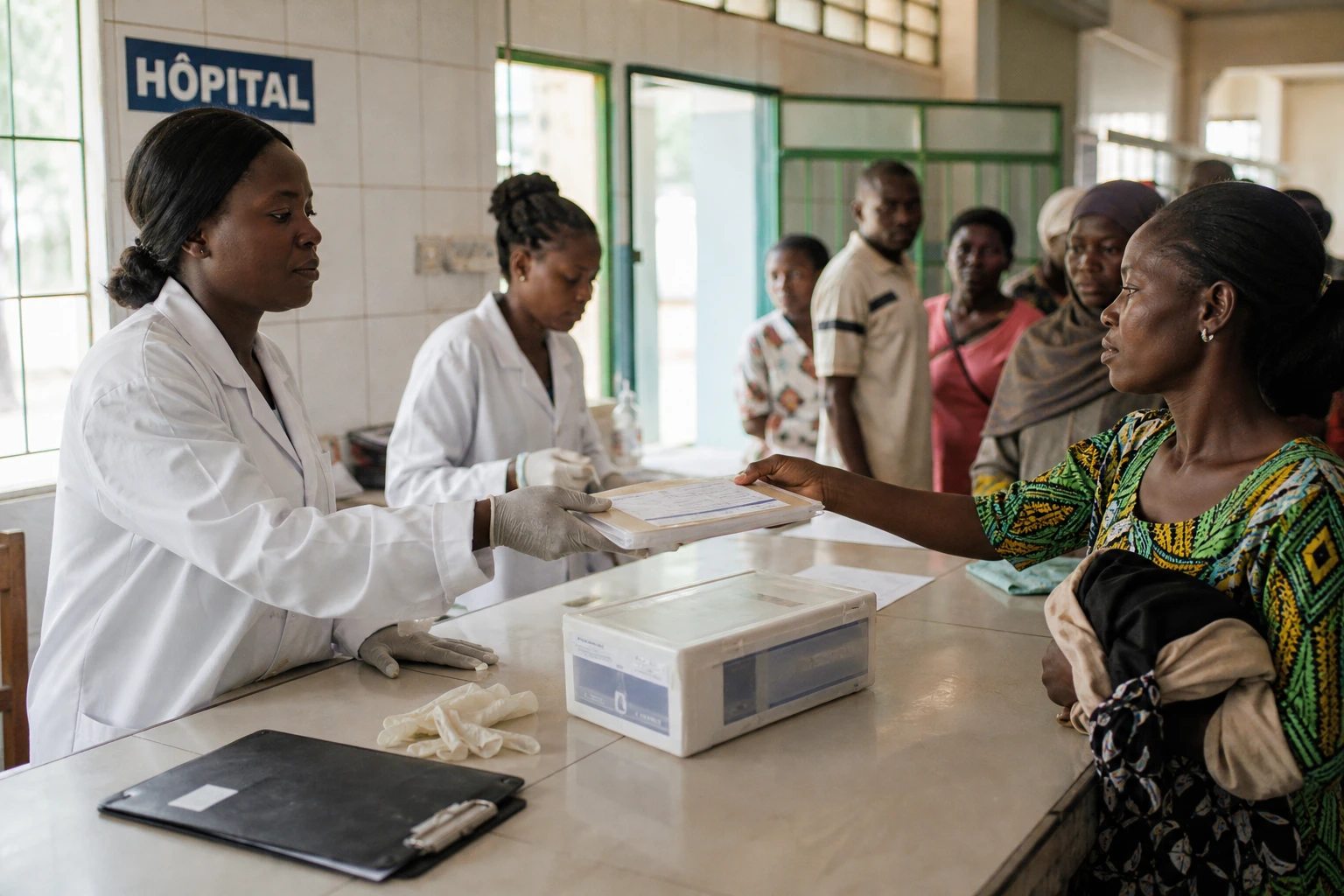
In Butembo, in the east of the Democratic Republic of the Congo, a few hours can determine how a patient is managed and whether a chain of transmission is broken. In response to the Ebola outbreak affecting North Kivu and Ituri, testing was therefore brought closer to health centres, rather than relying solely on distant laboratories.
A laboratory closer to patients
The system set up in Butembo is based on a mobile unit capable of processing samples directly in the affected area. Technicians from the National Institute of Biomedical Research (INRB), the Congolese public body responsible, among other things, for biomedical research and diagnosis, prepare and analyse samples there.
This approach reduces a central challenge in epidemics in vast or hard-to-reach areas: transporting samples. Every journey between a treatment centre, a health zone and a fixed laboratory can add hours, or even longer when roads are in poor condition or security concerns require detours.
The mobile laboratory was deployed next to the Ebola treatment centre at Butembo’s Institute of Agricultural and Veterinary Technology. Its location also reflected the city’s particular circumstances: it is a major commercial hub in North Kivu, frequented by people from other regions of the Democratic Republic of the Congo and neighbouring countries.
According to information provided by health teams, results could take up to 72 hours before these units were introduced. The time was generally brought down to less than 24 hours afterwards, with some results available in about six hours.
A response that can follow outbreaks
The value of the system lies not only in its speed. Housed in a vehicle, it can be moved to another health zone if the virus spreads elsewhere. This is particularly useful in an outbreak marked by successive clusters and frequent population movements.
INRB officials explained that the unit could be taken to Katwa or another area in an emergency. The laboratory thus becomes an adaptable tool, able to follow the geography of the outbreak rather than waiting for samples to reach a distant site.
The World Health Organization reported as early as 2018 that a mobile laboratory was operational in Butembo to conduct tests on site. It also described a network of units deployed in several affected areas of eastern Congo, with trained personnel from the Democratic Republic of the Congo and support from African and international partners.
The principle is simple: quickly confirm a suspected case, isolate the patients concerned and avoid keeping people whose test is negative in an Ebola centre unnecessarily. This distinction protects both patients and conventional health facilities, which can resume treating other conditions.
Diagnosis, the first step in care
A rapid result does not cure a patient. It does, however, make it possible to begin the right medical response sooner. People who test positive can receive care suited to Ebola virus disease and be monitored under the relevant protocols.
Conversely, a negative test can prevent prolonged isolation and allow a patient to be referred to an ordinary health facility. This distinction matters in a region where treatment centres sometimes receive patients with symptoms similar to those of other infections.
Rapid diagnosis also helps teams tasked with tracing contacts. Once a case is confirmed, health workers can more quickly identify people who have been exposed, arrange to monitor them during the observation period and intervene before a new chain of transmission begins.
Available data on the Ebola response in eastern Democratic Republic of the Congo nevertheless show that the laboratory is only one part of the system. Surveillance, vaccination, infection prevention, safe burials and community acceptance are also crucial.
Health cooperation across the border
The deployment of capacity in Butembo was part of close cooperation between the Democratic Republic of the Congo and Uganda. The two countries share a busy border crossed by traders, families and workers. The movement of people made coordinated surveillance on both sides necessary.
Uganda stepped up its preparedness against the risk of cases being imported from North Kivu. In June 2019, Ugandan authorities and the World Health Organization confirmed the first case linked to the ongoing outbreak in the Democratic Republic of the Congo. The episode was a reminder that a response limited to one territory was not enough in such a mobile border area.
Cooperation covered laboratories, as well as training, the secure transport of samples and surveillance at crossing points. It illustrates a health reality that is often less visible: administrative borders do not always correspond to patients’ routes or regional trading networks.
Technology cannot replace trust
Mobile laboratories strengthen the response, but their effectiveness depends on being able to reach neighbourhoods and villages. In North Kivu, insecurity, attacks on health facilities and mistrust of some teams have at times slowed operations.
Health authorities therefore had to combine technical expertise with local dialogue. Without residents’ acceptance, it is difficult to collect samples, contacts are harder to identify and patients may delay going to a treatment centre.
This lesson goes beyond the Ebola outbreak. For the Democratic Republic of the Congo, the experience in Butembo helped consolidate a diagnostic network that can be deployed in an emergency. For Central Africa and the Great Lakes region, it highlights the importance of local capacity that can operate quickly, including in areas far from capital cities.
The impact of this innovation is measured as much in hours saved as in trust built. In Butembo, the mobile laboratory brought science closer to the places where the disease was emerging. It also strengthened Congo’s capacity to lead a health response in a cross-border, urban and unstable environment.



