Algeria
 Egypt
 Morocco
 Sudan
 Tunisia
 Benin
 Burkina Faso
 Cabo Verde
 Côte d'Ivoire
 Ghana
 Guinea
 Guinea-Bissau
 Liberia
 Mali
 Mauritania
 Niger
 Nigeria
 Senegal
 Sierra Leone
 The Gambia
 Togo
 Cameroon
 Central African Republic
 Chad
 DR Congo
 Equatorial Guinea
 Gabon
 Republic of the Congo
 São Tomé and Príncipe
 Burundi
 Comoros
 Djibouti
 Eritrea
 Ethiopia
 Kenya
 Madagascar
 Malawi
 Mauritius
 Mozambique
 Rwanda
 Seychelles
 Somalia
 South Sudan
 Tanzania
 Uganda
 Angola
 Botswana
 Eswatini
 Lesotho
 Namibia
 South Africa
 Zambia
 Zimbabwe
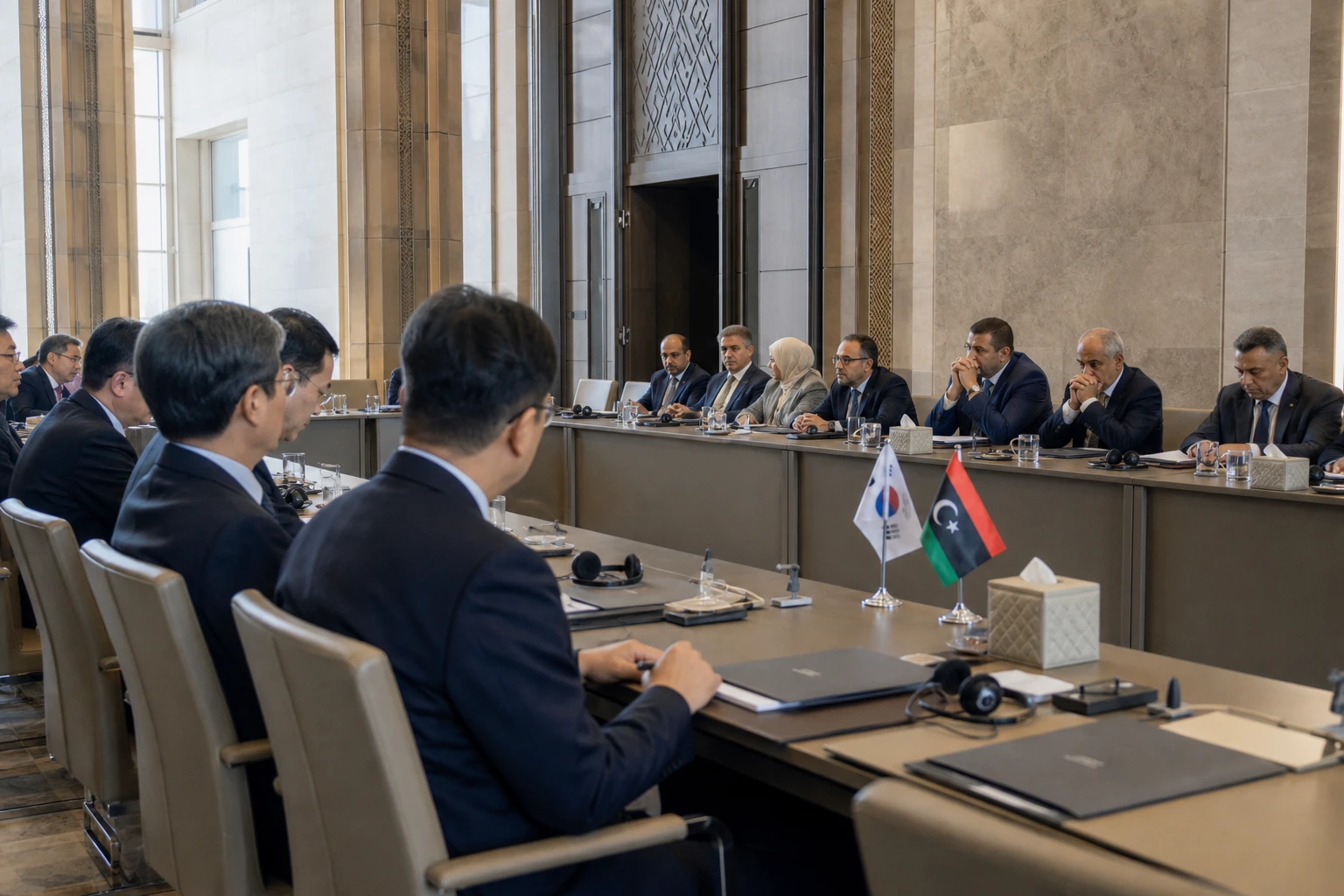
In Tripoli, cooperation between Libya and South Korea is taking an energy-focused turn. For both countries, the stakes go beyond simply selling crude oil. The aim is to secure supplies, revive infrastructure and create more value in a sector central to the Libyan economy.
Economic forum focused on a fresh start
The Libya–South Korea Economic Cooperation Forum was held on 27 and 28 September 2026 in Tripoli. It brought together public officials, businesses and representatives from the energy, construction and infrastructure sectors.
The event was organised with the participation of Libyan authorities and South Korea’s Ministry of Foreign Affairs. According to the South Korean government statement, nearly 150 participants took part in the discussions. Samsung, LG, Hyundai, Daewoo and other South Korean groups were among those present.
Libyan Minister of Economy and Trade Souhail Bouchiha advocated cooperation based on investment, production and technology transfer. Tripoli is therefore seeking to attract industrial partners, rather than merely expand its list of suppliers.
The forum is also a diplomatic signal. According to Seoul, it is the first economic event organised in Libya by the South Korean government since the outbreak of armed conflict in 2014. The announced reopening of South Korea’s diplomatic mission in Tripoli accompanies this gradual return.
Libyan refining at the heart of talks
Discussions focused on possible cooperation in refining crude oil in Libya. The aim would be to increase the availability of petrol and diesel on the domestic market, while considering allocating some Libyan production for export to South Korea.
The proposal was reported by several Libyan media outlets, including The Libya Observer. It was also raised during energy discussions in Tripoli. At this stage, however, no final contract or industrial timetable has been announced.
For Libya, the potential benefit is primarily domestic. The country has substantial oil resources but continues to face recurring strains on supplies of refined products. Shutdowns at plants, logistical difficulties and institutional disagreements regularly complicate fuel distribution.
Developing or upgrading refineries could reduce this vulnerability. It would also allow more value to be retained in Libya. Processing some crude locally generates activity in maintenance, transport, technical training and industrial services.
This prospect nevertheless depends on the stability of facilities and the governance of the sector. The National Oil Corporation remains the central player in production and exports. But energy management takes place in a divided institutional environment, with rival authorities and competing administrations.
Why Seoul is seeking a new source of oil
South Korea imports almost all the energy it needs. Its refineries have capacity that exceeds its domestic crude consumption. They therefore rely heavily on cargoes from abroad to operate.
This dependence is also geographical. Around 70% of South Korea’s crude oil imports come from the Middle East, according to several estimates reported by economic and international sources in 2026. A significant share of these volumes passes through the Strait of Hormuz, a strategic sea passage linking the Persian Gulf to the Indian Ocean.
Military tensions in the region have heightened Seoul’s concerns. South Korea has sought to diversify its suppliers and secure additional volumes from other producers. US, Brazilian and African cargoes are among the options being considered or used.
In this context, Libyan crude is of particular interest. Its production is located in the Mediterranean and can reach Asian markets by sea without relying directly on the Strait of Hormuz. Libya would not replace Gulf suppliers, but could provide an additional source.
The quality of Libyan crude is also a commercial factor. Some of this oil is relatively light and low in sulphur, which can make it easier to process in certain refineries. However, the profitability of such a relationship would depend on transport costs, payment terms, insurance and the regularity of deliveries.
An economic relationship that predates oil
The current rapprochement is not starting from scratch. Libya and South Korea have maintained diplomatic relations since 1980. South Korean companies have taken part in construction, engineering, electricity and water infrastructure projects.
The Great Man-Made River, a vast water-transfer network intended to supply Libyan cities, has involved foreign companies in a project of strategic importance to the country. South Korean groups have also worked in the construction and energy sectors.
According to trade data from the United Nations database, South Korean exports to Libya reached about $455 million in 2025. Vehicles and industrial equipment accounted for a significant share of these sales, according to statistics compiled from UN trade data.
Libyan exports to South Korea have remained much more modest. They have mainly consisted of mineral fuels and certain metals. This imbalance shows that there is still considerable scope for the two countries to expand trade.
Implementation will be decisive
The announced revival will have to overcome several obstacles. The first concerns the security of oil sites and transport infrastructure. The second is coordination between Libyan institutions, in a country where political rivalries still weigh on economic decisions.
South Korean companies will also seek guarantees on contracts, payments and the protection of their investments. For Tripoli, attracting these groups will require improvements to the administrative framework, customs procedures and access to foreign currency.
Libyan people will be watching above all for tangible results. Successful cooperation will not be measured solely by the value of signed contracts. It will also need to improve fuel availability, limit supply disruptions and create skilled jobs in the regions concerned.
Across North Africa, this rapprochement is part of a wider competition to attract Asian capital. Libya is seeking to rebuild ties with external partners while retaining control of its resources. South Korea, for its part, wants to secure its supply chains and return to a market where its companies already have experience.
The next step will therefore need to be concrete: an industrial agreement, a feasibility study, the rehabilitation of a refinery or a commitment to buy crude. Without a formal decision, the forum will remain a political signal. With a timetable and specific guarantees, it could mark the start of a new cycle of cooperation between Tripoli and Seoul.