Algeria
 Egypt
 Libya
 Morocco
 Sudan
 Tunisia
 Benin
 Burkina Faso
 Cabo Verde
 Côte d'Ivoire
 Ghana
 Guinea
 Guinea-Bissau
 Liberia
 Mali
 Mauritania
 Niger
 Nigeria
 Senegal
 Sierra Leone
 The Gambia
 Togo
 Cameroon
 Central African Republic
 DR Congo
 Equatorial Guinea
 Gabon
 Republic of the Congo
 São Tomé and Príncipe
 Burundi
 Comoros
 Djibouti
 Eritrea
 Ethiopia
 Kenya
 Madagascar
 Malawi
 Mauritius
 Mozambique
 Rwanda
 Seychelles
 Somalia
 South Sudan
 Tanzania
 Uganda
 Angola
 Botswana
 Eswatini
 Lesotho
 Namibia
 South Africa
 Zambia
 Zimbabwe
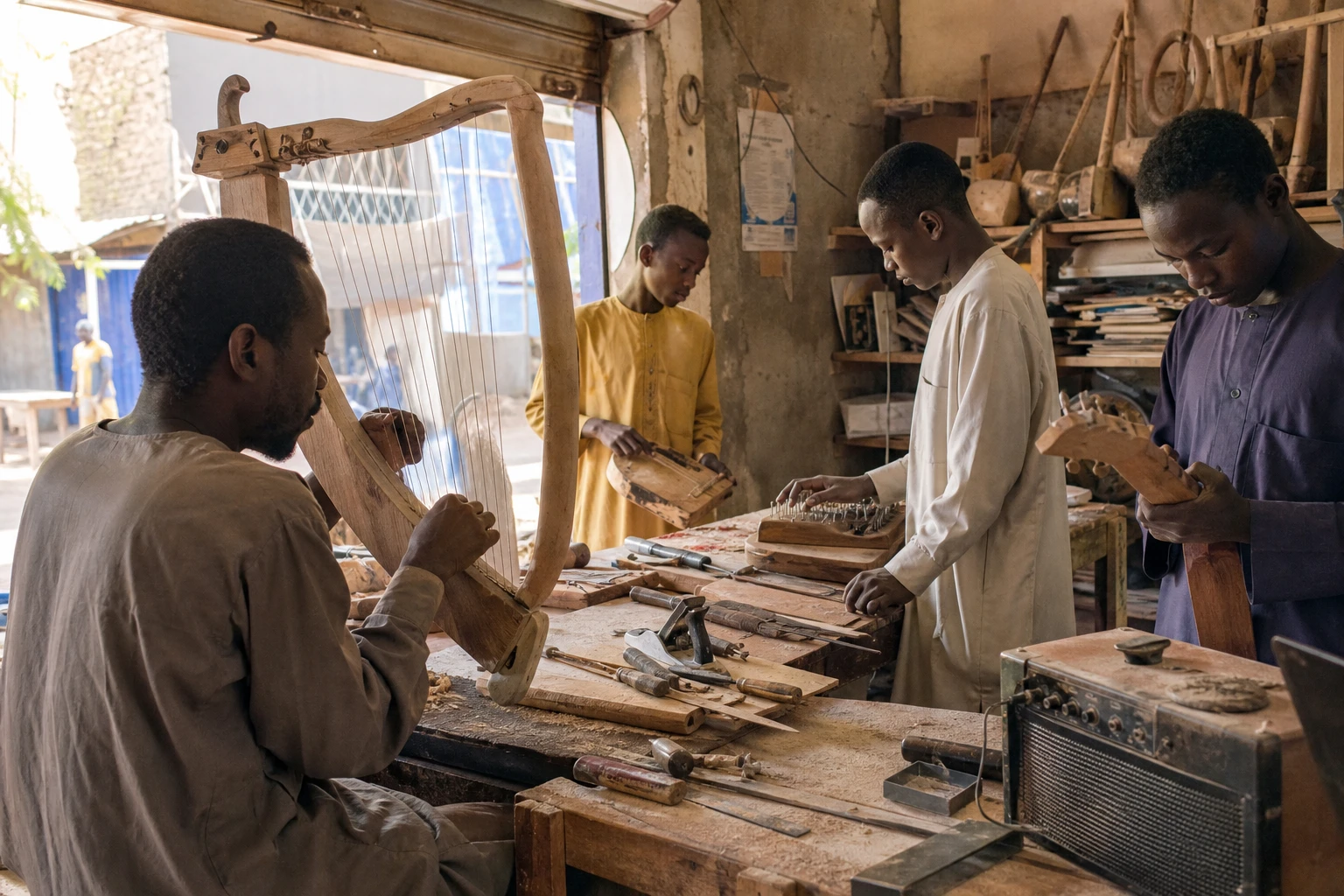
In N’Djamena, musical knowledge is passed on not only on stages and in studios. It is also nurtured in workshops, among wood, strings and skills handed down by elders. In the 7th district, Chadian artist Soléa Damas turns this idea into a method: making his own instruments, incorporating them into his compositions and training a new generation.
From southern Chad to a workshop in N’Djamena
Soléa Damas, whose real name is Damas Yoasngar Gérard, comes from Bodo, in Logone Oriental province. His work spans music, sculpture and instrument-making — the manufacture and restoration of instruments.
His interest in traditional sounds grew after a series of trips to the south of the country. For about two years, he worked in the provinces of Logone Oriental, Mandoul and Moyen-Chari with holders of traditional knowledge. There, he studied how to make and play several instruments, including the sanza, harp and balafon.
This approach led to the creation of the Kaya-Kendé Cultural and Artistic Company, established in N’Djamena in 2021. The organisation offers training, maintains instruments and seeks to make them more accessible to artists and young people. It also focuses on instruments from other African musical traditions, such as the kora and ngoni.
In 2023, Chadian media outlet Tchadinfos reported that Kaya-Kendé’s activities covered the balafon, sanza, harp and kora, as well as singing, guitar, piano, drums and percussion. This combination shows that Soléa Damas does not present tradition as a closed world. Instead, he seeks to bring it into dialogue with current musical practices.
Making instruments to play them better
In his workshop, woodworking tools accompany the melodies he hums. Craftsmanship thus becomes part of the creative process. The artist makes wooden instruments, tunes them and adapts them to the needs of the contemporary stage.
Among his creations is an electro-acoustic harp, made using parts salvaged from a discarded guitar. His approach is therefore not just about preservation. It also draws on experimentation and reuse to produce a sound compatible with modern equipment.
The sanza, an instrument with metal tines played with the thumbs, holds an important place in his work. It accompanies music that the musician describes as a blend of local rhythms, African influences and more contemporary arrangements. The result does not seek to reproduce an old repertoire unchanged. It tries to give it a new life.
This approach speaks to a broader question for Chadian creativity: how can heritage instruments be heard in an environment dominated by the electric guitar, keyboards, production software and the short formats of digital platforms? For Soléa Damas, the answer lies in practice. An instrument kept in a display case remains an object of memory. Played, it can become a living language again.
Training that goes beyond the stage
At the Kaya-Kendé workshop, learners come not only for an introduction to the arts. Some also see it as a professional skill. The sessions combine making, maintaining and playing instruments.
The presence of young people such as Menda Benjamin, a graduate without a job, illustrates this dimension. The training offers a route into cultural craftsmanship, a sector that is still poorly structured but can bring together creativity, skills transmission and economic activity. Instruments can be made for Chadian artists, schools, cultural centres or diaspora communities.
The participation of young teenagers also gives the initiative an educational purpose. It enables learning through observation and practice, rather than solely through theory. It also helps diversify the people working in a field often associated with recognised male figures.
In an article published in 2025, newspaper Le Pays Tchad reported that the artist was preparing a second album, announced for 2026. This prospect extends his work: the instruments made in the workshop are not just intended for display. They are meant to find a place in songs, concerts and recordings.
The challenge of raw materials
Instrument-making nevertheless faces a practical constraint: access to wood and other materials. Soléa Damas says he has to travel long distances to find suitable resources. At certain times, he returns to the provinces and works with deadwood, particularly for drums and tambourines.
This difficulty takes on particular significance amid climate pressures. Instrument production cannot depend on the indiscriminate exploitation of resources. It requires thought about wood species, reuse, salvage and less resource-intensive techniques.
The issue therefore extends beyond the career of a single artist. It concerns craftspeople, local authorities, music schools and cultural organisations seeking to develop a local industry. Without sustained support, individual initiatives risk remaining fragile. With training spaces, commissions and outlets, they can help build a Chadian cultural economy.
A national and regional ambition
Soléa Damas wants to develop Kaya-Kendé into a fully fledged academy. The aim would be to strengthen training, expand the network of instructors and pass on techniques in several cities across Chad.
This ambition is rooted in a highly diverse cultural landscape. Instruments, rhythms and languages vary between the north, centre and south of the country. The harp, balafon, sanza, drums and stringed instruments are not all associated with the same communities or uses. Bringing them together in a creative space therefore requires respect for this plurality.
The project could also appeal to the cultural sphere of Central Africa. Chad shares longstanding connections with Cameroon, the Central African Republic and the two Congos. Instruments and musical practices cross borders, sometimes long before institutional programmes do. A Chadian academy devoted to instrument-making could thus become a meeting place for craftspeople, musicians, researchers and young creators from across the region.
For now, work continues in N’Djamena, amid wood shavings and the notes of the sanza. The challenge is not to choose between traditional and modern music. It is to enable Chadian instruments to take a full part in the present, without losing the stories and skills that give them meaning.