
 Algeria
 Egypt
 Libya
 Morocco
 Sudan
 Tunisia
 Benin
 Burkina Faso
 Cabo Verde
 Côte d'Ivoire
 Ghana
 Guinea
 Guinea-Bissau
 Liberia
 Mali
 Mauritania
 Niger
 Nigeria
 Senegal
 Sierra Leone
 The Gambia
 Togo
 Cameroon
 Central African Republic
 Chad
 Equatorial Guinea
 Gabon
 Republic of the Congo
 São Tomé and Príncipe
 Burundi
 Comoros
 Djibouti
 Eritrea
 Ethiopia
 Kenya
 Madagascar
 Malawi
 Mauritius
 Mozambique
 Rwanda
 Seychelles
 Somalia
 South Sudan
 Tanzania
 Uganda
 Angola
 Botswana
 Eswatini
 Lesotho
 Namibia
 South Africa
 Zambia
 Zimbabwe
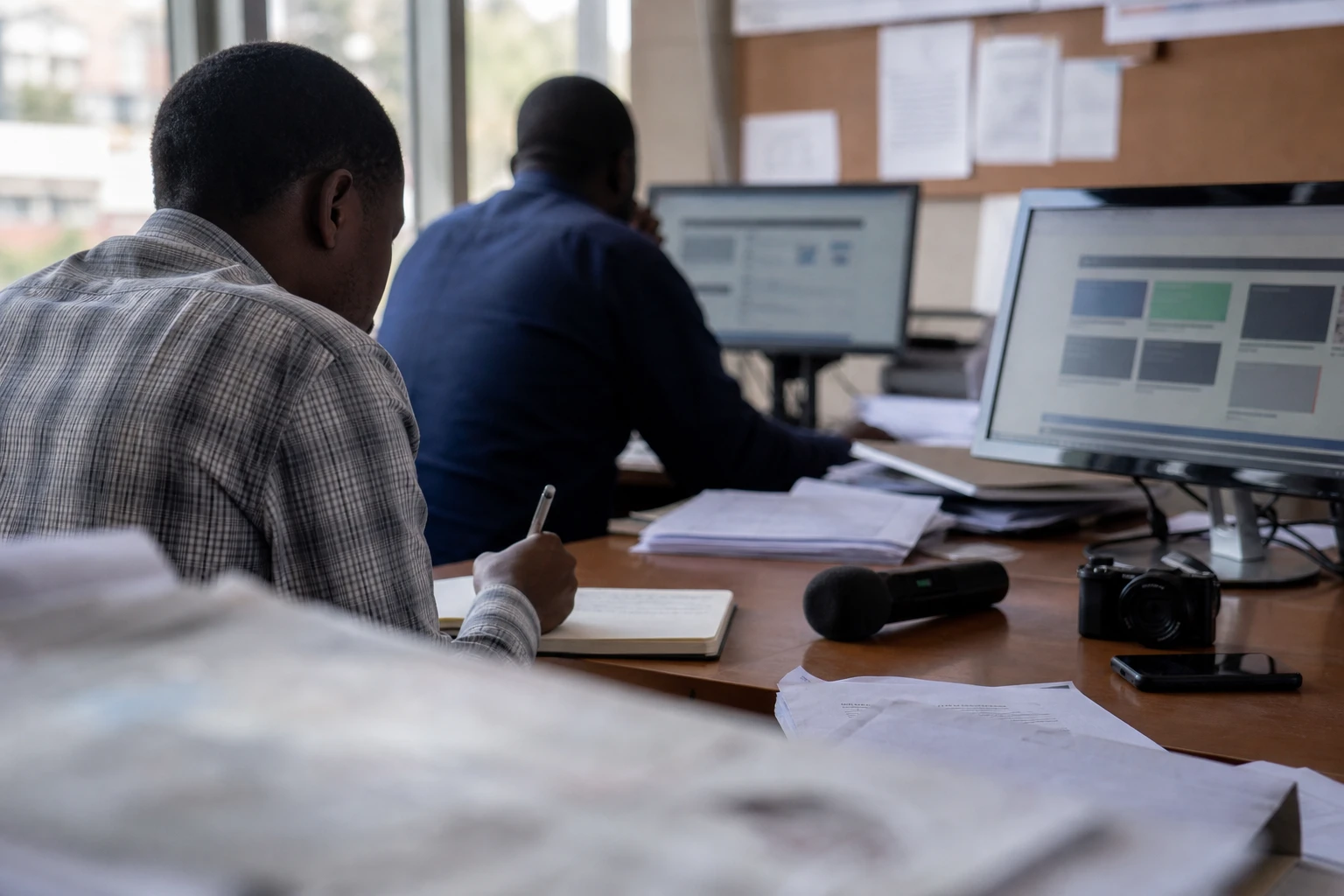
In Goma, MONUSCO is no longer facing only the question of its departure. It must now demonstrate what a UN presence can still contribute in an area where front lines, de facto authorities and diplomatic mechanisms overlap.
The debate therefore goes beyond whether to maintain or reduce the number of peacekeepers. It concerns the mission’s ability to protect civilians, document ceasefire violations and support a political process without becoming a combat force.
A mission repositioned within the regional framework
The Democratic Republic of the Congo remains engaged in several forums discussing the crisis in the east of the country. The Doha process concerns talks between Kinshasa and the AFC/M23. In parallel, the Expanded Joint Verification Mechanism brings together representatives of the parties and regional experts to examine allegations of ceasefire violations.
This mechanism operates within the security environment of the Great Lakes. It involves, in particular, the International Conference on the Great Lakes Region, a regional organisation tasked with promoting cooperation and conflict prevention among its member states. MONUSCO is therefore operating within a framework in which the UN is not the only actor.
This shift comes after a period of heightened tensions between Kinshasa and the mission. In 2023, the Congolese authorities called for MONUSCO’s withdrawal to be accelerated. The mission was then accused by some members of the public and political leaders of failing to respond adequately to persistent insecurity.
Withdrawal has begun in several areas. However, the deterioration in the security situation in North Kivu and South Kivu has complicated the idea of a uniform timetable. The Security Council has since maintained the mission, with a mandate adapted to conditions on the ground.
In Goma, the UN focuses on verifying the facts
On 23 September 2026, James Swan, the UN Secretary-General’s Special Representative in the Democratic Republic of the Congo and head of MONUSCO, met in Goma with members of the mechanism tasked with monitoring the ceasefire. He also held talks with representatives of the AFC/M23, which controls parts of North Kivu and South Kivu.
The UN mission has confirmed that it is ready to continue its support, within the limits of its mandate. It has already provided logistical support to verification missions in Minembwe, in South Kivu, and in Masisi territory, in North Kivu.
In practical terms, this support can take several forms. It may include air transport, access to certain hard-to-reach areas, logistical security or the gathering of information. The mission can also help establish a timeline of incidents and facilitate exchanges between members of the mechanism.
This role remains limited. Peacekeepers are not mandated to enforce an agreement by force. As Jean-Pierre Lacroix, the UN Under-Secretary-General for Peace Operations, has pointed out, imposing peace would mean waging war. That is not the role of a peacekeeping operation.
Kinshasa’s change of position
For the Congolese authorities, the issue is no longer necessarily to demand an early withdrawal at any cost. Kinshasa now advocates a change to MONUSCO, agreed with the Congolese state and tailored to local needs.
This approach prioritises three functions: protecting civilians, supporting the ceasefire and assisting verification mechanisms. It also provides for a possible review of any reduction in the mission if the security situation deteriorates.
The shift is significant. It reflects a distinction between MONUSCO’s conventional military presence and its technical or logistical support role. It also responds to a reality: in several territories in eastern DR Congo, the withdrawal of an international actor does not automatically mean that the Congolese state has the capacity to take over all its functions.
The consequences are not the same for everyone. In Kinshasa, the priority is sovereignty and control of the national timetable. In Goma, in the territories of North Kivu and in the highlands of South Kivu, the question is more immediate: who documents attacks, who accompanies teams in the field, and who can raise the alarm when civilians are threatened ?
Rural populations are particularly exposed to the limitations of the system. They often live far from administrative centres and operational bases. In these areas, the verification of an incident depends on access, the safety of teams and the cooperation of the actors present.
A mission caught between expectations and budget constraints
The Congolese debate is taking place in a more difficult international context. The United States is calling for measurable objectives for peace operations and questioning whether some missions can deliver results commensurate with their cost. Washington supports an approach that could lead to the reconfiguration or even closure of operations considered insufficiently effective.
France, for its part, supports the idea of missions able to adapt and equipped with sufficient resources. These positions matter for DR Congo. Budget cuts can reduce transport, surveillance and protection capabilities at the very moment needs are increasing.
The issue is therefore not simply the number of troops deployed. A smaller mission can remain useful if it retains air assets, civilian teams, human rights specialists and access to the areas concerned. Conversely, a large presence loses its impact if it cannot move around or obtain independent information.
MONUSCO must also contend with the distrust of several actors. The Congolese authorities want to prevent it from acting outside the framework agreed with Kinshasa. The AFC/M23 disputes its role and accuses it of siding with the government camp. The public, meanwhile, mainly expects visible protection and a response to documented violations.
A test for the UN and African mechanisms
MONUSCO’s new role could foreshadow a broader transformation of peace operations. The UN is seeking to adapt its missions to conflicts in which military lines are shifting, armed groups control territory and agreements are repeatedly undermined.
In DR Congo, success will not be measured solely by the number of verification missions organised. It will also depend on the publication of credible information, the protection of witnesses, access to affected areas and the ability of the parties to respond to the findings.
Coordination with African mechanisms will be crucial. The International Conference on the Great Lakes Region, the African Union and the actors in the Doha process will need to avoid overlapping mandates and statements unsupported by follow-up mechanisms.
For Kinshasa and its international partners, the next step will be to define specific outcomes: access to affected areas, verification deadlines, information-sharing and measures in the event of a violation. Without these guarantees, the debate over withdrawal will remain abstract. With them, MONUSCO could move from a contested presence to a limited but useful tool serving a still-fragile peace process.



