
 Algeria
 Egypt
 Libya
 Morocco
 Sudan
 Tunisia
 Benin
 Burkina Faso
 Cabo Verde
 Côte d'Ivoire
 Ghana
 Guinea
 Guinea-Bissau
 Liberia
 Mali
 Mauritania
 Niger
 Nigeria
 Senegal
 Sierra Leone
 The Gambia
 Togo
 Cameroon
 Central African Republic
 Chad
 Equatorial Guinea
 Gabon
 Republic of the Congo
 São Tomé and Príncipe
 Burundi
 Comoros
 Djibouti
 Eritrea
 Ethiopia
 Kenya
 Madagascar
 Malawi
 Mauritius
 Mozambique
 Rwanda
 Seychelles
 Somalia
 South Sudan
 Tanzania
 Uganda
 Angola
 Botswana
 Eswatini
 Lesotho
 Namibia
 South Africa
 Zambia
 Zimbabwe
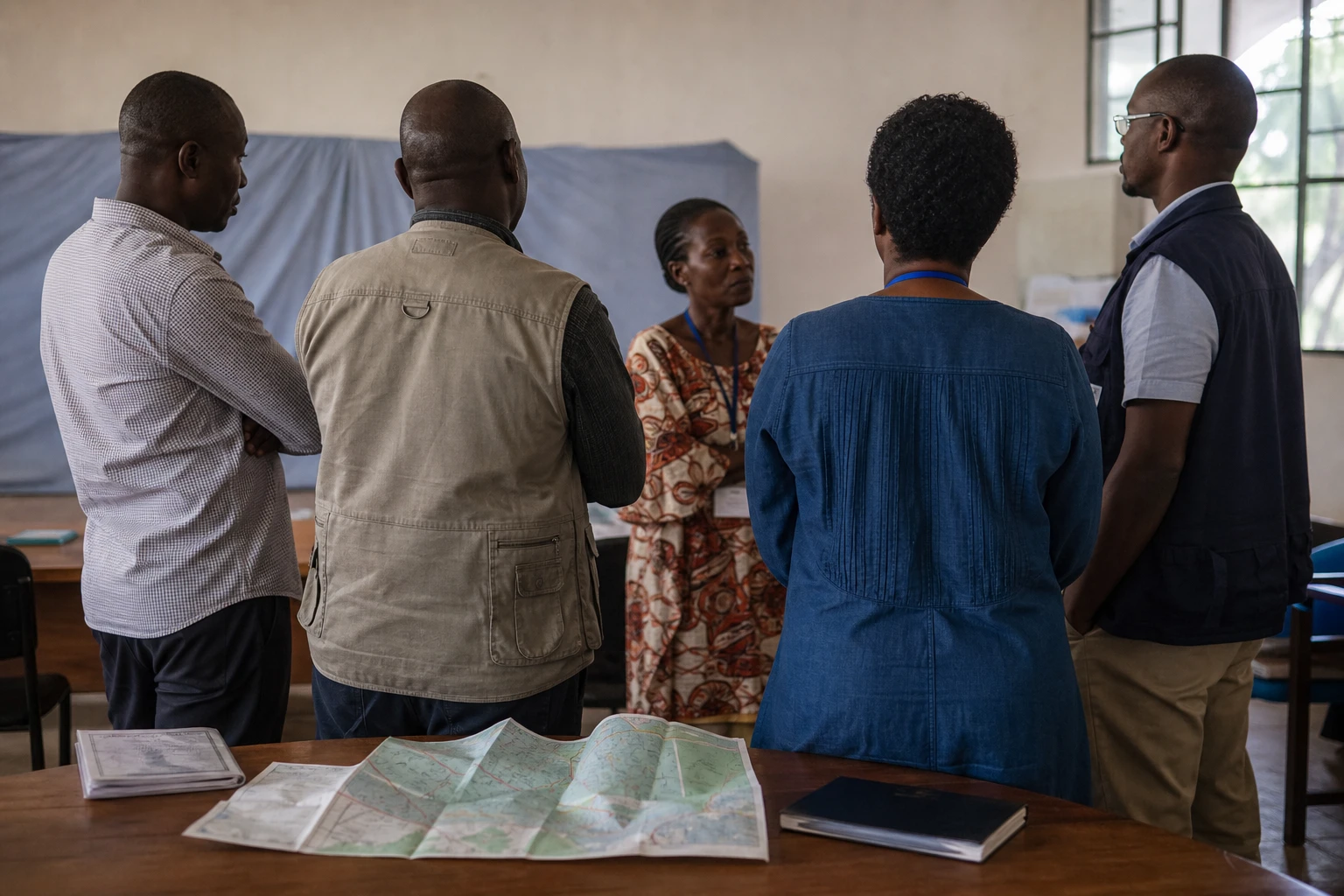
In the east of the Democratic Republic of the Congo, reaching a health zone can sometimes be as difficult as treating the injured. Humanitarian teams have to contend with clashes, roadblocks, threats and restrictions imposed on routes linking territories in North Kivu and South Kivu.
This pressure does not only slow the work of organisations. It puts healthcare, drinking water, protection and food aid further out of reach for displaced people and those who remain in rural areas.
Humanitarian space is shrinking
The United Nations Joint Human Rights Office (BCNUDH), which monitors human rights violations in the Democratic Republic of the Congo, recorded 31 violations of international humanitarian law in the first half of 2026, according to figures reported by Congolese media outlet Digitalcongo.org.
These incidents include attacks on hospitals, a school, protected persons and sites benefiting from special protection during conflict. The material reviewed mentions ten attacks on hospitals, one on a school, 17 targeting protected persons and three against protected sites.
International humanitarian law requires parties to a conflict to protect civilians, healthcare facilities, medical personnel and relief operations. An attack on a hospital therefore affects more than a building. It can halt emergency services, displace patients and deprive an entire area of essential care.
The same BCNUDH report documents 2,996 human rights violations and abuses between 1 January and 30 June 2026. These incidents reportedly affected 6,189 victims nationwide. In conflict-affected provinces, 2,607 violations were recorded, affecting 5,032 victims.
A mission halted in Mwenga
The territory of Mwenga, in South Kivu province, illustrates these difficulties in concrete terms. On 1 May 2026, ten members of Médecins Sans Frontières (MSF) were reportedly threatened in Kalambi as they travelled from Bukavu to Mwenga to assess healthcare needs.
The team was temporarily prevented from continuing its journey. After the incident, MSF suspended its activities in Mwenga-centre and initially abandoned plans to deploy to Kamituga and Kitutu, according to information provided in the source material.
Congolese media also reported on 6 May 2026 that an MSF convoy had been attacked near Kalambi. The circumstances and precise classification of the incident must, however, be distinguished from the facts documented by the BCNUDH. The team members reportedly emerged unharmed, while property was allegedly looted.
These events demonstrate how vulnerable missions are in territories far from Bukavu. A team may set out to assess needs, prepare a vaccination campaign or reinforce a health centre. A roadblock or a threat can then be enough to suspend the operation.
Obstacles go beyond armed attacks
The risks are not limited to gunfire and abductions. Organisations also report illegal barriers, movement restrictions, armed robberies, looting and direct threats against their employees.
These are compounded by taxes on some humanitarian imports and a growing number of administrative permits. Such constraints raise the cost of transporting medicines and lengthen the time between a product’s purchase and its arrival at a healthcare facility.
In rural areas, the impact is immediate. A centre short of antibiotics, blood bags or obstetric equipment cannot always be resupplied quickly. Residents then have to travel long distances, often on foot or by motorbike, to reach a hospital that is still functioning.
Cities are not spared. In 2025, MSF described access between Bukavu and Uvira as severely disrupted. The organisation said it had treated nearly 400 war-wounded patients and 800 cholera cases in Uvira since February 2025, while supporting healthcare facilities in Kamanyola.
This reality creates an uneven geography of aid. Provincial capitals and major urban centres retain more services. Isolated territories, meanwhile, depend on exposed humanitarian corridors and often irregular funding.
An access crisis compounded by shrinking funding
Security concerns are arising amid more limited resources. Humanitarian organisations have to cut some activities, prioritise emergencies and concentrate their teams in areas where access conditions remain acceptable.
Yet needs continue to grow. The M23 offensive, the ongoing activity of armed groups such as the ADF and CODECO, and clashes between state forces and armed groups have caused fresh displacement in the east of the Democratic Republic of the Congo.
The BCNUDH attributed 198 human rights abuses to the ADF in Ituri and North Kivu in the first half of 2025. According to the UN report, the violence had claimed at least 1,071 victims. These figures do not directly describe attacks on humanitarian aid, but they show the environment in which teams have to work.
In 2025, the United Nations Office for the Coordination of Humanitarian Affairs (OCHA) recorded 626 incidents affecting humanitarian workers in the Democratic Republic of the Congo. North Kivu accounted for 290 cases, followed by South Kivu with 177 incidents and Ituri with 89.
Burglary, armed robbery and intrusion accounted for 36% of incidents. Interference and movement restrictions made up 34%, while intimidation, threats and physical assaults represented 27%.
The regional challenge of reaching communities
The situation in eastern Congo extends beyond national borders. North Kivu and South Kivu lie at the heart of a cross-border area linking the Democratic Republic of the Congo, Rwanda, Uganda, Burundi and Tanzania.
Population displacement, the closure of some routes and the movement of armed groups complicate coordinated responses. The East African Community, of which the Democratic Republic of the Congo is a member, is directly affected by the impact of this instability on borders and trade corridors.
For communities, the stakes are tangible. The suspension of a mission can mean the closure of a maternity service, a delayed evacuation or the interruption of a cholera campaign. For the Congolese authorities and regional actors, the priority is to guarantee safe corridors, tackle extortion and investigate attacks.
The coming months will show whether diplomatic and security commitments genuinely improve access to these territories. In the east of the Democratic Republic of the Congo, protecting humanitarian aid remains a key measure of the ability of armed actors and authorities to safeguard civilians beyond declarations.



