
 Algeria
 Egypt
 Libya
 Sudan
 Tunisia
 Benin
 Burkina Faso
 Cabo Verde
 Côte d'Ivoire
 Ghana
 Guinea
 Guinea-Bissau
 Liberia
 Mali
 Mauritania
 Niger
 Nigeria
 Senegal
 Sierra Leone
 The Gambia
 Togo
 Cameroon
 Central African Republic
 Chad
 DR Congo
 Equatorial Guinea
 Gabon
 Republic of the Congo
 São Tomé and Príncipe
 Burundi
 Comoros
 Djibouti
 Eritrea
 Ethiopia
 Kenya
 Madagascar
 Malawi
 Mauritius
 Mozambique
 Rwanda
 Seychelles
 Somalia
 South Sudan
 Tanzania
 Uganda
 Angola
 Botswana
 Eswatini
 Lesotho
 Namibia
 South Africa
 Zambia
 Zimbabwe
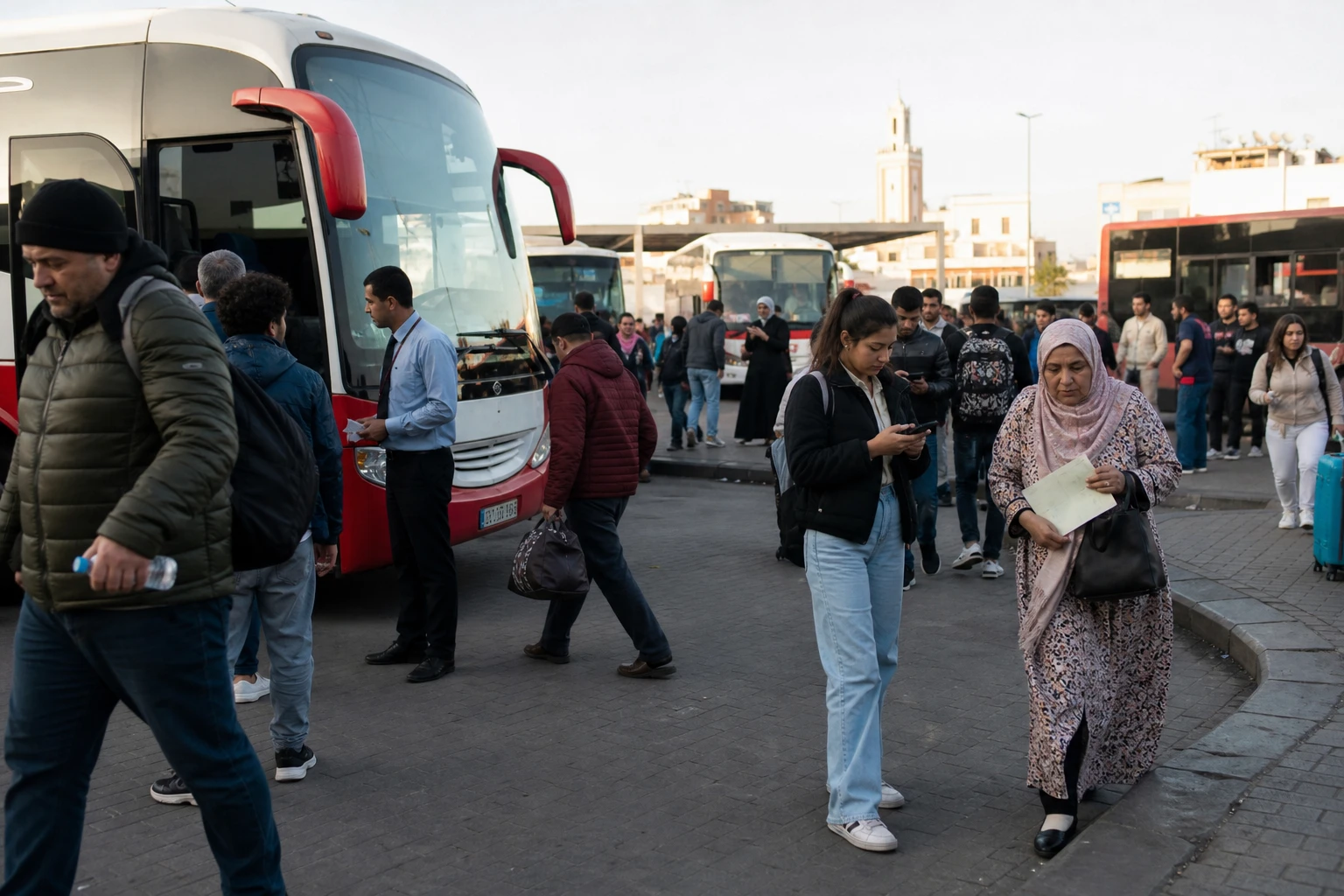
In Rabat and Casablanca, Wednesday 23 September 2026’s vote raised one question above all: how many Moroccans, particularly young people, still want to have a direct influence on political life? Two hours before polling stations were due to close, national turnout remained below the level recorded at the same point in 2021.
A national vote marked by wait-and-see attitudes
Nearly 15.8 million voters were registered to elect the 395 members of the House of Representatives, the lower house of Morocco’s parliament. Polling stations opened at 8am and were due to close at 7pm across the Kingdom.
The Interior Ministry announced a turnout of 28.05 per cent at 5pm. This was eight percentage points below the figure reported at the same time during the 8 September 2021 election, when turnout had reached 36 per cent before polls closed.
The 2026 figure is not, however, the final result. Some voters traditionally go to the polls late in the day, particularly in large cities, after work. The final tally was therefore expected before any full comparison with previous elections.
According to figures published by the Moroccan authorities, 28 political parties and two independent lists were contesting seats in the House of Representatives. Voters were choosing their representatives amid rising living costs, difficulties accessing employment and persistent distrust of political parties.
Youth at the heart of the vote
Youth participation was one of the main indicators of election day. Moroccans aged 18 to 24 accounted for just 4 per cent of registered voters, while those aged 25 to 34 made up 15 per cent of the electorate. These figures also reflect the composition of the electoral rolls, not the actual proportion of young people in the population.
In several urban neighbourhoods, the atmosphere around polling stations contrasted with the demographic weight of those under 35. Older voters appeared more present, while many young people expressed their distance from the campaigns and political promises.
This reluctance does not necessarily mean a lack of interest in public affairs. On the contrary, it may reflect a different way of expressing themselves. Debates on social media, local campaigns and criticism of public services show that young Moroccans follow political decisions, even when they do not vote.
The GenZ 212 movement, which emerged the previous year, brought demands relating to employment, healthcare, education and regional inequalities into the open. A year later, its impact was measured less by a single electoral instruction than by the difficulty parties faced in convincing a generation demanding tangible results.
The gap between promises and everyday experience
For some young Moroccans, the issue is not simply a choice between parties. It concerns the credibility of the entire process. Promises of jobs, lower prices and improved public services are regularly renewed. Yet their impact remains uneven across regions and social groups.
In major cities such as Casablanca, Rabat and Salé, housing costs, insecure employment and transport weigh heavily on households. In rural areas, difficulties accessing healthcare, education and economic opportunities fuel other forms of frustration. National turnout therefore conceals very different experiences.
Older voters may see voting as a civic responsibility or a way to preserve the country’s stability. Younger people, by contrast, are more likely to judge institutions by their everyday lives: the chance of finding a job, the quality of a hospital, the cost of training or access to housing.
This difference in outlook partly explains why electoral mobilisation can remain weak even when political issues are widely discussed. Abstention then becomes a signal that is difficult to interpret. It may express rejection of the parties, a sense of powerlessness, material constraints or simply the absence of an offering deemed convincing.
An incoming majority faces immediate demands
The party that comes first will then take part in forming a new government majority. Under Morocco’s system, the king appoints as head of government the figure from the party that comes first in the parliamentary election. That figure must then build a coalition capable of securing the confidence of the House of Representatives.
The incoming government will face a difficult balancing act. It will have to maintain major national programmes, including social protection and infrastructure, while delivering swift responses to social difficulties. Expectations are particularly high in employment, healthcare and education.
Measures designed to encourage young candidates to enter electoral contests can bring in new faces, but are not enough on their own to restore trust. The presence of candidates under 35 does not, by itself, guarantee lasting representation for young people. Those elected must also have room to act and account for their work.
Campaign financing is also an issue. When voters associate politics with one-off promises or appeals made only during the election period, the relationship between parties and citizens is weakened. Trust is more likely to be rebuilt through regular monitoring of commitments and verifiable results.
A signal to watch across North Africa
Morocco’s election goes beyond competition between political parties. It is taking place in a North Africa where electoral participation, youth representation and institutions’ ability to meet social expectations remain central issues.
Morocco is not part of a fully operational regional economic community comparable to ECOWAS or SADC. It remains, however, engaged in African Union mechanisms and in economic and political partnerships with several countries on the continent. The stability of its institutions and its ability to reduce social divisions are therefore being watched beyond its borders.
The next step will be the publication of the final results, followed by the formation of a parliamentary majority and government. But the vote’s first lesson is already clear: for Morocco’s political parties, the challenge is no longer simply to get people to the polls on election day. It is to convince an attentive, informed and demanding young generation that its vote can bring visible change.



