Algeria
 Egypt
 Libya
 Sudan
 Tunisia
 Benin
 Burkina Faso
 Cabo Verde
 Côte d'Ivoire
 Ghana
 Guinea
 Guinea-Bissau
 Liberia
 Mali
 Mauritania
 Niger
 Nigeria
 Senegal
 Sierra Leone
 The Gambia
 Togo
 Cameroon
 Central African Republic
 Chad
 DR Congo
 Equatorial Guinea
 Gabon
 Republic of the Congo
 São Tomé and Príncipe
 Burundi
 Comoros
 Djibouti
 Eritrea
 Ethiopia
 Kenya
 Madagascar
 Malawi
 Mauritius
 Mozambique
 Rwanda
 Seychelles
 Somalia
 South Sudan
 Tanzania
 Uganda
 Angola
 Botswana
 Eswatini
 Lesotho
 Namibia
 South Africa
 Zambia
 Zimbabwe
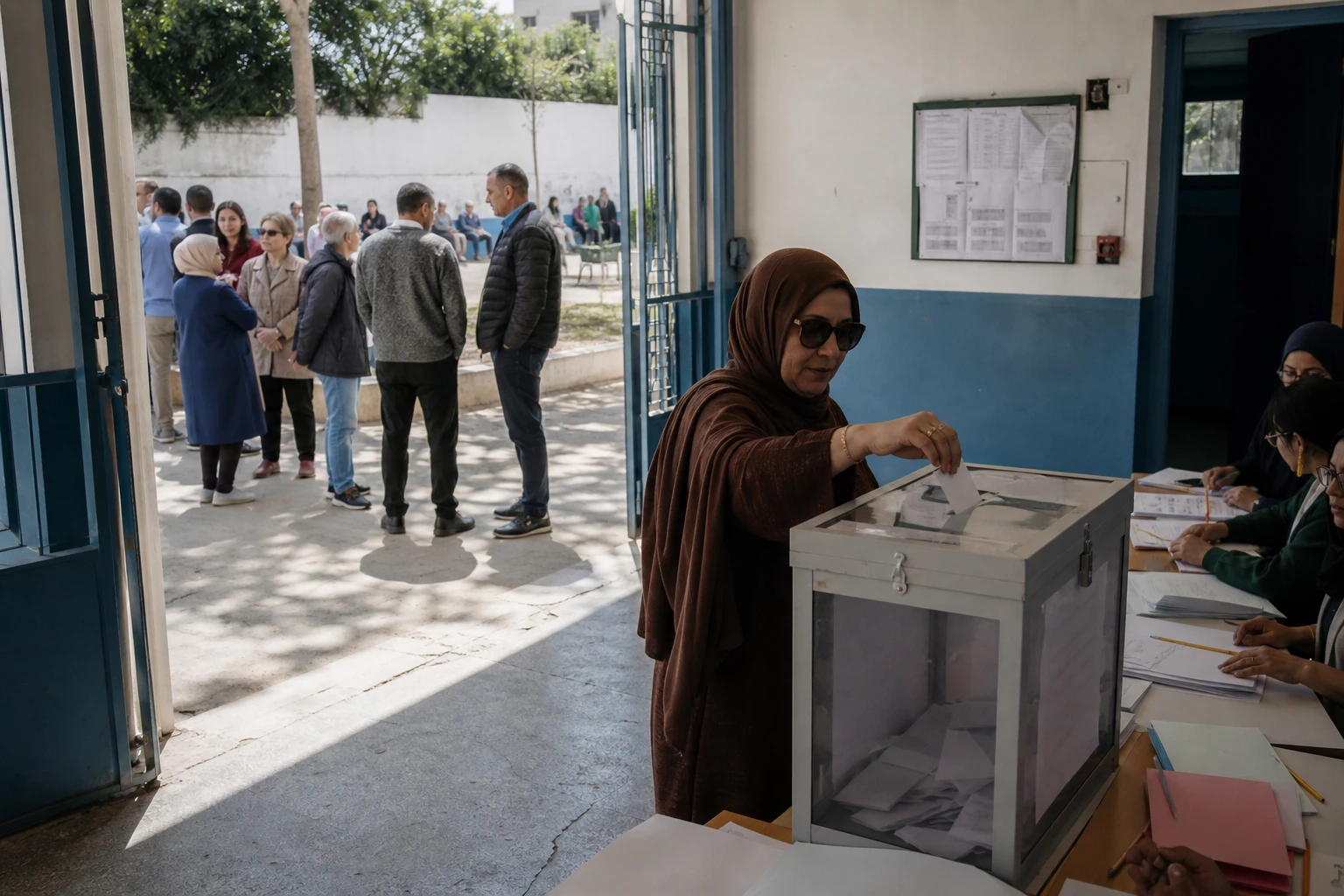
In Rabat and other Moroccan cities, the vote on 23 September 2026 was meant to measure far more than the popularity of political parties. Above all, it was meant to show whether political promises can still address everyday concerns: prices, jobs, health, schools and housing.
The main figures competing in the election cast their ballots in the morning. The vote will renew all 395 seats in the House of Representatives, the lower house of Morocco’s parliament. The party that comes first will then have to negotiate the formation of the next government.
A national vote in a particular regional context
Morocco does not belong to an economic regional organisation comparable to ECOWAS or SADC. Its political environment is shaped instead by the Maghreb, marked by tensions between Rabat and Algiers, as well as by the dynamics of the African Union and partnerships with Europe.
The election also comes after five years of government led by the National Rally of Independents, or RNI. In 2021, the party came first with 102 MPs. It subsequently formed a coalition with the Authenticity and Modernity Party and the Istiqlal Party.
The 2026 campaign therefore focused on the record of this majority. Voters were asked to consider social reforms, infrastructure and job creation. They were also asked whether the country could turn its investments into visible improvements in neighbourhoods and regions.
Leaders vote as voters judge the results
Mohammed Nabil Benabdallah, secretary-general of the Party of Progress and Socialism, voted in Rabat. The left-wing opposition party made turnout and electoral punishment a major theme of its campaign.
Before the vote, Benabdallah had urged Moroccans to overcome abstention and express their dissatisfaction at the ballot box. He also mentioned the goal of winning several dozen seats, while leaving open the question of possible participation in the next government.
RNI leader Mohamed Chaouki also voted in the capital. He defended his party’s campaign and the programme presented to voters. The RNI was seeking to retain its dominant position, as the outgoing government’s record was directly associated with the candidacies of its leaders.
The contest was not, however, simply a duel between the RNI and the PPS. The Authenticity and Modernity Party, Istiqlal, the Justice and Development Party, and several left-wing and centrist parties were also seeking to increase their representation in the House.
Figures illustrate the scale of the contest
According to data published by the Moroccan authorities, 15,801,162 voters were registered on the general electoral rolls. A total of 7,288 candidates were competing, across 1,850 local and regional lists.
The authorities recorded 28 political groupings, including alliances, as well as two lists of independent candidates. Other campaign communications gave the figure as 27 parties taking part. The difference reflects how alliances formed for the election are counted.
Polling stations were open from 8am to 7pm local time. The first results were due to be announced in the evening, after ballots had been counted and the official reports collated.
These figures give an idea of the electoral choice on offer, but they do not show how many parties can realistically win significant representation. Morocco’s electoral system favours coalitions. No party won a majority on its own in previous parliamentary elections, and the next government will probably have to rely on several groups.
The cost of living at the heart of the verdict
The campaign took place amid persistent economic concerns. Households are watching food, rent, transport and energy prices. In rural areas, access to healthcare, water and administrative services remains a central issue.
In major cities, demand focuses more on skilled jobs, housing and the quality of public services. For several years, graduates have decried the gap between their level of education and the opportunities available to them. In the informal economy, workers are chiefly seeking more accessible social protection and steadier incomes.
Youth unemployment is therefore a major political test. Pledges to create jobs will have to be measured against regional realities. A national promise does not have the same effects in Casablanca, the provinces of the Oriental region, the Rif or the southern territories.
Voters are also assessing the state’s ability to reduce disparities between urban centres and smaller towns. Major projects are improving infrastructure and the country’s attractiveness. Their impact, however, will depend on their ability to create lasting jobs and support local businesses.
The 2030 World Cup as a political horizon
The next government will have to oversee major investments in infrastructure, transport, hotels and sports facilities. Morocco will co-host the 2030 FIFA World Cup with Spain and Portugal.
This deadline gives the election particular significance. The authorities want to accelerate the country’s modernisation and strengthen its international appeal. The parties, in turn, must convince voters that the spending will benefit citizens too, and not just the major economic centres.
The debate is therefore about how the benefits will be distributed. People in metropolitan areas could quickly benefit from the new facilities. More remote regions, for their part, are looking for roads, hospitals, schools and economic opportunities. The question will not only be how to build, but how to maintain and fund this infrastructure.
An election watched beyond Morocco’s borders
The vote is of interest to Morocco’s African partners. For several years, Rabat has sought to strengthen its economic and diplomatic ties with West Africa, the Sahel and the institutions of the African Union. Political stability and continuity in public policy will shape these relations.
The result will also have implications for negotiations with Europe, foreign investment and co-operation on mobility. The future government will have to manage these external issues while responding to very tangible social demands at home.
The key indicator will therefore not simply be which party comes first. Attention will need to be paid to turnout, the representation of young people and women among elected members, the make-up of the governing coalition and the first measures on prices, jobs and public services.
For Morocco, 23 September 2026 thus marks the start of a new political chapter. The next administration will face an ambitious timetable, but also a straightforward demand: to turn national announcements into results people can see in their homes and communities.
The official figures for Morocco’s parliamentary elections, published by the national portal, detail the number of registered voters, candidates and seats to be filled.
The tally of lists and candidates was also announced by Morocco’s National Broadcasting and Television Company.