
 Algeria
 Egypt
 Libya
 Morocco
 Sudan
 Tunisia
 Benin
 Burkina Faso
 Cabo Verde
 Côte d'Ivoire
 Ghana
 Guinea
 Guinea-Bissau
 Liberia
 Mali
 Mauritania
 Niger
 Nigeria
 Senegal
 Sierra Leone
 The Gambia
 Togo
 Cameroon
 Central African Republic
 Chad
 Equatorial Guinea
 Gabon
 Republic of the Congo
 São Tomé and Príncipe
 Burundi
 Comoros
 Djibouti
 Eritrea
 Ethiopia
 Kenya
 Madagascar
 Malawi
 Mauritius
 Mozambique
 Rwanda
 Seychelles
 Somalia
 South Sudan
 Tanzania
 Uganda
 Angola
 Botswana
 Eswatini
 Lesotho
 Namibia
 South Africa
 Zambia
 Zimbabwe
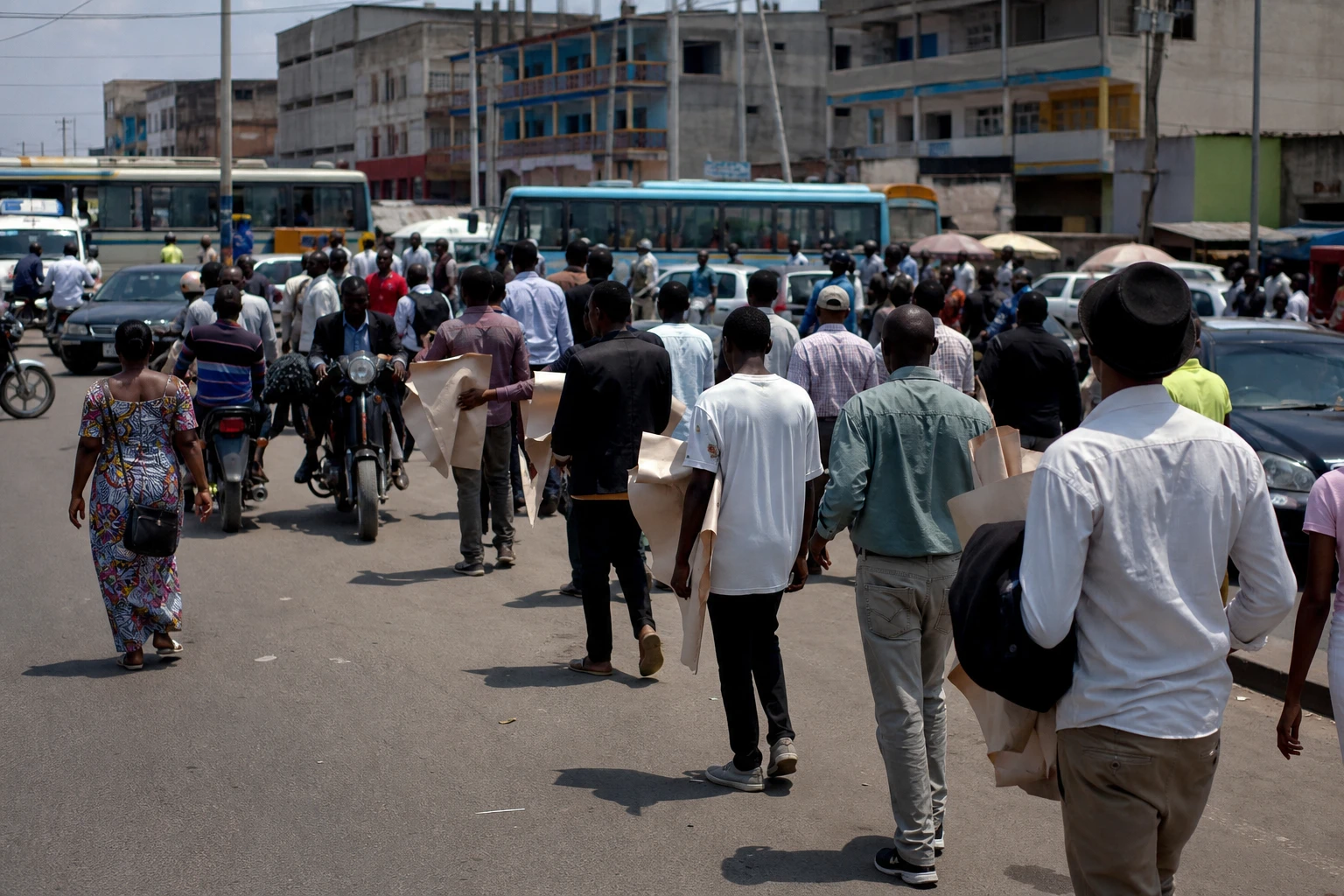
In Kinshasa, the battle over the Constitution has moved out of meeting rooms and on to the streets. On 22 September 2026, the UDPS and several parties allied to President Félix Tshisekedi organised a march to demonstrate their support for the proposed referendum and the national dialogue announced by the head of state.
A political response to the opposition’s mobilisation
The demonstration came a week after a march by the Coalition for the Defence of Article 64, known as C64. The platform brings together, among others, Martin Fayulu, Moïse Katumbi, Jean-Marc Kabund, Augustin Matata Ponyo and Delly Sesanga. It rejects any amendment to the 2006 Constitution and fears that a new basic law could allow Félix Tshisekedi to seek a third term.
In Kinshasa, the ruling majority’s procession set off from 11th Street, in the Limete municipality, before ending near the Cabu Bridge. Thousands of UDPS activists and supporters, as well as those of allied parties, took part, according to several Congolese media outlets.
UDPS secretary-general Augustin Kabuya described the mobilisation as a direct response to the C64 march held on 15 September. He challenged some media outlets’ interpretation of the opposition’s mobilisation and claimed the presidential camp had demonstrated its strength.
The organisers also voiced support for the institutions of the Republic, the law governing referendums and the national dialogue proposed by Félix Tshisekedi. The march was therefore not solely about constitutional reform. It also sought to show that the president retains an active activist base in the capital.
Referendum at the centre of a tense institutional debate
The Congolese Constitution limits presidents to two terms. It also protects certain fundamental provisions from direct revision. The presidential camp nevertheless argues that a new Constitution could be put to a popular vote if the institutions or citizens decide to do so.
The debate accelerated in 2026. A legislative proposal adopted by both chambers of Parliament is intended to enable a referendum on a new Constitution. The opposition believes this mechanism could reset the clock for the head of state. It sees it as an indirect way of circumventing term limits.
The majority takes a different view. Its leaders say a referendum would give the Congolese people the final say. Some figures in the ruling camp speak of a reform intended to adapt the institutions better to the realities of the Democratic Republic of the Congo, a vast, decentralised country facing intense security pressure in its eastern region.
This principled disagreement is not enough, however, to settle the question. The precise content of any new Constitution, its timetable and the safeguards surrounding the vote remain crucial. Without these details, the referendum remains, for now, a focus of political confrontation rather than a settled institutional process.
Polarisation extends beyond party leadership
The succession of marches reveals a contest to control the national narrative. The majority wants to show that reform responds to popular demand. The opposition, for its part, seeks to present the defence of the Constitution as a democratic red line.
In both camps, images of crowds play a central role. They are used to gauge the parties’ organisational capacity and send a signal to elected officials, regional partners and the international community. Yet a mobilisation in Kinshasa is not enough to measure opinion across the entire country.
The Democratic Republic of the Congo has 26 provinces, with very different political and social realities. The expectations of a civil servant in Kinshasa are not those of a trader in Lubumbashi, a farmer in Kasai or a displaced family in the east of the country. In rural areas, constitutional reform may seem far removed from daily necessities such as access to roads, healthcare, electricity and security.
The controversy is also unfolding against a difficult national backdrop. Persistent violence in eastern DR Congo, population displacement and economic hardship occupy much of the public’s attention. The opposition says that opening a constitutional process at this time would divert the government from immediate priorities. The majority, by contrast, argues that institutional reform could improve the state’s ability to respond to these crises.
National dialogue remains another point of division
Félix Tshisekedi has announced a dialogue focused on peace, national cohesion and the refoundation of the state. The government wants to involve political and social forces that accept the republican framework. It excludes actors engaged in armed struggle, including groups accused of attacking the state.
C64 does not consider this initiative sufficient. Its leaders are calling for a more inclusive dialogue and fear that the announced process will serve to legitimise a constitutional reform already decided upon. This mistrust makes it harder to find a compromise.
The parliamentary calendar adds to the tension. The ordinary September session opened amid close political scrutiny, following the opposition demonstration and reported clashes around it. Any further restrictions on rallies or controversial police intervention could deepen distrust among the opposition.
Implications for Central Africa
The Congolese political crisis is not confined to Kinshasa. The DRC is a major player in the Southern African Development Community (SADC), which supports the Congolese authorities in their efforts against armed groups in the east. It is also central to security balances between Central Africa and the Great Lakes region.
A contested reform could therefore have effects beyond constitutional law. It could reshape relations between the central government, the provinces, political forces and regional partners. It could also influence security cooperation as the DRC seeks to consolidate its territorial authority.
The next step will be the concrete content of the draft Constitution and the rules governing the referendum. The authorities will need to specify the timetable, participation arrangements and oversight mechanisms. The opposition, meanwhile, will need to turn its demonstrations into a lasting political strategy.
For the Congolese, the stakes go beyond the rivalry between two camps. They concern the strength of institutions, the credibility of the popular vote and the country’s ability to prevent constitutional reform from becoming another source of crisis.



