Algeria
 Egypt
 Libya
 Morocco
 Sudan
 Tunisia
 Benin
 Burkina Faso
 Cabo Verde
 Côte d'Ivoire
 Ghana
 Guinea
 Guinea-Bissau
 Liberia
 Mali
 Niger
 Nigeria
 Senegal
 Sierra Leone
 The Gambia
 Togo
 Cameroon
 Central African Republic
 Chad
 DR Congo
 Equatorial Guinea
 Gabon
 Republic of the Congo
 São Tomé and Príncipe
 Burundi
 Comoros
 Djibouti
 Eritrea
 Ethiopia
 Kenya
 Madagascar
 Malawi
 Mauritius
 Mozambique
 Rwanda
 Seychelles
 Somalia
 South Sudan
 Tanzania
 Uganda
 Angola
 Botswana
 Eswatini
 Lesotho
 Namibia
 South Africa
 Zambia
 Zimbabwe
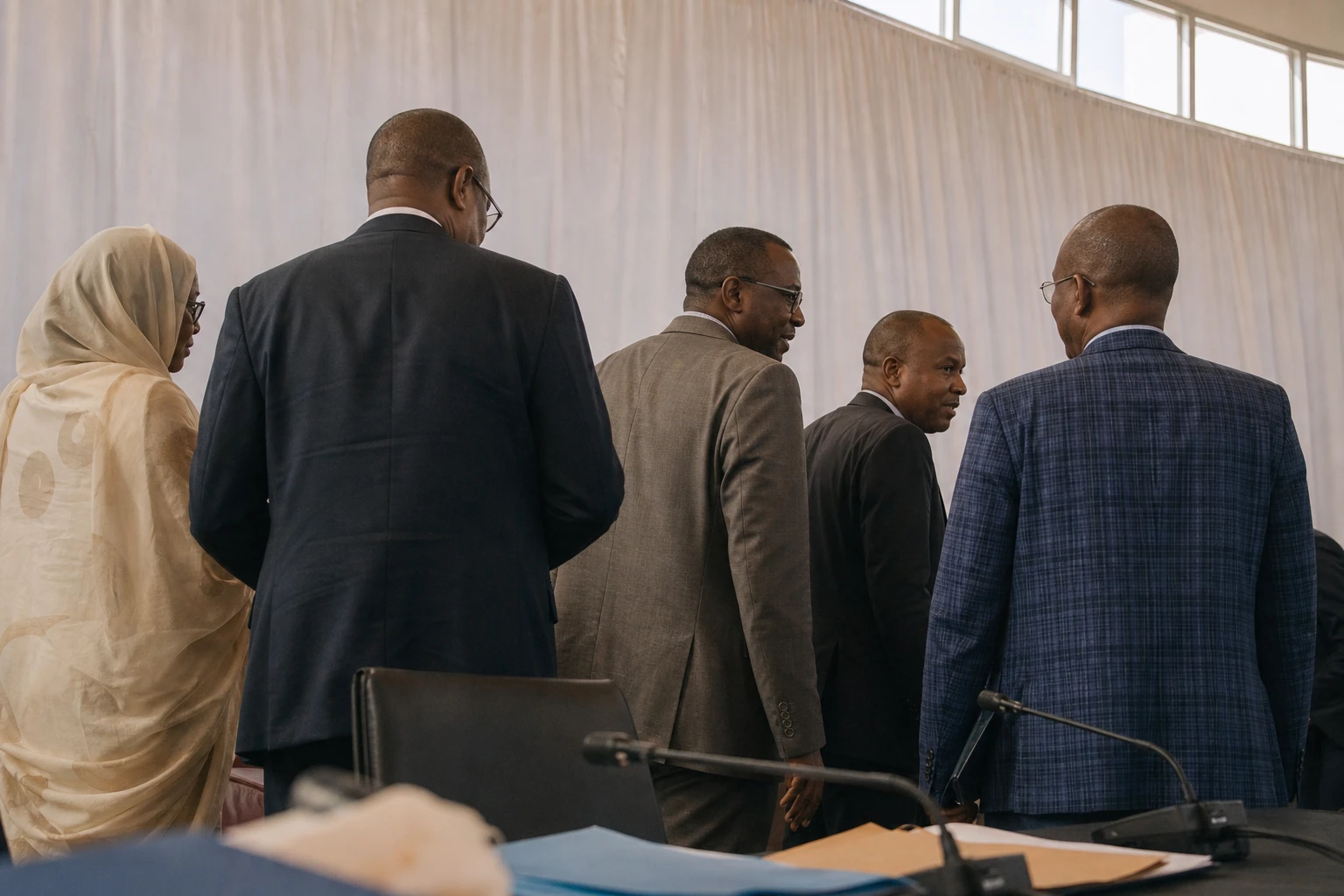
In Atar, in Adrar, the president’s visit is more than a tour of construction sites. It comes as debate over what happens after 2029 gains ground in Mauritania. The authorities are highlighting direct contact with residents and investment. The opposition, meanwhile, sees it as a political operation intended to maintain a nationwide presence and prepare public opinion for a possible extension of the president’s time in power.
A tour of the north to listen and account for progress
Mohamed Ould Cheikh El Ghazouani began his visit on Sunday 20 September 2026 in Atar, the regional capital of Adrar. The programme then includes stops in Chinguetti, Ouadane and Aoujeft, before a visit to Inchiri, notably Akjoujt and Benichab. His return to Nouakchott is scheduled for Saturday 26 September.
The Mauritanian presidency describes the tour as a field visit focused on listening to residents and monitoring development projects. In Adrar, meetings are intended to allow residents to set out their difficulties and the authorities to identify local priorities.
In Atar, the head of state defended an approach based on direct dialogue. He said his presence was intended to help him understand the problems facing the wilaya and inform citizens about the country’s broad policy direction. The Mauritanian News Agency also reported that the president had discussed current economic and geopolitical challenges.
The authorities are highlighting measures to safeguard market supplies and contain the prices of certain essential goods. A figure close to the ruling majority cited, in particular, the continued subsidies on hydrocarbons and the stabilisation of consumer prices. These announcements address a concrete concern for households, in Nouakchott as well as in regions far from the main economic centres.
Development promises set against local expectations
In Atar, Mohamed Ould Cheikh El Ghazouani also announced the electrification of 40 villages. The pledge directly affects agricultural, craft and commercial activities. It also concerns access to public services, since electricity is often essential to the operation of health centres, schools and water networks.
The president also said that 36 billion ouguiyas, or about €780 million, had been mobilised during the first six months of 2026. That figure should, however, be read precisely. It is a figure cited by the head of state as part of his account of government action. A breakdown between investment, social spending and infrastructure programmes was not provided in the information available.
In Adrar, the issue is not simply the scale of the announcements. Residents are above all waiting for visible and lasting results. Water, electricity, roads, jobs and access to healthcare remain at the centre of regional concerns. The historic towns of Chinguetti and Ouadane have considerable cultural and tourism potential. Yet their remoteness and the lack of some facilities continue to limit the economic benefits for local people.
The tour will therefore be judged on its ability to turn commitments into reliable services. An announced electrification project does not have the same impact as a network that is actually connected, maintained and affordable. Similarly, a road project can reduce isolation, but only if the work is completed and local authorities have the means to maintain it.
Opposition fears a political show
Opposition criticism is directed less at the principle of a presidential visit than at its context. Political figures say tours of the country’s interior repeat an old practice: gathering residents around the head of state, announcing new projects and presenting the president’s presence as proof of his closeness to the people.
Nouredine Mohamedou, president of the Mauritania Forward party, has challenged the effectiveness of this approach. He believes these trips are repeated without providing sufficient answers to unemployment, water problems or the lack of electricity. This view reflects a familiar divide between government communications and citizens’ day-to-day assessment of public policies.
For the ruling majority, by contrast, the visit helps address governance that is too concentrated in Nouakchott. The authorities want to show that the regions are not being forgotten and that national projects must be monitored on the ground. The two narratives therefore clash over the same event: the authorities speak of proximity and development, while the opposition denounces a political display with no sufficiently measurable record.
The controversy has been intensified by calls among circles supportive of the president to consider a third term. Mohamed Ould Cheikh El Ghazouani was elected in 2019 and re-elected in 2024 for a second term. The Mauritanian Constitutional Council recalled, at his inauguration in August 2024, that the Constitution limits presidential terms.
The president has not announced another candidacy. Nor did he present the tour in Atar as an election campaign. He did, however, say that national dialogue should not call the foundations of the state into question. That wording leaves open the debate over the dialogue’s content and timetable, and any institutional reforms that might result from it.
An issue that extends beyond Mauritania’s borders
Mauritania occupies a distinctive position in West Africa. It left the Economic Community of West African States, ECOWAS, in 2000, but retains links with the organisation as an associated partner. It is also a member of the Arab Maghreb Union and plays an important role in the Sahel’s political balance.
In a region marked by unconstitutional changes of government and tensions between military authorities and regional organisations, the question of term limits carries particular weight. Mauritania’s neighbours will be watching respect for the rules on succession, as will the African Union, of which the country is a founding member.
The next areas to watch will therefore be twofold. Domestically, attention will focus on the next steps in the national dialogue and the president’s official position on any constitutional reform. Socially, people in Adrar and Inchiri will expect the commitments announced in Atar to be delivered, particularly the electrification of villages and improvements to essential services.
In Nouakchott, as in the regions visited, the debate will not be only about the president’s popularity. Above all, it will concern the state’s ability to turn a field tour into lasting results, without confusing political visibility with progress that people actually experience.