Algeria
 Egypt
 Libya
 Sudan
 Tunisia
 Benin
 Burkina Faso
 Cabo Verde
 Côte d'Ivoire
 Ghana
 Guinea
 Guinea-Bissau
 Liberia
 Mali
 Mauritania
 Niger
 Nigeria
 Senegal
 Sierra Leone
 The Gambia
 Togo
 Cameroon
 Central African Republic
 Chad
 DR Congo
 Equatorial Guinea
 Gabon
 Republic of the Congo
 São Tomé and Príncipe
 Burundi
 Comoros
 Djibouti
 Eritrea
 Ethiopia
 Kenya
 Madagascar
 Malawi
 Mauritius
 Mozambique
 Rwanda
 Seychelles
 Somalia
 South Sudan
 Tanzania
 Uganda
 Angola
 Botswana
 Eswatini
 Lesotho
 Namibia
 South Africa
 Zambia
 Zimbabwe
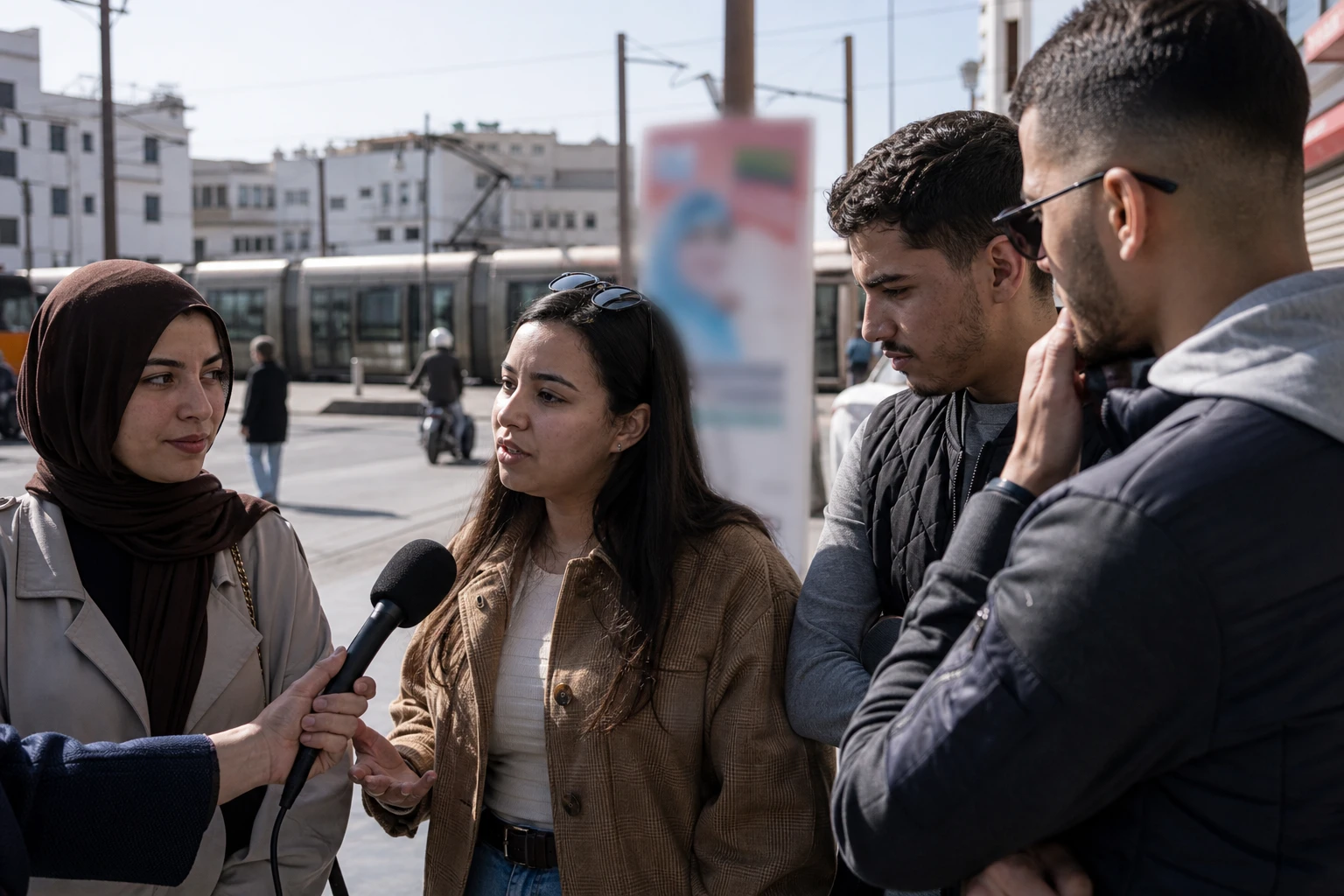
Just days before Morocco’s parliamentary elections on 23 September 2026, the real stakes are not confined to polling stations. They can also be measured in the distance between some young people and the institutions meant to represent their concerns. A year after the GenZ212 mobilisation, jobs, purchasing power and access to public services remain central to public debate.
A mobilised generation, but not yet persuaded to vote
The GenZ212 collective emerged on social media in autumn 2025. The number 212 refers to Morocco’s international telephone code. The movement quickly brought young Moroccans together around social and political demands.
Its demands included improving public education and healthcare, fighting corruption, creating jobs and ensuring more credible representation for young people. Protesters also challenged the government’s budget priorities, as Morocco invests in major sports infrastructure linked to the 2025 Africa Cup of Nations and the 2030 World Cup.
The demonstrations in September and October 2025 stood out for their decentralised organisation. Calls to action circulated on Discord, TikTok and other platforms. This approach enabled the movement to reach several cities quickly, without relying on a party or an identifiable leader.
But this strength is also a limitation. A digital collective can express anger effectively. It is harder for it to turn that energy into an election platform, a candidacy or a local presence. Street mobilisation does not automatically lead to participation at the ballot box.
The movement suspended some demonstrations after several weeks of mobilisation. It nevertheless maintained its demands. According to observers and Moroccan media, this pause did not mean the discontent had disappeared. Instead, the debate shifted to families, campuses, workplaces and social media.
Unemployment and the cost of living fuel disillusionment
For many young Moroccans, the main problem remains gaining access to an independent life. Finding a stable job, securing housing and building a family life are becoming difficult, especially in large cities where expenses are rising quickly.
The situation is even more difficult for graduates cycling between internships, short-term contracts and periods without work. Opportunities are often more limited in rural areas and medium-sized cities. Regional disparities thus deepen the sense of abandonment expressed in the 2025 protests.
Morocco’s labour market is creating jobs in several sectors, including industry, services, digital technology and infrastructure-related activities. However, this momentum is not benefiting all sections of the population equally. Young people without professional networks or suitable training remain vulnerable to precariousness.
The informal sector also plays an important role. It provides income for many families, but without guaranteeing full social protection or sufficient stability. For the young people concerned, election promises on jobs are therefore judged against a concrete experience: finding declared, lasting work.
Purchasing power adds to the daily pressure. The cost of essential goods, transport and housing weighs on households. Urban middle-class families and rural households alike have to make tougher choices about spending. In this context, macroeconomic indicators are not enough to convince people if the promised improvement is not visible in everyday life.
Education and healthcare: public services at the heart of the debate
GenZ212 placed education and healthcare at the heart of its message. This choice reflects widely shared experiences: overcrowded schools, regional inequalities, inconsistent access to healthcare and recruitment difficulties in some specialities.
Morocco has launched several reforms to strengthen social protection and modernise public services. The expansion of health insurance is a major transformation. However, having coverage does not always guarantee access to a doctor, hospital or treatment close to home.
The same is true of schools. Investment in infrastructure and curriculum reform can have lasting effects. But families also expect less overcrowded classrooms, better educational support and a more direct route into employment after their studies.
These expectations create a gap between national announcements and local reality. In Rabat and Casablanca, residents can access more services and opportunities. In remote or mountainous provinces, distances and staff shortages make reforms less tangible.
Parties face distrust that extends beyond the ballot box
Moroccan political parties are seeking to mobilise voters around economic and social platforms. Yet some young people do not identify with the existing parties. They criticise their electoral rhetoric, lack of renewal and failure to account for their actions between elections.
The problem is therefore not just abstention. It is also about representation. A young person may vote without believing that a party genuinely defends their interests. Another may stay away from the polls while closely following political debate on social media.
This shift is changing the traditional relationship between citizens and parties. Young people get their information from content creators, online groups and digital media. They quickly compare public statements, reported results and personal experiences. Political discourse is thus subject to constant scrutiny.
Elections alone will not resolve this deficit of trust. The incoming elected representatives will above all have to demonstrate their ability to oversee public policies over time. Transparency will also be an issue: what targets, what budgets and what results in employment, healthcare and education?
An election watched beyond Morocco’s borders
The vote on 23 September 2026 comes amid a regional environment in which young people are playing an increasingly prominent political role. In several North African countries and across the continent, recent protests have used social media to denounce unemployment, inequality and weak public services.
Morocco belongs to the Arab Maghreb Union, a regional organisation whose political activity remains limited. It also maintains close economic ties with West Africa, Europe and the rest of the continent. Choices on employment, training and social protection will therefore have implications beyond the national context.
For Morocco’s leaders, the challenge is twofold. They must preserve institutional stability while responding to social demands that have become more visible. For the parties, the task is to convince a generation that is no longer satisfied with general promises. For young people, the question remains open: turn the anger expressed in 2025 into political participation, or keep up the pressure from outside the system?
The election result will provide an initial indication. It will then be important to examine the make-up of the House of Representatives, the next government’s priorities and the place given to public policy in areas far from the centres of decision-making. It is on these factors, more than on campaign speeches alone, that the political response to the discontent expressed by young Moroccans will be judged.