Algeria
 Egypt
 Libya
 Morocco
 Sudan
 Benin
 Burkina Faso
 Cabo Verde
 Côte d'Ivoire
 Ghana
 Guinea
 Guinea-Bissau
 Liberia
 Mali
 Mauritania
 Niger
 Nigeria
 Senegal
 Sierra Leone
 The Gambia
 Togo
 Cameroon
 Central African Republic
 Chad
 DR Congo
 Equatorial Guinea
 Gabon
 Republic of the Congo
 São Tomé and Príncipe
 Burundi
 Comoros
 Djibouti
 Eritrea
 Ethiopia
 Kenya
 Madagascar
 Malawi
 Mauritius
 Mozambique
 Rwanda
 Seychelles
 Somalia
 South Sudan
 Tanzania
 Uganda
 Angola
 Botswana
 Eswatini
 Lesotho
 Namibia
 South Africa
 Zambia
 Zimbabwe
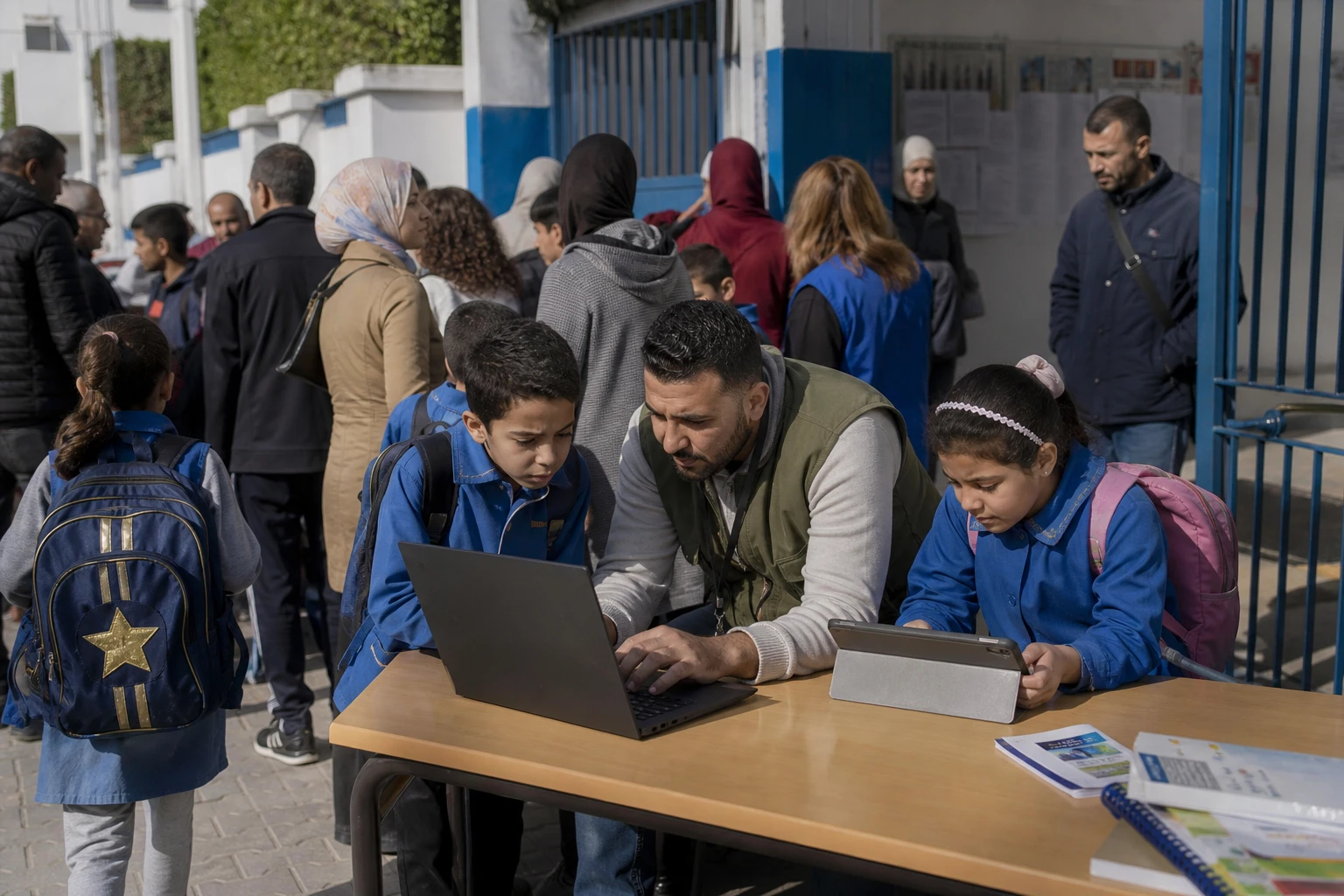
When digital technology enters schools, equipment is no longer the only question
In Tunisia, the education challenge is no longer limited to opening a classroom. It also means deciding who can access digital technology, at what age and under what conditions. In a country where primary school remains a decisive stage in narrowing learning gaps, private initiatives are now part of a broader public debate: how can pupils be given useful tools without widening the divide between better-equipped schools and the rest?
It is in this context that the Orange Tunisia Foundation is continuing its work on digital education and school solidarity. The operator is active in an environment where the Ministry of Education has already launched projects on the use of technology in teaching through the National Centre for Educational Technologies (CNTE), a public institution tasked with integrating ICT into Tunisia’s education system. The approach is therefore not new. It has, however, become more visible as Tunisian schools contend with new uses, new risks and greater expectations around educational achievement.
Schools equipped, but also supported
The Digital Schools programme, launched in 2014 with the Ministry of Education and the CNTE, is at the heart of this strategy. According to figures provided, 200 primary schools across Tunisia have benefited to date. The programme is said to have reached 67,690 pupils, with a range of equipment and content including tablets, laptops, projectors, educational games and robotics kits.
The most important figure is not simply the amount of equipment distributed. It is the programme’s duration. More than ten years after its launch, the challenge is no longer to bring digital tools into schools, but to embed them in teaching practices. The Tunisian ministry also notes in its policy documents that technology should support teacher training, digital content and learning itself. In other words, equipment only makes sense if it is used in the classroom.
The programme has also taken on a pedagogical and symbolic dimension through the WikiChallenge Écoles d’Afrique. Since 2018, 16 prizes have been awarded to pupils at Tunisian schools for their contributions published on Vikidia, the encyclopaedia for young readers. This recognition shows that Tunisia is not simply receiving equipment: it is also producing content, experiences and practices that extend beyond its borders. The competition’s African network confirms this momentum, with schools in several countries across the continent taking part in the same initiative.
The start of the school year exposes inequalities
School solidarity remains the other side of this work. According to figures provided, the 16th edition of Magic Rentrée supplied schoolbags and stationery to 1,013 pupils from 15 public primary schools. A total of 2,813 pupils are said to have benefited from the initiative since it began. Behind these figures lies a simple reality: the start of the school year is not experienced in the same way depending on family income, a school’s location or access to support networks.
In rural areas, where transport, clothing and stationery costs weigh more heavily, initiatives of this kind ease some of the burden on families. In poorer urban neighbourhoods, they play a different role: limiting visible disparities between children as the school year begins. The impact here is tangible. It affects pupils’ confidence, family organisation and schools’ ability to operate in better conditions.
This year, the Orange Tunisia Foundation ran the initiative with the association Un Enfant, Des Sourires and with the help of volunteer employees. This detail matters. It shows that social action relies not only on funding, but also on a practical chain of preparation, sorting, distribution and follow-up. At a time when institutional solidarity remains in demand, staff involvement also gives the company a more rooted image in Tunisian society.
Learning about digital technology without facing its risks alone
The second initiative for the 2026-2027 school year is ForGoodConnections, launched in 2024 to raise awareness among pupils, families and the education community about safer use of digital technology. The stated aim is to reach 260 public primary schools. The issue goes far beyond technology itself. It concerns hyperconnectivity, exposure to unsuitable content and cyberbullying — three realities now familiar to many Tunisian families, as well as families in other African countries.
This point is important in understanding the shift in focus. For a long time, digital policies concentrated mainly on access. Today, protection is taking centre stage. Pupils are no longer simply expected to learn with connected tools. They must also learn to use them without getting lost in them. This requires trained teachers, informed parents and messages suited to children’s ages.
The addition of 10 new RoboKids clubs completes the picture. Here too, the aim is not simply to introduce children to robotics. It is to stimulate creativity, reasoning and familiarity with technological tools often seen as the preserve of cities or more privileged communities. By introducing them in primary schools, the programme seeks to shift the boundary between everyday uses and the skills of the future.
A local initiative in a broader African trend
The reach of this kind of programme extends beyond Tunisia. In several African countries, education policies are seeking to make digital technology a means of promoting equal opportunity, while preventing it from becoming another source of social sorting. Tunisia, with its Ministry of Education, the CNTE and private-sector actors working on the ground, is part of this search for balance.
This period of activity also says something about the balance of power across the continent. States retain responsibility for public education services. But operators, foundations and associations are now working on the margins of the system, often where needs are most visible: equipment, support, awareness-raising and content production. The question is therefore not only who provides the funding. It is how these initiatives fit with public policies so they can endure, expand and avoid unequal coverage.
For Tunisia, the challenge in the coming months will be tangible. Progress will need to be tracked on the announced rollout of new digital schools, the expansion of RoboKids clubs and the implementation of awareness-raising in the 260 targeted public schools. The school calendar gives the issue an immediate dimension. But its significance is broader: it concerns how a North African country prepares its young people to learn, create and protect themselves in an environment where digital technology has become central.