
 Algeria
 Egypt
 Libya
 Morocco
 Sudan
 Tunisia
 Benin
 Burkina Faso
 Cabo Verde
 Côte d'Ivoire
 Ghana
 Guinea
 Guinea-Bissau
 Liberia
 Mali
 Mauritania
 Niger
 Nigeria
 Senegal
 Sierra Leone
 The Gambia
 Togo
 Cameroon
 Central African Republic
 Chad
 Equatorial Guinea
 Gabon
 Republic of the Congo
 São Tomé and Príncipe
 Burundi
 Comoros
 Djibouti
 Eritrea
 Ethiopia
 Kenya
 Madagascar
 Malawi
 Mauritius
 Mozambique
 Rwanda
 Seychelles
 Somalia
 South Sudan
 Tanzania
 Uganda
 Angola
 Botswana
 Eswatini
 Lesotho
 Namibia
 South Africa
 Zambia
 Zimbabwe
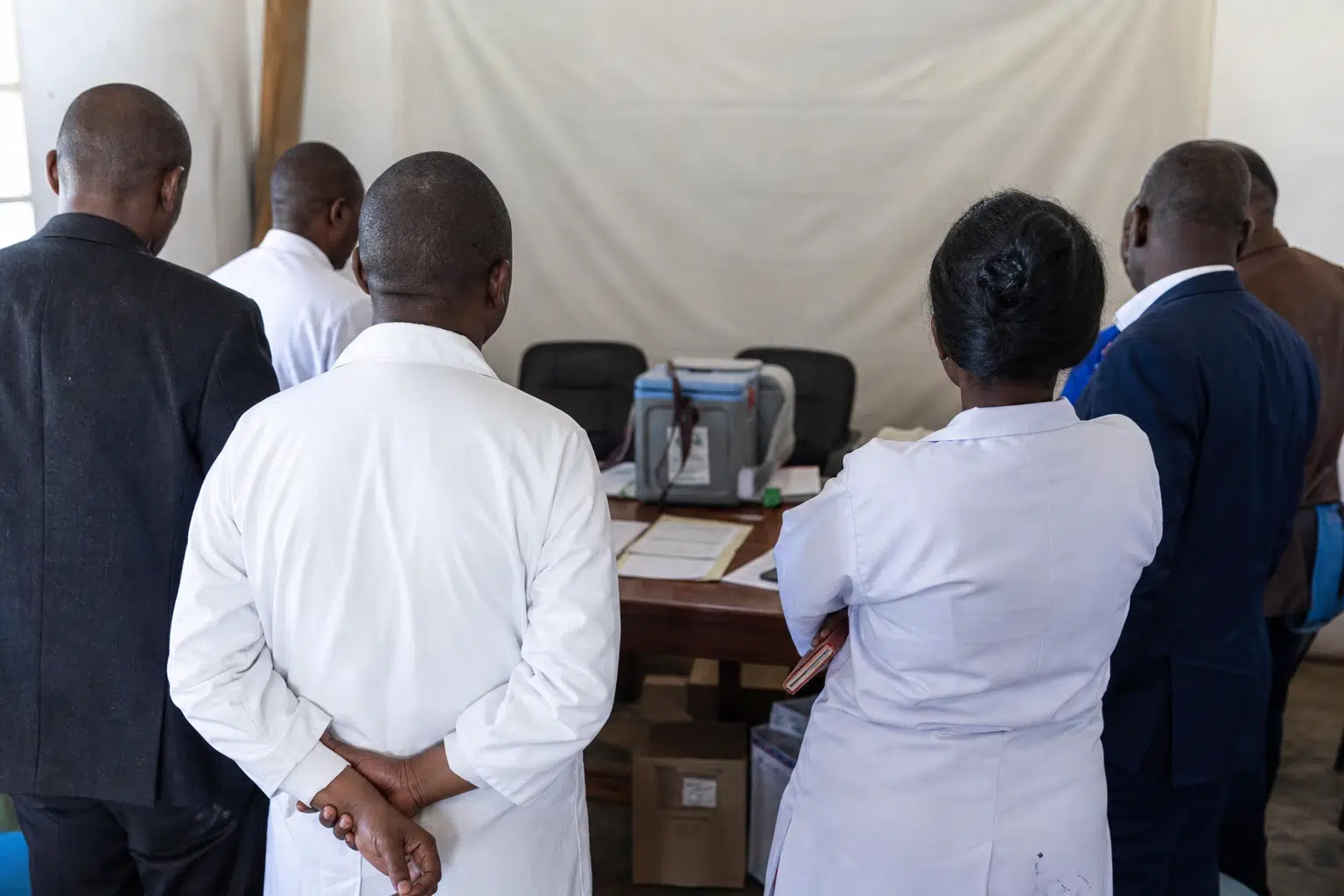
In Bunia, vaccination sends one clear message: time is of the essence
In eastern Democratic Republic of the Congo, every hour counts when Ebola is spreading. In Bunia, the capital of Ituri, the response is not limited to treating patients: it must also protect those who come into contact with them first, risking infection themselves.
The act is simple, but the message carries weight. Vaccinating health workers means recognising that they are on the front line of an outbreak advancing through a territory already weakened by insecurity, population displacement and pressure on often overstretched health centres. In a province such as Ituri, public health depends as much on hospitals as on the ability to maintain communities’ trust.
This comes against a broader national backdrop. The DRC is experiencing a new outbreak of Ebola virus disease caused by the Bundibugyo strain, distinct from the Zaire strain, against which the Ervebo vaccine has already proved effective. That difference is crucial: at this stage, the country has no vaccine specifically approved for Bundibugyo.
A targeted campaign for the most exposed staff
The campaign launched in Bunia is aimed first at health workers and frontline staff. This is no arbitrary choice. They triage patients, provide care, take samples, support families and sometimes carry out community surveillance. In other words, they are at the heart of the health response and in direct contact with the risk.
Congolese health authorities have opted to use Ervebo in a research setting, with a specific aim: to document its ability to offer cross-protection against Bundibugyo. The WHO confirmed that 70,000 doses had been released for the DRC, including 20,000 for a phase III clinical trial and 50,000 reserved for health workers and frontline responders.
The vaccine is therefore not being presented as a definitive solution. Rather, it is a tool for reducing risk while more robust data are gathered. This is a cautious but realistic approach to a strain for which there is neither an approved vaccine nor a specific treatment. In an emergency, research itself becomes an instrument of response.
On the ground, this choice also meets an operational need. When treatment centres are under pressure, patient queues grow longer and health workers face a heavy emotional burden, protecting teams helps preserve continuity of care. Without available staff, no strategy for testing, isolation or contact tracing can be sustained.
In Ituri, insecurity and a fragile health system hamper the response
Ituri is not only an outbreak zone. It is also an area where the movement of people, local tensions and instability complicate the tracing of transmission chains. The authorities and their partners face a familiar problem in health crises in Central Africa: the disease spreads faster than logistical resources, and mistrust can spread faster than information.
There are also very practical difficulties. Health workers have already denounced payment delays and strikes at some treatment centres, signs of a response under strain. When teams are exhausted or demoralised, the system becomes less responsive. And when patients arrive late, the risk of transmission rises both within families and in healthcare facilities.
The provincial government, Congolese health services, the National Institute for Biomedical Research and the WHO are therefore trying to meet two imperatives at once: provide care and generate evidence. That is the logic behind the ongoing clinical trials. The aim is not simply to vaccinate quickly, but to establish precisely what the vaccine protects against, which strain, in which groups and under what conditions.
This approach may seem slow. Yet it is essential. In a Bundibugyo outbreak, any promise made too soon would be fragile. The immediate priority remains to reduce infections among exposed staff, break chains of transmission and prevent the outbreak from spreading further beyond Ituri.
A test for the DRC and the entire Great Lakes region
The Congolese case extends beyond the provincial level. The virus respects neither administrative borders nor regional routes. That is why the response also draws on the African Union’s health cooperation mechanisms, through Africa CDC, and the WHO’s coordination mechanisms. In the Great Lakes region, where cross-border movement is constant, surveillance is as important as vaccination.
The DRC is seeking to turn an emergency into scientific capital. If Ervebo proves to offer useful, even partial, protection against Bundibugyo, that could change the options available in future outbreaks. If, on the other hand, protection proves limited, the country will at least have helped clarify a key question for the entire African scientific community.
The signal is therefore twofold. In the short term, Bunia is becoming a priority site for protecting health workers. In the medium term, Ituri is becoming a site for generating knowledge. This matters on a continent often portrayed as merely receiving solutions from elsewhere: the DRC is helping to shape the responses of tomorrow.
The coming days will bring developments on several fronts. It will be necessary to monitor the pace of vaccination, the trend in confirmed cases, the functioning of treatment centres and, above all, the preliminary trial results. The country’s ability to bring this outbreak under control without leaving behind a new area of health uncertainty will depend on them.



