Algeria
 Egypt
 Libya
 Sudan
 Tunisia
 Benin
 Burkina Faso
 Cabo Verde
 Côte d'Ivoire
 Ghana
 Guinea
 Guinea-Bissau
 Liberia
 Mali
 Mauritania
 Niger
 Nigeria
 Senegal
 Sierra Leone
 The Gambia
 Togo
 Cameroon
 Central African Republic
 Chad
 DR Congo
 Equatorial Guinea
 Gabon
 Republic of the Congo
 São Tomé and Príncipe
 Burundi
 Comoros
 Djibouti
 Eritrea
 Ethiopia
 Kenya
 Madagascar
 Malawi
 Mauritius
 Mozambique
 Rwanda
 Seychelles
 Somalia
 South Sudan
 Tanzania
 Uganda
 Angola
 Botswana
 Eswatini
 Lesotho
 Namibia
 South Africa
 Zambia
 Zimbabwe
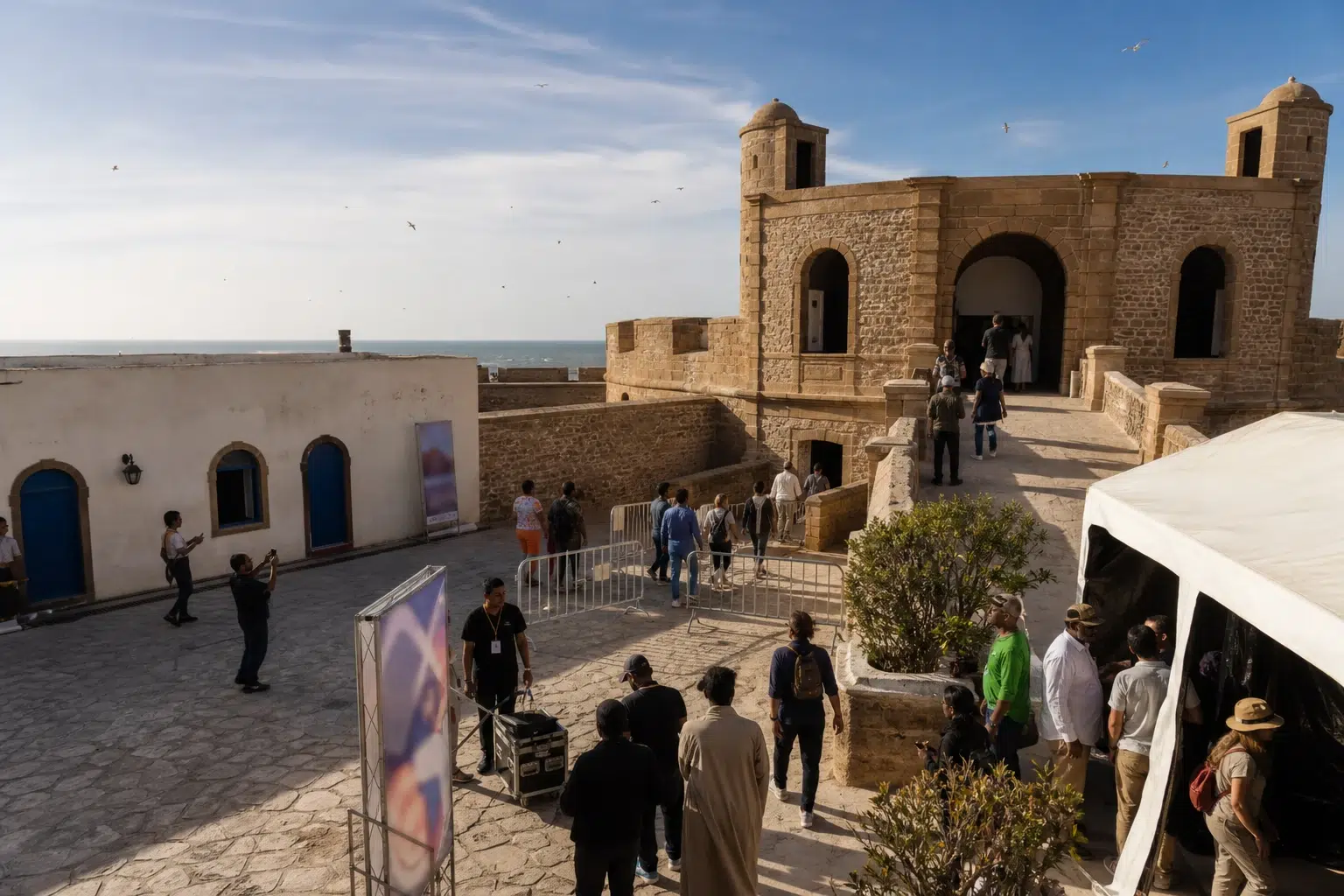
In Essaouira, a voice from the Levant shows that cultural encounters are more than a slogan
In Essaouira, the Gnaoua Festival stage does more than host a succession of concerts. It builds bridges. When Yasmine Hamdan took to it in June, her voice gave tangible form to the idea of bringing musical memories into dialogue without flattening them. The Lebanese singer, who lives in Paris and has passed through several cities during her career, delivered a restrained, taut, almost intimate set, far from showmanship. Moroccan audiences found a festival that makes Moroccans spectators of the world, from Rabat to Essaouira, while keeping at its heart a local tradition that has become part of the world’s heritage.
This gathering does not take place in a cultural vacuum. Gnaoua culture, inscribed in 2019 on UNESCO’s Representative List of the Intangible Cultural Heritage of Humanity, is an integral part of Moroccan identity, while also carrying a broader history linked to African and Mediterranean exchange. The Essaouira festival is therefore part of a clear national trajectory: preserving a living heritage while also exposing it to contemporary forms that speak to different audiences. For Morocco, events of this kind also matter for the country’s image, cultural diplomacy and local economy, in a city strongly shaped by tourist flows and seasonal activity.
An artist shaped by several countries, languages and ways of listening
Born in Lebanon, Yasmine Hamdan has forged her musical world between Beirut, Kuwait, Greece and Paris. Her official website says she first came to prominence with Soapkills, an electronic indie duo she co-founded in the late 1990s, before embarking on an internationally acclaimed solo career. This personal geography matters to her music. It explains a way of singing that does not seek uniformity, but instead brings pop, electronic music, Arab heritage and the poetry of vocal inflections into contact.
Her career also sheds light on her approach. The artist says she spent years listening to old Arabic music, particularly figures such as Asmahan and Mohammed Abdel Wahab, not to copy them, but to absorb their rhythms, melodies and appetite for experimentation. This detail matters. It shows a musician treating memory as living material, not as a museum. In a musical landscape often divided between tradition and modernity, she instead embraces permeability. This is precisely the kind of exchange that the Gnaoua Festival seeks to make visible in Essaouira.
The June concert: stage restraint, maximum intensity
On 28 June 2026, SNRT News described her performance in Essaouira as one of the most distinctive concerts of the 27th edition of the Gnaoua and World Music Festival. The concert took place at Borj Bab Marrakech. According to the report, the artist relied on precision, restraint and contained emotion, carried by delicate electronic arrangements. The festival had already announced her appearance in its official programme, alongside Moroccan and international artists from India, Palestine, France, Ethiopia and the United States.
This restraint is not a retreat. It is a stagecraft choice. At a festival often associated with trance, fusion and large ensembles, Yasmine Hamdan chose a different path: few effects, but a strong presence. That contrast matters. It is a reminder that a pan-African and Mediterranean festival is not defined solely by collective energy. It can also welcome more sparse, inward-looking forms without losing its power. For Moroccan audiences, this diversity broadens the very definition of world music. It avoids reducing Gnaoua to a single image.
What her presence says about Morocco and the region
The Essaouira Gnaoua Festival occupies a distinctive place in Morocco’s cultural landscape. The 2026 edition took place from 25 to 27 June and brought together 460 artists, according to SNRT News. Another article by the same source mentions more than 300,000 visitors by the close of the edition. Beyond the figures, the stakes are clear: Morocco is showing that it can keep an ancient heritage alive in a contemporary setting without distorting it. It is also a signal to the North African region: culture can become a space for influence, exchange and cooperation, not merely tourist consumption.
The festival also built its programme around a powerful idea: port cities as places of cultural mixing. Essaouira is a natural fit. Open to the Atlantic, the city reflects artists whose lives have been shaped by travel, departures, returns and multiple languages. Yasmine Hamdan fits this setting perfectly. Her career connects the Levant, Europe and the contemporary Arab scene. Her presence in Essaouira says something broader: the Mediterranean and North Africa are not cultural margins, but centres of artistic reinvention.
Local impact also deserves attention. For Essaouira, these few days of festival concentrate media attention, travel, hotel and restaurant activity, and informal economic activity. For Moroccan artists, the Gnaoua stage remains a space for transmission and visibility. For Morocco, it is also a marker of cultural diplomacy. The country is showing that it can host an African, Arab, European and American programme without losing its roots. And for the continent, events of this kind are a reminder that ambitious cultural policy can tell Africa’s story differently: through exchange, creativity and shared memory.
What to watch after Essaouira
The significance of this evening goes beyond the concert itself. The Gnaoua Festival continues to strengthen a format in which Moroccan heritage provides a foundation for transcontinental dialogue. This also explains its resonance beyond Morocco. In a region where cultural scenes often struggle to exist amid economic constraints and political instability, Essaouira offers another path: start from a strong local heritage, then open it to the world. Yasmine Hamdan found a setting suited to her. The festival, meanwhile, has confirmed that it can welcome artists who see music as a language of passage.