
 Algeria
 Egypt
 Libya
 Morocco
 Sudan
 Tunisia
 Benin
 Burkina Faso
 Cabo Verde
 Côte d'Ivoire
 Ghana
 Guinea
 Guinea-Bissau
 Liberia
 Mali
 Mauritania
 Niger
 Nigeria
 Senegal
 Sierra Leone
 The Gambia
 Togo
 Cameroon
 Central African Republic
 Chad
 Equatorial Guinea
 Gabon
 Republic of the Congo
 São Tomé and Príncipe
 Burundi
 Comoros
 Djibouti
 Eritrea
 Ethiopia
 Kenya
 Madagascar
 Malawi
 Mauritius
 Mozambique
 Rwanda
 Seychelles
 Somalia
 South Sudan
 Tanzania
 Uganda
 Angola
 Botswana
 Eswatini
 Lesotho
 Namibia
 South Africa
 Zambia
 Zimbabwe
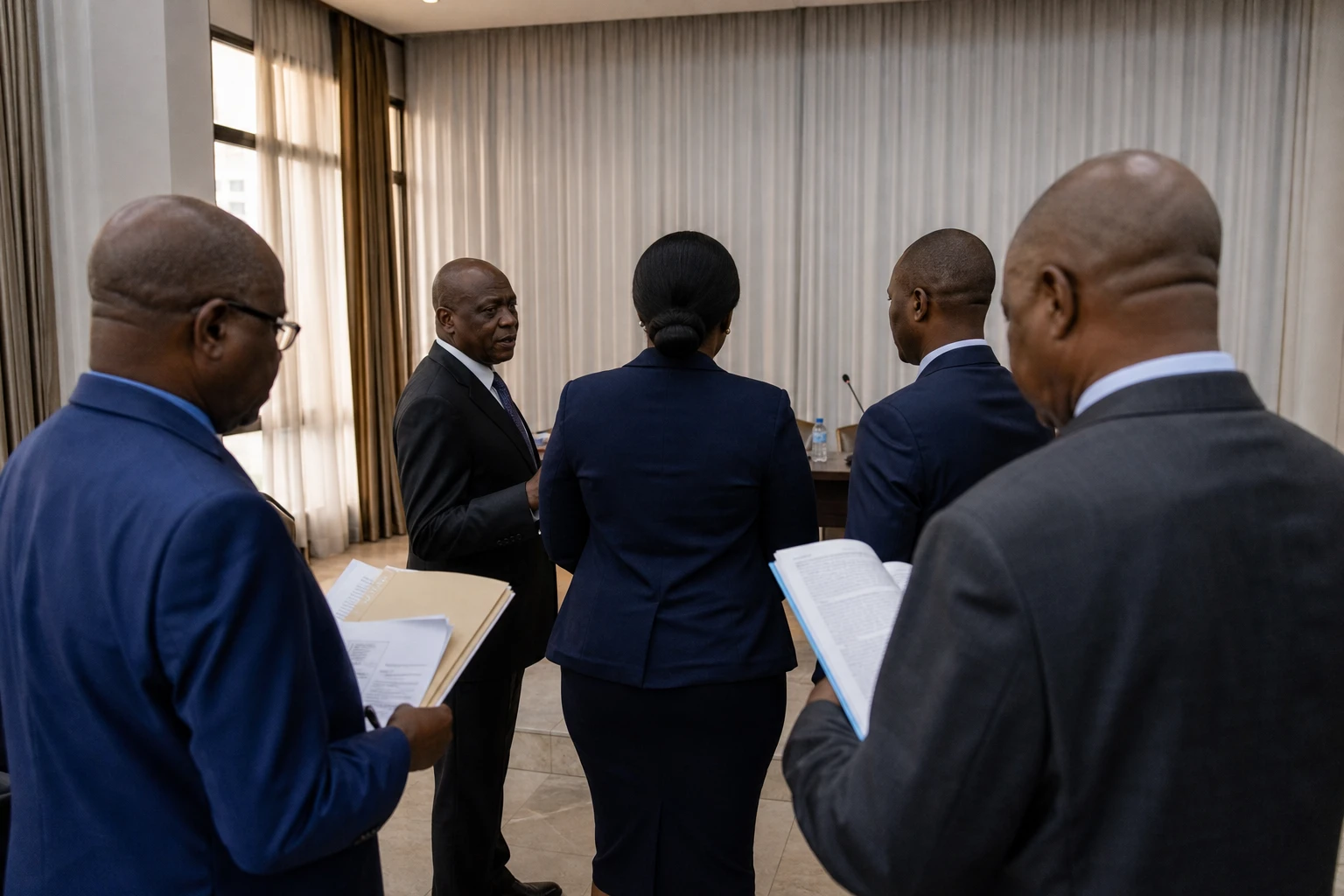
In Kinshasa, a political march is never just a march. It often becomes a test of strength between the opposition, the government, the police and supporting groups competing for public space. On 15 September 2026, the C64 coalition’s mobilisation against any proposed constitutional change brought that reality into focus, with clashes, mutual accusations and, above all, a central question for Congolese people: who still protects the right to demonstrate in the capital?
An authorised march, but an already tense climate
The Congolese political context gives this episode significance beyond the day of 15 September alone. The Constitution of the Democratic Republic of the Congo protects the right to demonstrate, while Article 220 notably bars any limitation on the number of presidential terms. This legal framework fuels the political battle over any idea of constitutional revision.
The C64, an opposition coalition bringing together several Congolese political forces, had announced in mid-August a peaceful march across the country to denounce any possible constitutional change. On the eve of the mobilisation, the CNDH itself had called on the authorities to “prevent rather than repress”, stressing that the right to demonstrate must remain peaceful and be regulated in a way that respects civil liberties.
In Kinshasa, the march was due to converge on the city’s institutional centre, near the Palais du Peuple, where the parliamentary session usually opens in September. The coincidence of a street mobilisation with a major institutional moment heightened tensions. The Congolese National Police had announced a substantial security operation, while several meeting points had been made public the previous day.
What happened in the Congolese capital
On the day of the march, incidents broke out before the procession reached its destination. Radio Okapi reported a major security deployment and demonstrators moving along Lumumba Boulevard in Limete, before the situation became tense. Actualité.cd reported that clashes had broken out between demonstrators and pro-government activists, before police dispersed them with tear gas.
The National Human Rights Commission says it sent observers to the scene. Its statement refers to human rights violations and says an observation mission saw people carrying, among other things, sticks and machetes. The CNDH said it would continue its work to produce a report on the events.
The police, for their part, described a day under close surveillance and said that no deaths had been reported in their account at that stage. On the ground, however, the opposition described a day marked by violence, makeshift roadblocks and a forceful dispersal before the march reached the Palais du Peuple. At this stage, casualty figures should therefore be treated with caution and attributed to the source making the claim.
The “Forces of Progress”, the government and the battle over the narrative
The dispute escalated on the political narrative front. The civic movement Lucha denounced the use of young people armed with machetes and sticks, whom it said it had identified as members of the “Forces of Progress”, a group the opposition describes as close to the UDPS, the presidential party. This affiliation is reported by critics of the government and should not be confused with formal institutional recognition of the group.
Jacques Issongo, a Lucha activist, said these groups were not there to observe the demonstration but to attack, assault and injure opposition figures and members of civil society. He also accused the police of acting in collusion with these young people. Here again, these are allegations reported by someone on the ground, not an established judicial finding. In a country where political demonstrations are often closely scrutinised, the line between security management and street intimidation has become a major issue.
The episode also highlights the fragility of the political climate in Kinshasa. On the one hand, the government says public order must be preserved, especially amid parliamentary sessions and national tensions. On the other, the opposition and civil society argue that a debate on the Constitution cannot be emptied of meaning by force. By calling for prevention rather than repression, the CNDH has positioned itself on this fault line.
What this episode says about the DRC and the region
For Congolese people, the stakes go beyond the march itself. They concern the credibility of democratic rules, the ability of institutions to manage dissent without distorting it, and the already fragile trust between public authorities and citizens. In the capital, political activity now takes place as much in the streets as in institutions. In the provinces, its effects spread even more quickly, because local branches of the state, political parties and civic movements do not always have the same means of control or protection.
Regionally, the DRC is watched by the SADC, of which it is a member, and by the African Union, because any tension over presidential terms and civil liberties resonates beyond Kinshasa. In Central Africa, where the question of institutional transitions remains sensitive, each episode of this kind feeds a wider debate about the place of the vote, checks and balances, and the streets as a space for political expression.
What happens next will depend on three factors: the CNDH’s promised report, the response of the authorities in Kinshasa, and whether the opposition maintains its political pressure. In the Democratic Republic of the Congo, a halted march does not necessarily bring political conflict to an end. It shifts it, documents it and prolongs it in the days that follow.



