Algeria
 Egypt
 Libya
 Morocco
 Sudan
 Tunisia
 Benin
 Burkina Faso
 Cabo Verde
 Côte d'Ivoire
 Ghana
 Guinea
 Guinea-Bissau
 Liberia
 Mali
 Mauritania
 Niger
 Nigeria
 Senegal
 Sierra Leone
 The Gambia
 Togo
 Cameroon
 Chad
 DR Congo
 Equatorial Guinea
 Gabon
 Republic of the Congo
 São Tomé and Príncipe
 Burundi
 Comoros
 Djibouti
 Eritrea
 Ethiopia
 Kenya
 Madagascar
 Malawi
 Mauritius
 Mozambique
 Rwanda
 Seychelles
 Somalia
 South Sudan
 Tanzania
 Uganda
 Angola
 Botswana
 Eswatini
 Lesotho
 Namibia
 South Africa
 Zambia
 Zimbabwe
Civic rights under pressure in a country still marked by insecurity
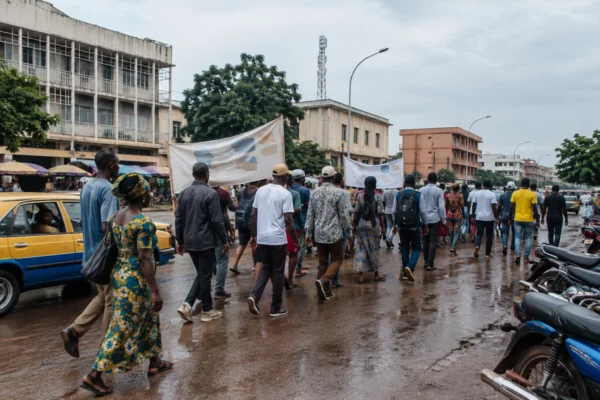
In the Central African Republic, human rights are not just a matter of grand declarations in Bangui. They are also at stake in remote villages in Haut-Mbomou, along the mining tracks of Ombella-M’Poko, and in the power struggles between the state, armed groups and ordinary citizens. In a country where the combined elections of December 2025 left some areas vulnerable, protecting civilians remains a practical test of the state’s ability to govern without violence.
This context is part of a broader trajectory: the Central African Republic remains a member of CEMAC, the economic organisation of Central Africa, and continues to be closely monitored by MINUSCA, the United Nations mission deployed to stabilise the country. Regionally, the quality of the rule of law in CAR therefore matters well beyond Bangui, because it affects cross-border security, civilian movements and the credibility of African human rights protection mechanisms.
What rights defenders are documenting: hostages, impunity and shrinking public space
The report presented in Bangui first highlights the situation of three state agents who are still being held after the attack on Bambouti, in Haut-Mbomou, in late December 2025. MINUSCA confirmed that the attack, attributed to AAKG elements, prevented elections scheduled for that day from taking place and triggered population movements towards South Sudan. Human rights defenders are calling for the release of the hostages to remain a national priority, because as long as an administrative official can be captured for many months, the state’s authority on the ground remains incomplete.
The report also stresses the shrinking of civic space. In practice, this term refers to the growing difficulty for citizens, journalists and activists to criticise those in power or document abuses without risk. The assessment echoes that of Human Rights Watch, which noted in 2026 the return of press offences to Central African law, after their decriminalisation in 2020. Amnesty International, for its part, has reported a deterioration in the environment for civil liberties and conflict-related sexual violence, confirming that pressure on freedoms is not confined to a single issue.
Civil society also points to several crimes that have yet to receive a clear judicial response, notably the murder of Father Crépin Martial Monga in Zémio in June 2026, and the deaths of Swiss geologist Lucca Maggini and his aide-de-camp in Damara in August 2026. In both cases, the issue goes beyond the crime itself: it touches on road safety, the movement of civilian personnel and confidence in investigations. In a country where serious crimes keep occurring, impunity eventually becomes a political language in its own right.
Nationality, mining and the Cameroonian border: three highly political issues
The report also addresses the case of opposition figure Anicet-Georges Dologuélé, at the centre of a standoff over his nationality and travel documents. The issue took on national significance after his diplomatic passport was confiscated in spring 2026, followed by debate over the procedure for reinstating him as a Central African national. Legally, the question relates to the 2023 Constitution and the nationality code; politically, it raises questions about the space left for the opposition at a time when electoral competition remains tense.
The LCDH also draws attention to the mining sector, particularly the Zamboï gold-mining site near the Cameroonian border. A deadly landslide was reported there on 18 August 2026. The authorities and rights defenders stress that the presence of foreign workers in some mining areas must be subject to the authorisations required under the national mining code. This is a sensitive issue, because artisanal gold mining generates local income but also fuels informal networks, repeated accidents and disputes over oversight between the administration, operators and local communities.
At heart, these issues all point to the same thing: in CAR, human rights are not a separate sector but a gauge of governance. When the border is porous, mines escape effective control and justice is slow to deliver rulings, the population pays a heavy price while the state loses credibility. CEMAC, which monitors the stability of its member states for both political and economic reasons, therefore also views Bangui through this lens.
A Central African Republic moment that matters across Central Africa
The significance of this issue extends beyond the Central African Republic’s borders. The violence in Bambouti showed how a local flashpoint can quickly become a cross-border problem, with refugees fleeing to South Sudan and security repercussions along routes in Haut-Mbomou. The handling of hostages, civilian protection and control of mining areas are therefore of interest to the whole of Central Africa, where several states face the same tensions between proclaimed sovereignty and fragmented armed presence.
Meanwhile, assessments published in 2026 by MINUSCA, the United Nations Independent Expert on human rights and several NGOs point to a country where some gains remain — including occasional judicial progress and monitoring mechanisms — but where freedoms remain vulnerable. The question to watch is now less about the assessment than the response: credible investigations, effective protection for defenders, clarification of political rules and genuine control of mining areas. For Bangui and the region alike, this is where the difference lies between superficial stabilisation and lasting consolidation.