
 Algeria
 Egypt
 Libya
 Morocco
 Sudan
 Tunisia
 Benin
 Burkina Faso
 Cabo Verde
 Côte d'Ivoire
 Ghana
 Guinea
 Guinea-Bissau
 Liberia
 Mali
 Mauritania
 Niger
 Nigeria
 Senegal
 Sierra Leone
 The Gambia
 Togo
 Cameroon
 Central African Republic
 Chad
 Equatorial Guinea
 Gabon
 Republic of the Congo
 São Tomé and Príncipe
 Burundi
 Comoros
 Djibouti
 Eritrea
 Ethiopia
 Kenya
 Madagascar
 Malawi
 Mauritius
 Mozambique
 Rwanda
 Seychelles
 Somalia
 South Sudan
 Tanzania
 Uganda
 Angola
 Botswana
 Eswatini
 Lesotho
 Namibia
 South Africa
 Zambia
 Zimbabwe
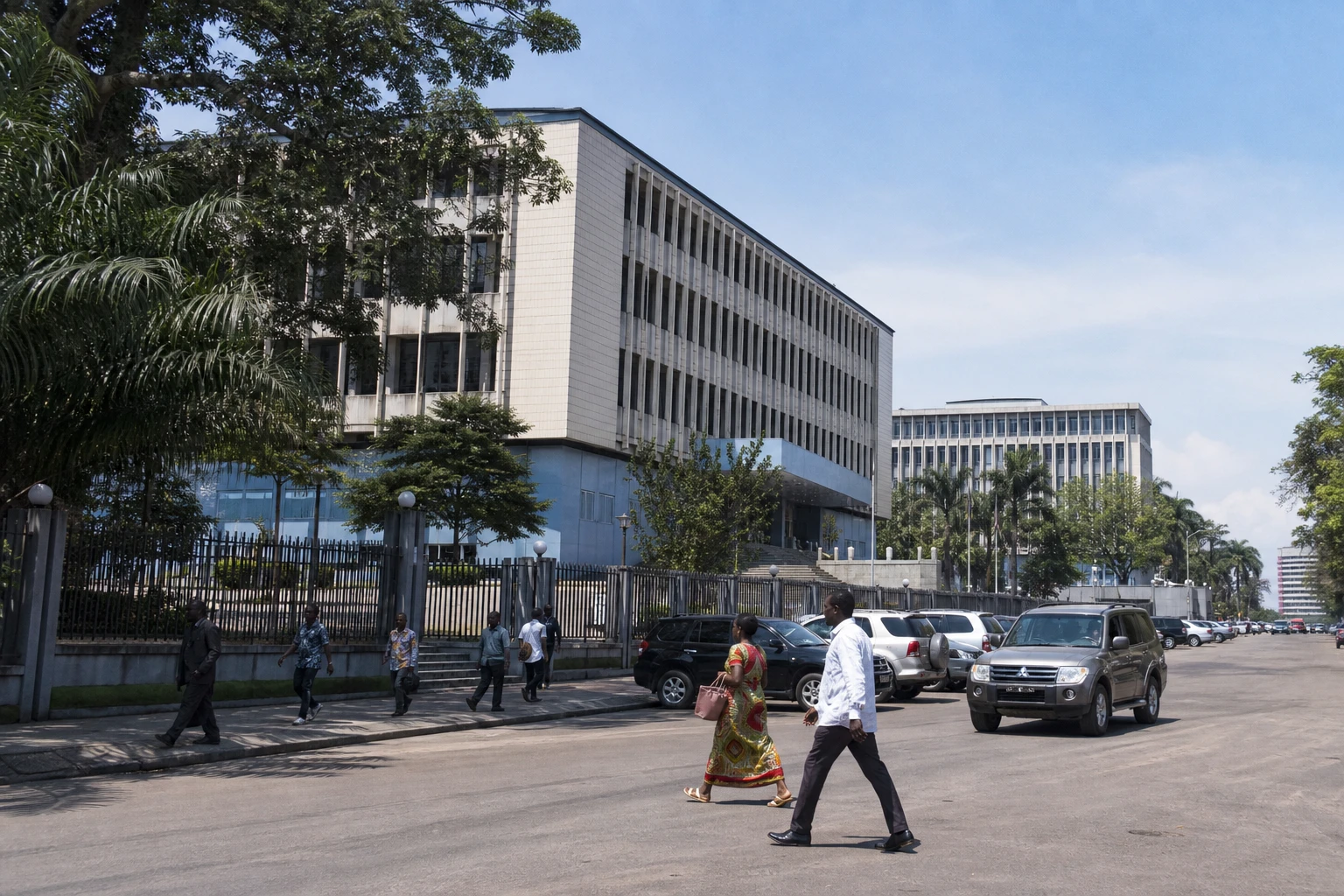
Kinshasa seeks a visible response to a daily problem
In Kinshasa, sanitation is no longer just a matter of appearances. It affects traffic, health, markets and neighbourhood life. In a city of more than 15 million people, every pile of rubbish quickly becomes as much a political issue as an urban problem. The Congolese authorities have therefore opted for a tightly supervised approach: assigning some of the clean-up work to young people who have passed through the National Service, a paramilitary reintegration body under the authority of the Presidency.
The decision is part of a broader sequence of events. Since late May 2026, a task force has been coordinating sanitation and mobility in the capital. On 8 June 2026, the Presidency brought together the main officials involved, including the governor of Kinshasa and several members of the government, to launch a more direct response to urban congestion. A few weeks later, operations were rolled out along strategic routes, notably between the Limete Interchange and N’djili airport.
Former offenders reintegrated through a public works project
On 21 June 2026, an initial group of 600 National Service workers arrived in Kinshasa to help clean up the capital. Those in charge of the operation said that more than 4,000 former “urban bandits”, often known as kuluna, were expected to follow in the coming days. These figures were later reported and confirmed by Congolese media that followed the programme on the ground.
The principle is simple in intent, but more complex in its effects: young people arrested for urban banditry are placed in a disciplinary framework, trained in trades and then mobilised for work in the public interest. The National Service command describes this approach as rehabilitation through work and supervision. The institution also notes that the Kaniama Kasese centre, in Haut-Lomami, was initially designed to reintegrate young people involved in the kuluna phenomenon before expanding its remit to other groups from several provinces.
This is not an isolated case. Since 2021, the same programme has been used to transfer young people arrested for urban crime to Kaniama Kasese, with the stated aim of providing them with training and a place in the formal or semi-formal economy. In April 2024, an initial group of 1,600 former kuluna had already returned to Kinshasa after a lengthy rehabilitation programme. In other words, the Congolese capital is not witnessing an improvised experiment, but the expansion of a model that the authorities want to establish for the long term.
Urban policy combining security, reintegration and productivity
This strategy says much about the situation facing the Democratic Republic of Congo. On the one hand, the state wants to show that it is taking back control of sanitation and public order in Kinshasa, a capital often seen as a reflection of its real capabilities. On the other, it is seeking a practical way to address a dual social challenge: street crime and youth unemployment. The use of the National Service makes it possible to turn some of this population into a visible, disciplined workforce that can be presented as a political success.
For residents, the impact is immediate. A cleared street, a cleaned drain and removed rubbish can change daily life far more quickly than a lengthy speech about urban reform. But the operation’s success will depend on continuity. Kinshasa suffers less from a temporary shortage of volunteers than from a structural lack of waste collection, planning, local funding and organisation of waste flows. Without a lasting chain for collection, transport and treatment, a one-off clean-up risks being little more than a catch-up effort.
The choice of military-style supervision also raises questions about the approach. The authorities see it as a tool for discipline and retraining. Some members of the public see it as a quick way to get results. But this model places young people who have passed through a military-style institution at the centre of civilian tasks, with objectives that combine reintegration, public order and productivity. This hybrid approach is typical of the DRC today, where responses to social problems often rely on highly centralised administrative structures.
Beyond Kinshasa, a signal for Central Africa
The issue extends beyond the Congolese capital. Across Central Africa, several major cities face the same threefold challenge: rapid urban growth, overstretched municipal services and a large youth population, sometimes without stable employment. The Congolese approach will therefore interest local decision-makers as well as regional observers, because it seeks to combine social reintegration and public service in a single mechanism. The Southern African Development Community, of which the DRC is a member, is also closely monitoring issues of internal stability and governance in the country, given their impact on the wider sub-region.
One fundamental question remains: can this model become a genuine path out of marginalisation, or is it merely an emergency response to a visible problem? The coming months will show whether the young people sent to clean up Kinshasa gain lasting opportunities for integration, with skills, jobs and follow-up, or whether they serve only as a temporary solution for a capital still waiting for a more structured urban policy. That is where the true significance of this Congolese initiative will be determined.



