
 Algeria
 Egypt
 Libya
 Morocco
 Sudan
 Tunisia
 Benin
 Burkina Faso
 Cabo Verde
 Côte d'Ivoire
 Ghana
 Guinea
 Guinea-Bissau
 Liberia
 Mali
 Mauritania
 Niger
 Nigeria
 Senegal
 Sierra Leone
 The Gambia
 Togo
 Cameroon
 Central African Republic
 Chad
 Equatorial Guinea
 Gabon
 Republic of the Congo
 São Tomé and Príncipe
 Burundi
 Comoros
 Djibouti
 Eritrea
 Ethiopia
 Kenya
 Madagascar
 Malawi
 Mauritius
 Mozambique
 Rwanda
 Seychelles
 Somalia
 South Sudan
 Tanzania
 Uganda
 Angola
 Botswana
 Eswatini
 Lesotho
 Namibia
 South Africa
 Zambia
 Zimbabwe
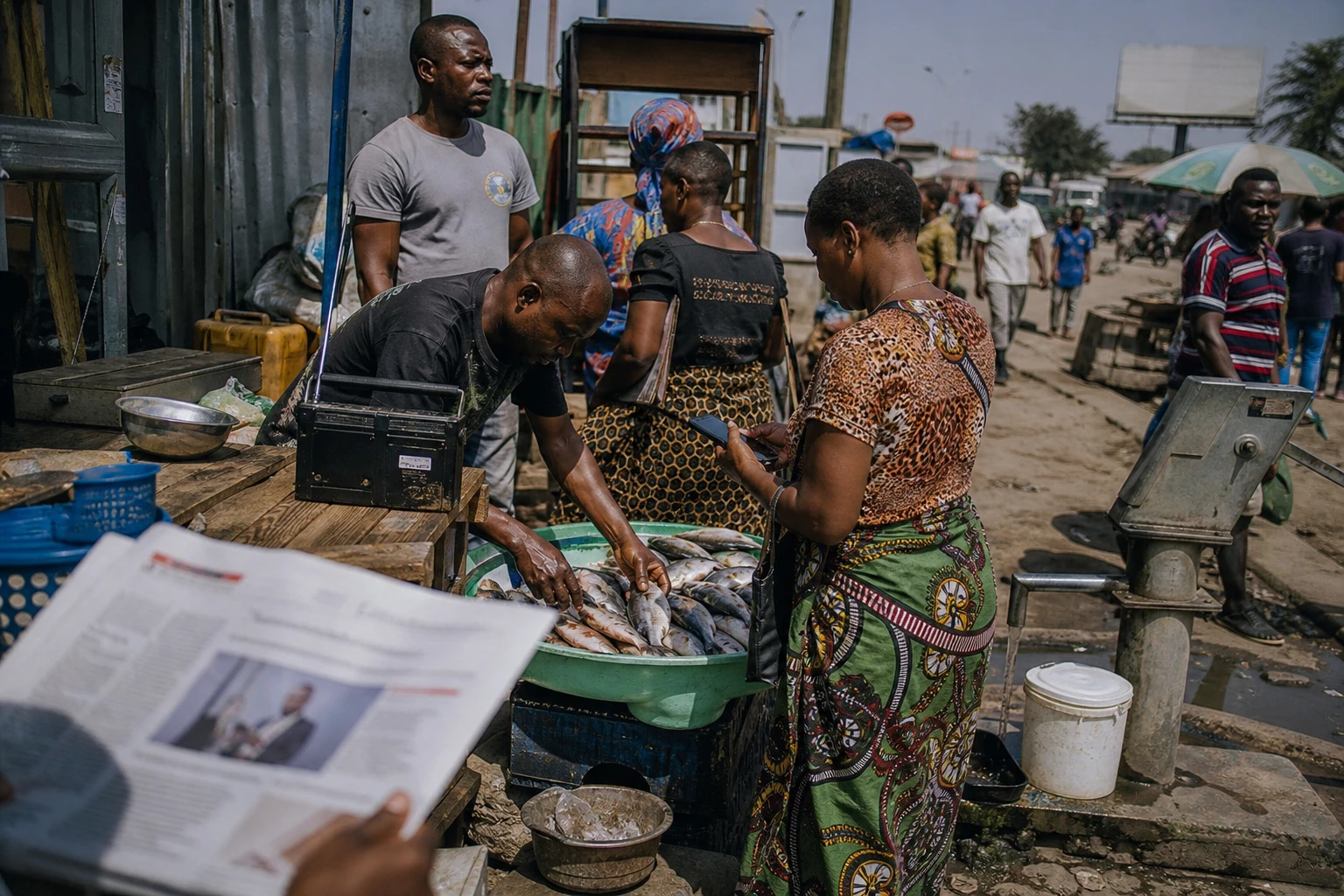
In Lubumbashi, a health alert also highlights copper’s hidden cost
In the copper capital, water is never a purely local issue. It affects families’ health, food supplies in riverside neighbourhoods and the reputation of a city whose economy depends heavily on the mining sector. When fish suddenly die in a river running past industrial facilities, the first question is not just ecological. It is economic and social, too.
In Lubumbashi, in Haut-Katanga, vigilance is all the greater because the city has already experienced other episodes of pollution linked to extractive activities. The case that emerged in September 2026 is therefore part of a longer history of tensions between the mining industry, environmental monitoring and riverside residents’ right to clean water. In the DRC, the legal framework specifically requires impact assessments and the self-monitoring of effluent at facilities likely to affect the environment.
What is known, and what remains to be established
On 14 September 2026, several dead fish, including catfish, were spotted in the Lubumbashi River, in the Mampala neighbourhood. The alert first spread on social media, then was picked up by local media. Municipal councillors went to the site to assess the situation, while residents said they had collected fish without initially knowing whether they were safe to eat.
So far, no results from independent tests of the water or fish have been published. This is the central issue in the case. Without laboratory measurements, it is impossible to determine the exact cause of the deaths. Suspicions nevertheless centre on pollution from mining, because the river passes near the facilities of the Société pour le traitement du terril de Lubumbashi, or STL.
The company denies any link to the incident. Its managing director says water associated with the site is monitored every day and circulates in a closed loop, with no discharge into the river. He also says pH readings remain within the limits set by mining regulations. These statements should be understood as the operator’s account, not as sufficient proof that the site poses no environmental risk.
The STL is not just another company in the Congolese industrial landscape. It is a subsidiary of Gécamines, a historic player in the country’s mining sector, and recently reached a symbolic milestone with its first exports of germanium concentrates produced from the Big Hill tailings in Lubumbashi. This matters because it is a reminder that the strategic value of certain minerals should not eclipse the need to monitor waste and process water.
A precedent that shapes how the case is viewed
The Lubumbashi River does not exist in a vacuum. In November 2025, a pollution incident blamed on the mining company Congo Dongfang Mining, or CDM, had already caused serious concern in the city. In February 2026, an interministerial commission referred to a compensation process and clean-up operations under way. In other words, the authorities and residents already have a recent precedent in mind, heightening sensitivity around the current case.
The accumulation of incidents raises a broader question: are environmental monitoring mechanisms really keeping pace with the expansion of mining in the south-east of the DRC? Congolese law nevertheless sets out clear obligations. It regulates discharges into water, requires effluent monitoring and prohibits several forms of dumping that pose toxicity risks. The problem is therefore not just a legal one. It is also a matter of practical enforcement, on-the-ground oversight and trust between companies, the authorities and the public.
For riverside residents, the consequences are immediate. A river suspected of being polluted can disrupt artisanal fishing, food supplies and domestic uses. In low-income neighbourhoods, where tap water is not always available continuously, even the smallest environmental alert has very tangible implications. For mining companies, by contrast, the stakes are twofold: preserving their social licence to operate and preventing every incident from becoming a reputational crisis.
What the case says about the DRC’s mining sector and the region
The events in Lubumbashi go beyond Haut-Katanga. They speak to a continental debate about the governance of strategic minerals. The DRC wants to capture more value from its mining chain, including through processed products such as germanium. But this move up the value chain can only be sustainable if it is accompanied by credible and verifiable environmental standards.
Across Central and Southern Africa, where the DRC plays a major role in copper, cobalt and industrial by-product supply chains, the question of mining pollution is also one of regional governance. Lubumbashi’s riverside residents are not asking for statements of principle. They expect independent tests, clearly established responsibilities and, if necessary, remedial measures. The sector’s credibility now depends on this.
What happens next will therefore depend less on rumours than on evidence. If the tests confirm an industrial source, the precise origin of the discharge, its chemical composition and its health impact will have to be identified. If they rule out mining, that will have to be demonstrated with the same transparency. In an urban and mining basin such as Lubumbashi’s, trust cannot be decreed. It is built on evidence.



