
 Algeria
 Egypt
 Libya
 Morocco
 Sudan
 Tunisia
 Benin
 Burkina Faso
 Cabo Verde
 Côte d'Ivoire
 Ghana
 Guinea
 Guinea-Bissau
 Liberia
 Mali
 Mauritania
 Niger
 Nigeria
 Senegal
 Sierra Leone
 The Gambia
 Togo
 Cameroon
 Central African Republic
 Chad
 Equatorial Guinea
 Gabon
 Republic of the Congo
 São Tomé and Príncipe
 Burundi
 Comoros
 Djibouti
 Eritrea
 Ethiopia
 Kenya
 Madagascar
 Malawi
 Mauritius
 Mozambique
 Rwanda
 Seychelles
 Somalia
 South Sudan
 Tanzania
 Uganda
 Angola
 Botswana
 Eswatini
 Lesotho
 Namibia
 South Africa
 Zambia
 Zimbabwe
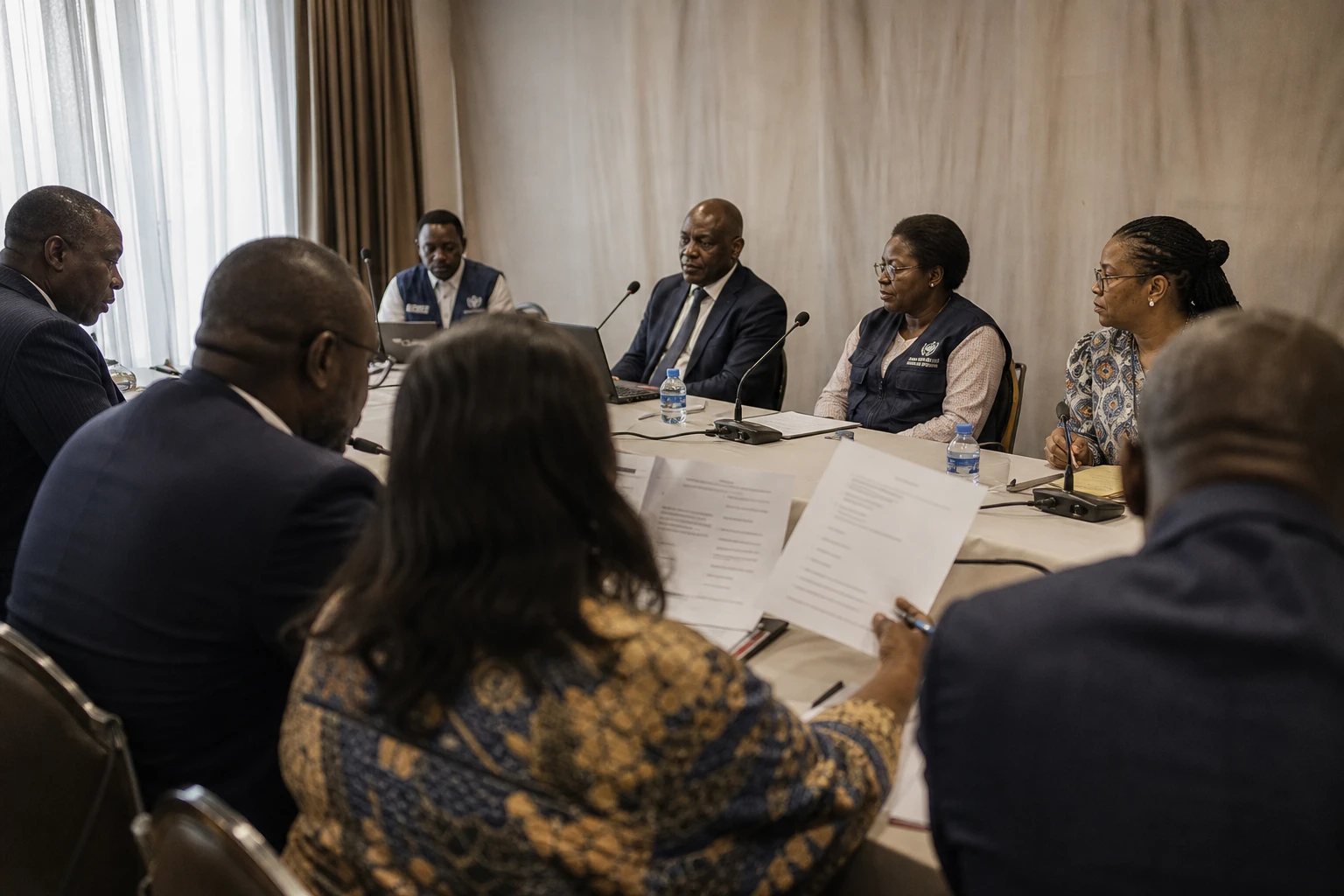
In eastern DR Congo, the response depends as much on health centres as on neighbourhoods
When an Ebola outbreak advances quickly in eastern Democratic Republic of the Congo, the issue is not only medical. It also affects residents’ trust, movement between provinces and the state’s ability to maintain its presence in areas already tested by insecurity and cross-border mobility. In North Kivu, the challenge is immediate: detect cases early, isolate quickly, provide treatment without delay and persuade communities that may be distrustful to work with health teams.
The regional context matters just as much. The current outbreak led the African Union, through Africa CDC, to classify the situation as a public health emergency of continental security on 18 May 2026. Cross-border coordination with Uganda and South Sudan was subsequently stepped up in Kampala, demonstrating that an outbreak in DR Congo can quickly become an issue for Central Africa and the Great Lakes region.
Rising figures, with North Kivu more exposed than the rest of the country
The WHO’s latest situation report, published on 17 September 2026, says the outbreak caused by the Bundibugyo virus has spread to a new health zone, Kayna, in North Kivu. The cumulative toll in DR Congo had reached 6,757 confirmed cases and 3,267 deaths as of 7 September 2026, a crude case fatality rate of 48.3%. In the 24 hours before that date alone, 71 new confirmed cases were reported in 17 health zones across Ituri, North Kivu and Haut-Uélé.
North Kivu remains the second-worst affected province, with 1,066 cumulative cases and 453 new cases in the 21 days preceding 7 September. The WHO also noted that one of the highest case fatality rates in this outbreak, 65.4%, was recorded there. Ituri remains the epicentre, but the geographical spread into North Kivu shows that the disease is no longer confined to a single outbreak zone.
Congo’s health ministry is monitoring the epidemic daily. Its surveillance portal says the 17th Ebola virus disease outbreak has been active since 15 May 2026 and that situation reports are published almost every day. On 14 September 2026, a new SitRep was still listed among the available documents, indicating that the response is ongoing and the situation continues to evolve.
Why cases are rising again in North Kivu
The “exponential” spread refers here to an operational reality: more areas affected, more contacts to trace, and transmission that remains difficult to interrupt. The WHO says the number of contacts under surveillance has increased sharply as the outbreak has spread. As of 7 September, 24,719 contacts required follow-up; 21,359 had been seen in the preceding 24 hours, representing 85.3% coverage. This is a high level of follow-up, but it also shows the scale of the daily tracing effort.
The area is further complicated by informal travel, unofficial crossings and porous borders. The WHO warns that these informal routes could facilitate the export or import of the virus. Africa CDC, for its part, highlighted as early as May the risk of regional spread linked to population movements, mining-related mobility, local insecurity and weak preventive measures at some points of care.
The Congolese government and its partners launched a revised 180-day plan in Kinshasa on 4 September to intensify the response. This multisectoral roadmap aims to improve coordination on surveillance, care, community communication and logistics. It brings together the health ministry, the WHO, the UN and Africa CDC. In short, the response is no longer being framed solely as a medical emergency, but as a state-led effort supported by regional and international partners.
What this outbreak means for Congolese people and the region
For Congolese people, the impact is first and foremost tangible. In the eastern provinces, an outbreak of this kind places a burden on households, delays access to routine care and can deter patients from going to already fragile hospitals. It also ties up public resources that must be shared between several health emergencies. DR Congo has only just emerged from other recent alerts, including the end of the mpox outbreak announced in spring 2026, underscoring the constant pressure on the health system.
Health workers, meanwhile, are operating in a challenging environment. The WHO says delays in detection continue to increase the risk of transmission within families, communities and health facilities. This means social trust is as important as beds, tests or mobile teams. Without local buy-in, the response moves more slowly than the virus.
At continental level, the episode confirms a broader trend: health emergencies in East and Central Africa do not stop at administrative borders. Africa CDC said its emergency consultative group had already recommended a next phase of the response, while the WHO is maintaining surveillance measures at official points of entry. In this situation, regional capitals, national public health institutes and continental organisations are now working together.
The situation in DR Congo therefore resonates far beyond North Kivu. It is a reminder that African health security rests on three interconnected pillars: strong national systems, swift regional coordination and a field presence capable of winning communities’ trust. Until these three conditions are met, a localised outbreak can continue to grow and spread beyond provincial boundaries.



